| Author |
 Replies: 9 / Views: 1,287 Replies: 9 / Views: 1,287 |
|
|
New Member
Australia
7 Posts |
Hi All, Below is a photograph of an Antioch (head of Zeus/Zeus seated) 24 mm bronze coin. I have (very) tentatively identified it as an RPC 4224v (40/41BC)��" Antioch under Roman rule Tetrachalkon year 9. My problem is that I have never seen one of these (the above is on its way to me) and the date is almost off flan. I can see what I think is a Greek Theta which possibly identifies it as above. Wildwinds shows RPC4224v as having the Theta at 6 o'clock and a "KL" (they say for Cleopatra) under that. I would appreciate advice as to whether I am correct in my identification and, if so, what do the KL (Cleopatra-mentioned in Wildwinds) characters, which are presumably below the theta, mean on a Roman coin of Antioch of this time. I've been trying to connect Cleopatra with Antioch in 40/41 BC, as per my coin, and can find nothing at all that will connect Cleo to Antioch in that year. I am now wondering whether the initials "KL" on the Wildwinds coin actually do stand for Cleopatra. Also there are TWO different Wildwinds illustrations for Antioch AE23-25s that are dated to 40/41 BC - one is RPC 4224v and is dated year 9 of the Caesarean Era and the other is RPC 4223 of year 272 of the Seleukid Era - both of which come out to 40/41 BC. You can see illustration of these at Wildwinds at the link:- http://www.wildwinds.com/coins/gree...tioch/t.htmlAs well as my original query regarding the "KL" and Cleopatra I would also appreciate knowing why Antioch would issue the two different coins, each showing a different method of dating, in the one year. Any ideas? All the best, Col 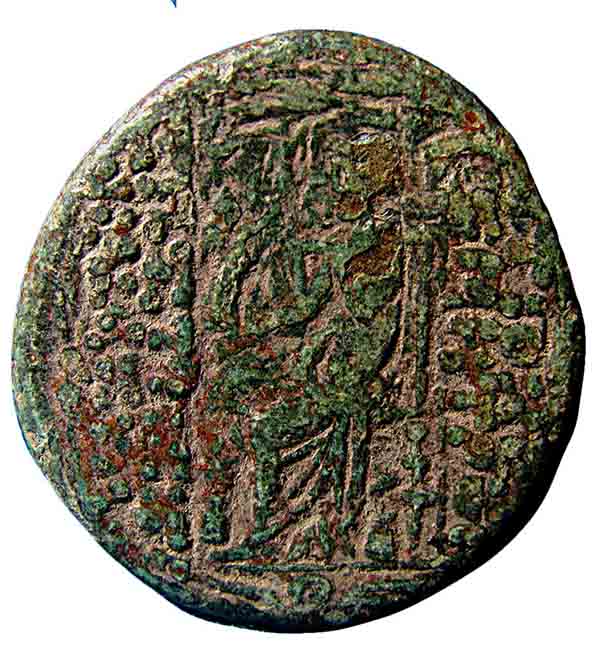 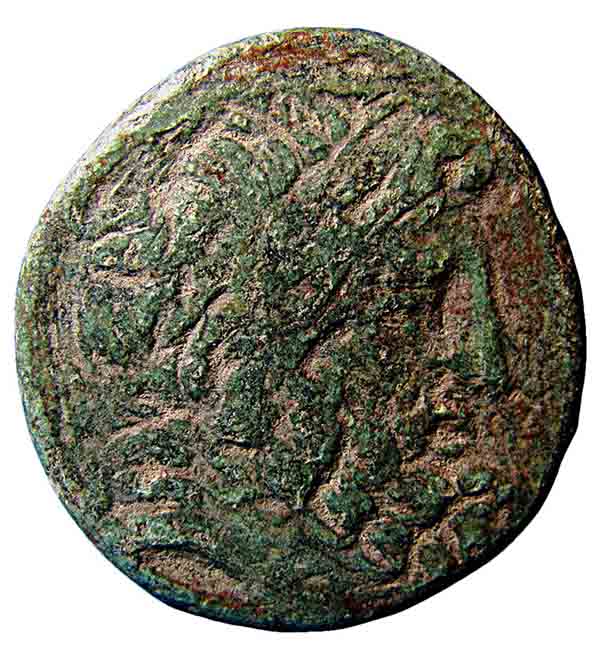 Edited by coldavo
02/11/2015 12:15 am
|
|
|
|
Pillar of the Community
3772 Posts |
Not sure that your coin matches the one from Wildwinds - the images look different, especially on the reverse. (*)
As per the dating, the year falls into the civil war and maybe at the beginning of the year someone was in charge, who didn't like to use the Caesarean dating. During that year (40/41BC) Kleopatra had a son by Mark Anthony, now with Mark Anthony in charge of the Eastern provinces that could explain the reference to Kleopatra.
(*) But I do agree that it is the general type used in Antioch in that time.
Edited by Medieval
02/11/2015 12:41 am
|
|
New Member
 Australia
7 Posts |
Hi Medieval, Yes, I did know of Antony's son born to Cleopatra in 40BC but couldn't relate it to the coin. However, with your note, I checked further and found the link: http://www.ancientegyptonline.co.uk...-Antony.html that “Mark Antony announced that he was also giving her the territory of Cilicia“. This was in 40BC. Also, from Wikipedia, it mentions that Cilicia “was reorganized by Julius Caesar, 47 BC, and about 27 BC became part of the province Syria-Cilicia Phoenice” From these two references we can see that Cleopatra apparently controlled Cilicia in 40BC and it, presumably, was associated with Antioch or Syria to which it was joined in 27BC. I think that we are getting closer to the answer - but not quite there yet? Thanks for the ideas. Any more ideas anyone? All the best, Col Edited by coldavo
02/11/2015 04:38 am
|
|
Moderator
 United States
23731 Posts |
 to the community I agree the coin is from the Antioch region, but due to the lack of a readable reverse legend at least for me, IMO it's going to be a bit difficult to pin it down to Cleopatra. |
|
New Member
Australia
7 Posts |
Hi echizento, The reverse legend is in (at least) four full lines so the third legend in the photo would not apply. The other two legends are possibilities with the characters underlined being what I think that I can recognise. Here's hoping that the legends will give someone a better idea. All the best, Col 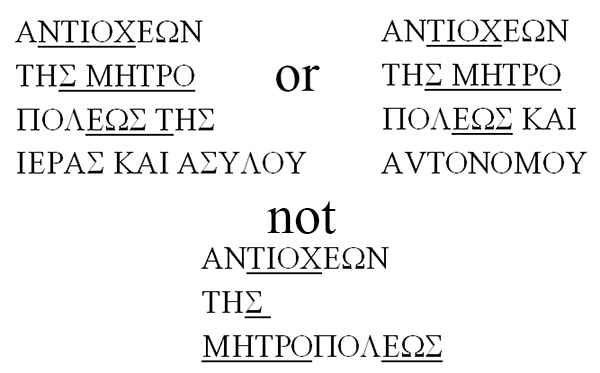 |
|
Pillar of the Community
3772 Posts |
From what I can see, cannot agree with the legend set-up given by you. Here my best reading of part: 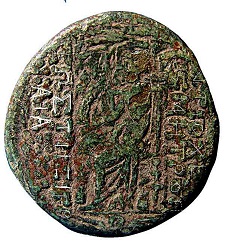 |
|
New Member
Australia
7 Posts |
Hi Medieval, The characters that you recognised did not come through in your reply. It is quite possible that I am wrong - I still think that I can see the characters mentioned - see the two photos. All the best, Col 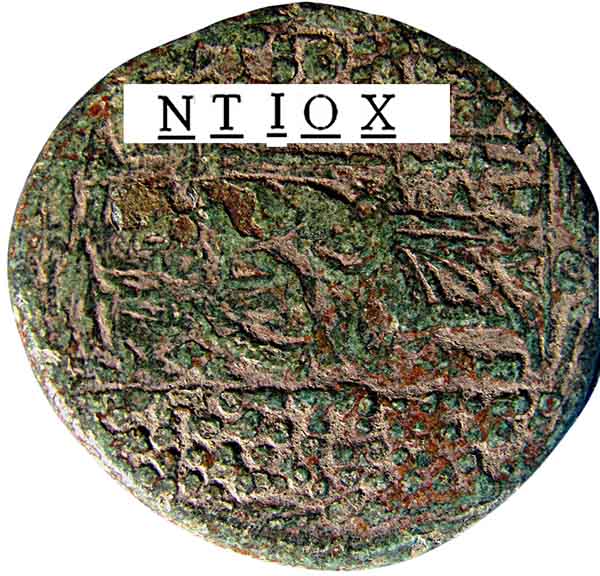 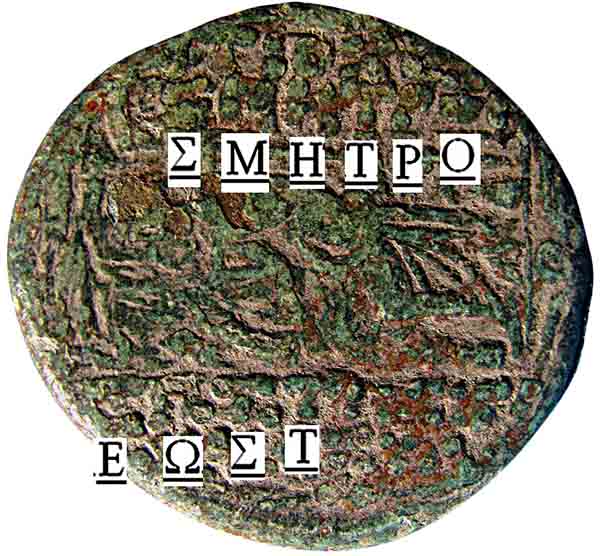 |
|
New Member
Australia
7 Posts |
Hi again Medieval, Sorry but my eyes aren't what they used to be. I now see your characters but haven't identified all letters yet (my eyes again). It appears that you can see all of the letters that I identified - and then some. Will try and work from there. I did notice that Cleopatra "owned" Antioch in 37BC (see below) but still can't tee up with the date "9". https://books.google.com.au/books?i...c%22&f=false “..in 37BC Antony went to Antioch where he married Cleopatra...Cleopatra demanded from Antony , and Rome, the return of the Egyptian lands, held by the Ptolemies two centuries previously, in return for military support. Cleopatra gained Tarus, Cyrene, Crete, Cyprus and Palestine, Cilicia and Coele Syria.” Thus we see that in 37BC Cleopatra controlled Antioch (which was in Coele Syria). All the best, Col Edited by coldavo
02/12/2015 02:34 am
|
|
Pillar of the Community
3772 Posts |
Had to reduce it to fit it into 100KB. Just load it into 'paint' and enlarge it to see it clearly.
|
|
New Member
Australia
7 Posts |
Hi All,
Still looking but feel that I'm a bit closer.
The two calendars in normal use, at around the time of this coin, were the Seleukid and the Antioch Caesarian. The year 9 on the coin obviously does not apply to the former and would date the coin to 40/41BC by the latter. However I just found that the actual Roman Julian calendar was dated from about 46BC which puts the coin (with its date of year 9) - at about 37BC - right at the time that Antioch was given to Cleopatra. So I'm hoping that this answers my original question?
What do you think?
All the best,
Col
|
| |
Replies: 9 / Views: 1,287 |
|










 Posted 02/11/2015 04:26 am


