Looked around and this was the best content I could find on whether its real or not. But still not sure what this would be graded.
Study the seller's photos carefully. If they are too small, you cannot tell anything about the coin. If the photos are less than 3x the size of the coin, it well be very difficult to detect markers of forgery on the coin. You will, however, often by able to spot if the coin has the correct obverse and reverse combination for the date. From 1873-75, all
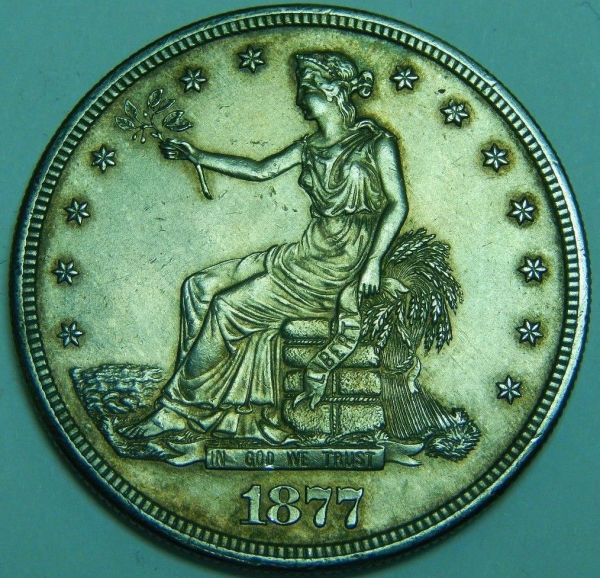
Trade dollars shared a common obverse design. The ribbon with "LIBERTY" on it has its tips pointing to the left. Also, the hand holding the branch has 3 fingers visible, a small detail often impossible to see in photos. example:
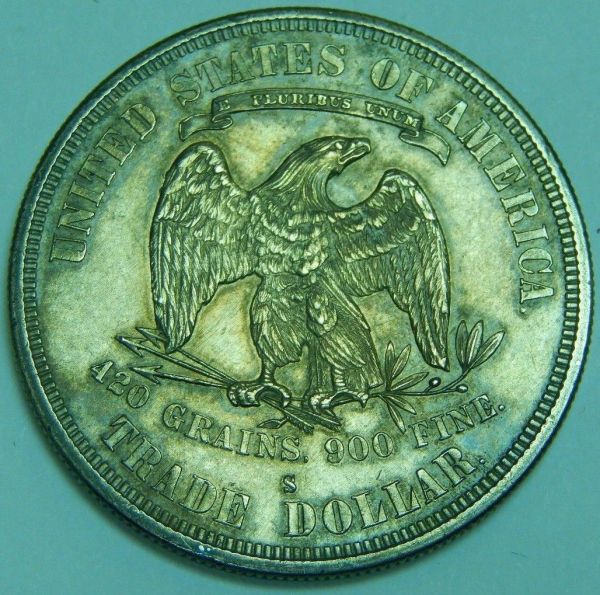
From 1873 until 1874, a common reverse was used(and continued to be used on some coins through 1876) there is an oval berry under the right side claw of the eagle, above the first 0 of 900:
Note that the tip of the lowest arrowhead ends between the 2 and 0 of 420.
Beginning in 1875, a new reverse was introduced, the type-2 or T-II reverse, which eliminated the berry and moved the arrow head slightly to the left, so it ends over the 2:
Both type 1 and type 2 reverses were in use for 1875 and 1876, and only type 2 from 1877 onward.
Beginning in 1876, another obverse was introduced, fittingly called type 2 or T-II, in which the ribbon tips pointed downward, and the hand with the branch has 4 fingers visible.
In summary, from 1873-1874, everything is type 1/1 (obv/rev); in 1875 we have type 1/1 or 1/2; In 1876 we have 1/1;1/2; and 2/2 (NOTE: NO 2/1 combination) and from 1877 onward only type 2/2. This comes in handy spotting fakes, because forgers mix up their dies and don't often pay attention to the obv/rev pairings. Thus, many of the fake 1878-cc
Trade dollars for sale raw have a type 1 reverse. It's also common to see a type-2 reverse on fake 1873 and 1874 coins. Next: the basics of dentistry (dentil analysis)







 Posted 02/27/2015 3:43 pm





