| Author |
 Replies: 9 / Views: 1,571 Replies: 9 / Views: 1,571 |
|
|
Pillar of the Community
United States
790 Posts |
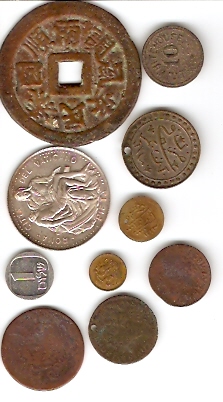
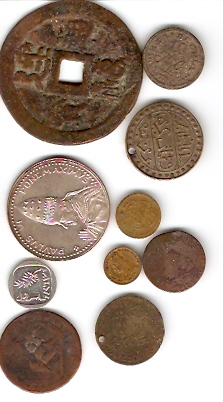
Hi, I am having problems identifying these items. I have some suspicions on some of these, but not solid facts. I know the little aluminum one is from Israel, but what is it? The small gold (?) coin is from an Ottoman place. I've had most of these for years and just don't know what they are. I realize the scan is not good, but if I can get a few of these identified, I can do a better job rescanning the remainder. Thanks is advance, Image:  scan0001.jpg scan0001.jpg56.65 KB Image: scan0002.jpg55.59 KB |
|
|
|
Moderator
 United States
23731 Posts |
Yours pics are a little too small to tell some of these coins. If you can post pics of one or two coins at a time we might be able to ID them better.
|
|
Pillar of the Community
 United States
790 Posts |
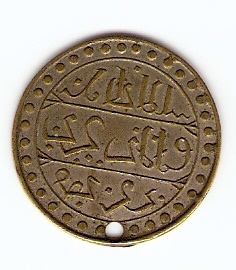
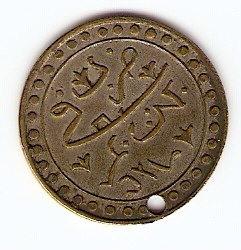
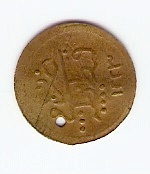
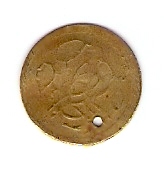
I've had these coins for years and have spent countless hours trying to ID them so I got anxious when I found the forum and thought I'd get all my answers at once! I'll post only a few at a time, hopefully the pics are better that way. The first item suspiciously resembles some coins from early Malaysia or Indonesia. It appears to be made of tin, but I don't think I have any other tin coins to really compare it to. Image: Malay1.jpg39.67 KB Image: Malay2.jpg39.32 KB The second item appears gold and is pretty small. It seems to read 1223, but I don't see a regnal year. I guess its from an Ottoman place, but for the life of me, I have never found it in Krause. Image: Ottoman1.jpg13.42 KB Image: Ottoman2.jpg12.59 KB Thanks for any help you can give. |
|
Moderator
Australia
16985 Posts |
Unfortunately, I believe both of these are imitation Ottoman coins. Your first one is an imitation based on the silver coinage of Ottoman Algeria. Here is an example on Zeno.ru of an apparently genuine specimen; here is a somewhat cruder imitation along much the same lines. Your second one also looks a bit too "crude" to be genuine. The mint name is a corrupted version of "Constantinople"; a real Constantinople coin wouldn't be that sloppy. The toughra on the other side is even worse. Here is a silver coin with this design. Don't say "infinitely" when you mean "very"; otherwise, you'll have no word left when you want to talk about something really infinite. - C. S. Lewis
|
|
Moderator
Australia
16985 Posts |
As for the other ones in the OP: The tiny aluminium one is another "shalom" token; blueczar had an identical one in this thread. The large Chinese cash-style object is a mystery; I can't quite match the text with any coins, so I suspect it's an amulet or charm. I can't make out enough details on the rest to even begin to guess, except that the really small, gold-coloured one appears to have Queen Victoria's portrait on it; that's probably either a "miniature coin" (play money) or a souvenir medal. ANd the one in the top-right appears to be a token of some kind; I'd suspect a WWI era notgeld token, from the style, except it appears to be in English. Don't say "infinitely" when you mean "very"; otherwise, you'll have no word left when you want to talk about something really infinite. - C. S. Lewis
|
|
Moderator
Australia
16985 Posts |
Sorry to spam your thread, but I've finally found a match for the large cash coin: the obverse (the side with only four characters) is of Emperor Kien Phuc of Annam (Vietnam), whose very brief reign (1883-1884) produced almost no official coinage. I can't even find a single example of a picture on the web to show you, but a couple of zinc coins are illustrated in Krause, particularly KM# 601. This site (dialup warning!) lists this emperor, way down the bottom of the screen, with his coins rated "extremely rare". This coin is almost certainly an unofficial amulet, made after the Emperor had been assassinated (probably long afterwards). The eight characters on the other side are probably a verse of poetry. Apparently, such large "coins" are popular in Vietnam even today as talismans for attaching to houses. Edit to add: this page shows a couple of charms, with very similar 8-character reverses. Don't say "infinitely" when you mean "very"; otherwise, you'll have no word left when you want to talk about something really infinite. - C. S. Lewis
Edited by Sap
12/01/2007 09:02 am
|
|
Pillar of the Community
United States
1984 Posts |
It's not spamming if the post is on topic--even your spammed footnotes are informational, Sap--thanks for the 411.
|
|
Pillar of the Community
United States
790 Posts |
Thanks for these insights. I remember now that the large one from Vietnam was purchased with a lot from French Indo-China so it would make sense. As for the small little aluminum token, who would bother with such a tiny thing, I can't imagine 1 Agorot was ever very much money. Maybe the "coin" is basically "monopoly money". Hey, maybe I've discovered a new collecting area in play money! I'll have to look into the rest of these replies later at home.
|
|
Pillar of the Community
United States
790 Posts |
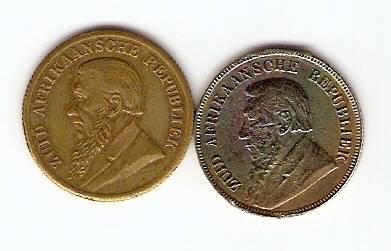
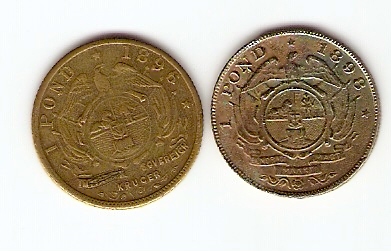
I've got a few more pics and questions. Image: SAObverse.jpg53.77 KB Image: SAREverse.jpg55.91 KB The coin on the left is obviously fake (the word imitation is crudely scratched out on the reverse). However, what about the one on the right? It is obviously a different metal. However, I have never owned a gold coin so I don't know what a gold coin looks like. |
|
Moderator
Australia
16985 Posts |
The colour looks off; gold should be a lot yellower than that. Unless your camera/scanner is seriously altering the colour, I'd assume it were fake, too.  When in doubt, weigh it. These should weigh the same as a British sovereign - 7.988 grams. An imitation will likely weigh much less than that. Don't say "infinitely" when you mean "very"; otherwise, you'll have no word left when you want to talk about something really infinite. - C. S. Lewis
|
| |
Replies: 9 / Views: 1,571 |
|








 scan0001.jpg
 scan0002.jpg

 Posted 11/30/2007 5:49 pm


 Malay1.jpg
 Malay2.jpg
 Ottoman1.jpg
 Ottoman2.jpg

 SAObverse.jpg
 SAREverse.jpg


