| Author |
 Replies: 9 / Views: 1,405 Replies: 9 / Views: 1,405 |
|
|
Valued Member
United States
220 Posts |
I am not very good at identifying roman coins in general, and getting down to the real specifics of a coin is a real challenge for me. Since I don't have that many of them, I was hoping you all could help me identify them to more than just the emperor. As I look these coins up, I find coins that look very similar, but are just not exactly the same. Here is an example: This appears to be Constantine II. The reverse is a globe on an alter, Trier mint; "RIC VII 410" is one ID that I found. I have found a few that look very much like it, but each one seems to have its own ID. I'm very confused. 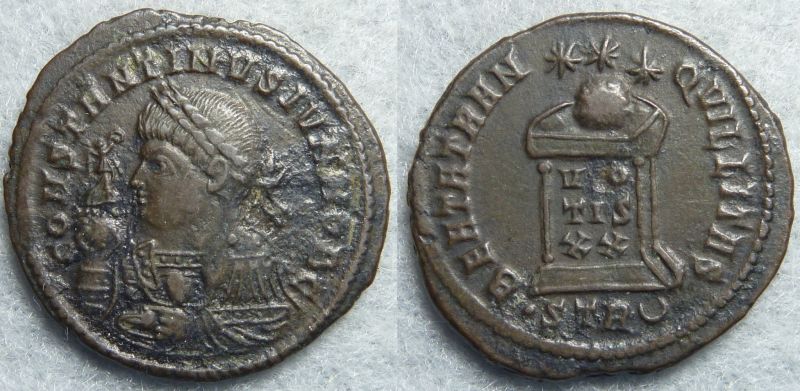 So how specific can one get identifying a roman coin? And can there be much difference in value between the slightly different varieties? Sorry if I'm not asking the right questions or making any sense. This is 20mm, and weighs 3.1g |
|
|
|
Moderator
 United States
23731 Posts |
|
|
Pillar of the Community
United Kingdom
4208 Posts |
Well, there are many thousands of varieties of Roman coins, especially in the later empire. At the highest level, you have different designs and emperors, but then for each emperor there are different busts, legend breaks, mint marks and field marks. Each number you are coming across represents one of these permutations.
Usually these differences are of very little significance or value, with some exceptions (such as rare mints, busts etc). The bust you have here, for example, does carry a small premium.
Heres its full description:
Constantine II
CONSTANTINVS IVN NOB C
BEATA TRAN-QVILLITAS
VO - TIS - XX
dot STR crescent
RIC VII Trier 410 var (bust type) <---This is the reference number, which you had correct (except the Var)
Rarity: R4 (Very Rare)
Year: 323
The rarity rating means very little here - they minted so many different permutations of this. The design itself is common and the bust is easily found too, it just so happens that this combination is rare. The numbering system can barely cope - Trier 410 actually covers 3 different busts (and so has 3 different rarity ratings), so if you find a picture of the type coin, it may not even be the same design as yours, let alone the same die.
To give you an idea of the numbers we're talking about here, Helvetica lists 2355 varieties of the Fallen Horseman design.
|
|
Pillar of the Community
United States
949 Posts |
You have identified the coin correctly in RIC VII. What were the alternative IDs that were giving you doubts?
If you have the RIC volumes, then in the long run you will be ahead of the game to master RIC. Too many different sorting systems can keep you dependent and confused.
Ben - what is the RIC variant you have in mind? The bust type is the I1 facing left as specified for 410. That is the ONLY bust type specified for 410.
Edited by lrbguy
04/08/2015 6:48 pm
|
|
Valued Member
 United States
220 Posts |
I don't own any roman coin books, I found a coin that looks a lot like mine at Wildwinds, so I'm quite surprised I nailed it. Thank you, Ben, for all of that information. I kind of got lucky on this coin, I am usually quite frustrated trying to find anything that matches exactly, front and back.
|
|
Pillar of the Community
United Kingdom
4208 Posts |
Thryan - I prefer Helvetica's spreadsheets, which are more extensive - usually complete. They allow for easier identification.
This is also where I found the bust varieties - LD-V-M left (Victory, Mappa), LT-V-SC left (Victory, Sceptre) and LD-Sol-M (Sol, Mappa) left.
|
|
Pillar of the Community
United States
949 Posts |
@thryan9
I thought you had been using RIC VII. Now that you mention Wildwinds, I get it. Wildwinds is based on Sear 1988 for Late Roman Bronze. Since the single volume of Sear is nowhere near as complete as the multi-volume RIC they had to double up on entries. You should also know that when the late Dave Surber put Wildwinds together in the first place, he was taking reports from all over the place to get examples of whatever. Can't say for sure how well that has all cleaned up, but as an authority it is not to be compared with RIC itself.
I am not yet familiar with Helvetica, but I want to find out why they are adding varieties to individual RIC listings. Maybe it's new finds, or maybe something else.
|
|
Valued Member
United States
220 Posts |
I have actually learned a lot just from this post, so I will simply ask how accurate I am with my attribution in the future. Thanks again.
|
|
Pillar of the Community
United States
949 Posts |
I just took a good look at the xls file for the Beata Tranquilitas module, and I like what I am seeing. They have extended the list of bust types significantly, and with attested examples even from people I know. This is very nice, and should make the next generation of RIC, in whatever form it takes, more comprehensive than ever. Too bad there isn't a collection of photos for all these obverses. Or is there?
Thanks for the heads up on Helvetica.
|
|
Pillar of the Community
United Kingdom
4208 Posts |
Helvetica, it turns out, is running Wildwinds, so perhaps in the future there will be pictures too.
RIC is continuously being rewritten by the powers that be - in not too long, the RIC volume containing Carausius will be released again. Its going to be a very hefty book. I dont know if it will be online too, but I do know that there are photograhs to go along with it, including photographs of multiple examples of key types.
|
| |
Replies: 9 / Views: 1,405 |
|










 Posted 04/08/2015 6:34 pm


