| Author |
 Replies: 8 / Views: 1,575 Replies: 8 / Views: 1,575 |
|
|
Pillar of the Community
Canada
5417 Posts |
 An interesting brockage error on a republican denarius. I don't see many errors on ancients, probably because through the ages people probably mistook them for counterfeits or simply melted them because they did not appear to be acceptable coinage. This isn't my coin and is only the third brockage I've ever seen on an ancient coin (the others being a stater and tetradrachm) and I've personally never owned one. Any of you own any interesting errors?
|
|
|
|
Bedrock of the Community
Australia
21792 Posts |
I don't think is IS a brokage, - not incuse.
Looks like it has been struck with two obverse dies.
Usually the obverse was the pile or anvil die, the hand held upper die was the trussel die, which was normally for the reverse.
The (usually) pile die was held in a large block of wood.
Edited by sel_69l
04/19/2015 12:00 am
|
|
Pillar of the Community
United States
949 Posts |
I think it's a normal obverse brockage. The image on the right is a mirror image of the same obverse and lettering as on the left, but shifted down so the initial Q is not plainly visible and the top of ROMA's tiara is. The letters retain the same proportional distance from the face on both images, and the beading on the right image corresponds to the right edge of the flan in the image on the left.
|
|
Bedrock of the Community
Australia
21792 Posts |
The lips and nose shapes are distictively different to my way of looking at them.
The die cutting style appears to be the same, and I suspect the same die cutter has been employed for the engraving of both dies.
|
|
Moderator
 United States
23731 Posts |
I agree with sel, there is just too much of a difference between the two dies to make it a brokage.
|
|
Pillar of the Community
Belgium
1194 Posts |
I also agree with sel , but I don t understand why two different obverse dies were used and why the second side is not incuse , but is a negative image of the first.albert
|
|
Pillar of the Community
United States
549 Posts |
Giles Carter investigated all the Roman Republican brockages at major museums to estimate the fraction that were brockages. He used his data to estimate brockages were about 2% of all denarii. They are not rare. I flipped the incuse image and got 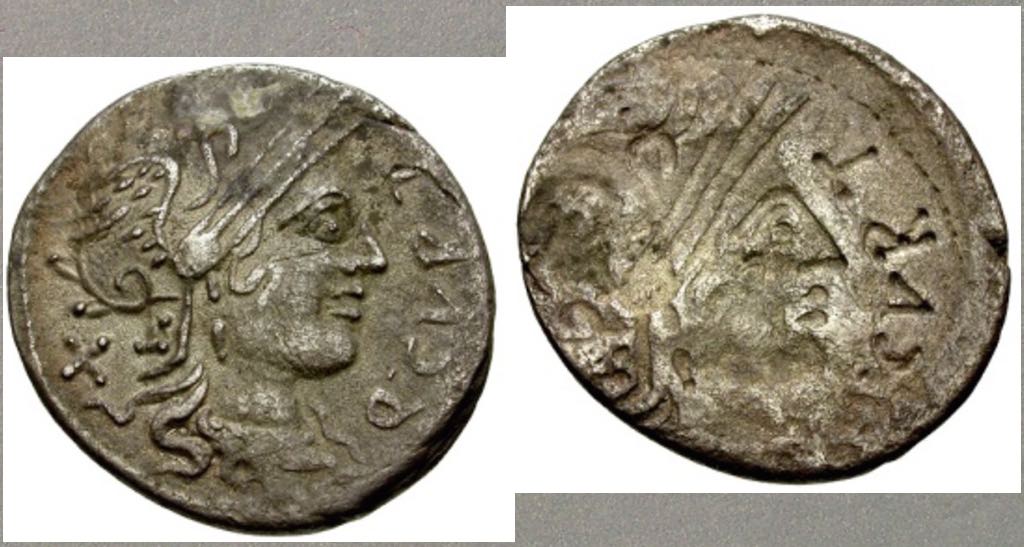 I think it is a brockage. The CVRT letters line up right. There are differences, but many similarities, and difference can be due to lighting or the fact the incuse strike is at a slighlty different angle. If you look for details, photographers know the same coin can look different when shot two different ways, so it is not a surprise the incuse may not look exactly like the original in relief. brockage. Besides, if it is not a brockage, how could it happen? |
|
New Member
3 Posts |
(I'm lrbguy under a separate account. Ran into a password problem on the original, and it kept me out yesterday)
If I had been able to respond yesterday I was going to show you what Augustus showed you with the images. Some of you are not recognizing that what you are seeing in the figure on the right IS an incuse image. No need to look for another. Part of the problem in this case is more about lighting than about real differences in the coin. Scanners are a godsend, but not for everything. When differences in relief matter, then a scanner is likely to mislead you. Here a positive relief image and a negative were being seen as two positives.
As for distortions in certain features, such as the fullness of the lips, augustus has explained how those kinds of details may be altered. (The object that produced the incuse impression was just as malleable as the blank being struck.) But it is the relative positions of things that tell a more important story, for those details will not change in a true brockage.
Finally some of you seem confused about the hammer and the anvil dies here. Without doubt the obverse was the anvil die in this case as usual. The incuse image was produced by a coin that got stuck in the hammer die, and left its impression on the blank being struck for what should have been the reverse of another coin. The part of the blank that faced down into the anvil became the normal obverse.
All is as it should be.
|
|
Pillar of the Community
United States
5010 Posts |
 my first thought was "brockage", but that was an interesting read. and a COOL coin! |
| |
Replies: 8 / Views: 1,575 |
|










 Posted 04/19/2015 12:04 am


