| Author |
 Replies: 19 / Views: 5,043 Replies: 19 / Views: 5,043 |
|
Valued Member
United Kingdom
438 Posts |
I went to the coin shop to pick up a prize for someone (Bobbycoin if he reads this board, I know it's supposed to be a surprise but i'll tell you it's a Titanic year coin!) Anyhow whilst I was there I looked over what was in stock to see if I fanicied anything for myself, thus I looked over the ancient coins and came out with the Septimus Severus denarius. And then I happened to see this English Edward I (1272-1307) penny lying there. (Edward I being 'Longshanks' of Braveheart fame). Now I don't collect these, although I had three of them already (i buy ones I like the look of because they're pretty cheap for what they are). What got me with this one is the sharpness of the strike, truly impressive. Looks as good as it did in 1280 when it was struck, so I bought it (£48 if you're wondering, before anyone asks!  ) Which I thought was fairly good value for the level of quality. 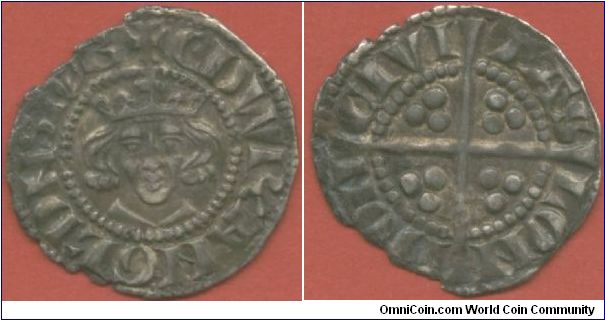 Obv; EDW R ANGL DNS HYB (Edwardus Rex Anglorum et Dominus Hiberniae; Edward King of the English and Lord of Ireland) Rev; CIVI TAS LON DON (City of London) Class 2A and thus struck in 1280. (Class 2 is split into two subtypes, class 2a and 2b both of which were struck in that year only and I now have both types, coincidentally!) Edited by Ætheling
10/02/2005 3:44 pm
|
|
|
|
Forum Mom
 United States
5877 Posts |
Looks like a great purchase to me...especially at that price! Way to go!  |
|
Banned
New Zealand
306 Posts |
That is a very nice London Mint Edward I 1d. coin.It is a very common coin however.Don't forget,the fact that this is a very common coin does not detract from the historical interest though.
Aidan.
|
|
Rest in Peace
United States
3730 Posts |
I'd love to have a similar coin. Haven't checked lately, but I think the oldest English coin I have is a George III Cartwheel.
|
|
Pillar of the Community
Australia
1079 Posts |
I love it especially the historical aspect.
Nice detail and not a bad price.
|
|
Valued Member
United States
123 Posts |
I love medieval English coins. That Edward I is an especially nice one; you're lucky to have it. I have two Edward I pennies, but they aren't nearly that nice. Maybe I should look for a better one.
My oldest English coin is a silver sceatt of East Anglia, c.710-740. Those aren't easy to find; I wouldn't mind getting more, but I don't often run into them and when I do they are usually really expensive. One of my favorite English coins is a Cnut penny that is well-struck and in an excellent state of preservation, much like your Edward I. Another favorite of mine is an Irish penny of King John. The triangle device that they used on Irish coins at that time is very attractive.
I'll post images of these eventually.
Heather
|
|
Valued Member
 United Kingdom
438 Posts |
Yes do! I love looking at Medieval Brit coins. I've got quite a few, mind you as I'm in England I do have an advantage there.
Cnut pennies are really something (as are Æthelred II ones) both of which are fairly common. The prices were doing well on them at one point then in about 2000 archaeologists discovered several hoards of Cnut and Æthelred stuff (several thousand coins in each), the prices fell through the floor. Very good time to buy it was, the prices are now returning to healtheir levels though.
The Irish stuff is particularly eye catching. I have several English pennies from several centuries. I've got nothing as early as 710-740 as of yet, although those sceatts are quite alluring. You wouldn't think so at first, but when you pick one up it's like... "wooow! this little (yes little!) round thing has really been there", when that was minted England wasn't even a nation. Makes you think.
My earliest coin thus far of English origin is an Edward the Elder.
|
|
Valued Member
United States
123 Posts |
England certainly is a good source for coins from the British Isles. Although I live in the United States, I got most of my better ones from dealers in England. It would be easier if I lived there or visited, but fortunately there are many dealers who will sell to international customers.
If I remember correctly, the silver sceatt, an Alexander III penny (scotland), about a dozen Celtic coins, and one or two others came from dealers in England. The Cnut was from a U.S. dealer, and it was around 2000 when I got it; I wonder if it came from those hoards. I don't remember for certain what I paid for it, but it seemed quite reasonable at the time.
I don't seem to keep good records of where I get things and how much I pay - I should probably get better about that.
Heather
|
|
Pillar of the Community
Australia
1079 Posts |
I must confess I really love them, but I think I need to save up to buy a few of them.
|
|
Valued Member
United Kingdom
438 Posts |
quote:
Originally posted by Heather the Hoarder
The Cnut was from a U.S. dealer, and it was around 2000 when I got it; I wonder if it came from those hoards. I don't remember for certain what I paid for it, but it seemed quite reasonable at the time.
.
.
.
I don't seem to keep good records of where I get things and how much I pay - I should probably get better about that.
Heather
Alot of the Cnut and Æthelred II coins generally have come from hoards, as have many Henry I and II coins. The former two though more so because they were used as payment of the Danegeld. Most Æthelred II coins were minted in England and shipped in bulk quantities of many millions to Denmark as bribe money. The agreement was, the Danes wanted money, the English didn't want invading, raiding, looting etc. So the Danes kindly agreed to negotiate instead, if England coughed up a few million pence every few years then the Danes promised not to invade. England was very rich at the time and agreed to pay, the Danes generally kept their word. Sometimes however, they'd accept the English payment and then invade England anyhow and take some more. So it should come as no surprise that alot of the hoards of these coins are found in Denmark. Coins of the Norman period turn up in England and in France. Post Norman tend to turn up in England more often that anywhere else. Although Edward I pennies really got around. Of your last paragraph about keeping records this is fairly important, generally for insurance reasons, but also it's a good idea to keep photographs and written records of what you've got somewhere safe so that if any coins are stolen then you've got; 1) evidence you had the coins in the first place, 2) The coins might turn up for sale someplace and if they do you can ask the dealer who they got it from and it can possibly be traced back to whoever stole them. Doesn't mean you'll get your coins back but it might prevent them from repeating their crime elsewhere. Of prices, it's best not to keep prices of what you paid, but more realistic market values, which in my experience aren't necessarily one and the same! |
|
Pillar Of The Community
3147 Posts |
So in what years would I need to look to find a coin of King Arthur times? I really like ancients but my lack of knowledge keeps me from buying them on the open market. Way to many counterfeits out there. I would have to put my faith in a dealer or someone who actively pursues such coins.
|
|
Valued Member
United Kingdom
438 Posts |
Ah now there is a question that cannot be answered with one answer. From what I'm led to believe Arthur's time was supposed to be sometimes between the transition from the end of Roman rule and into the early Dark Ages. I'd say you'd want to be looking for 5th/6th century stuff, which is virtually non existant. The Roman coinage ceased in the early 400s CE, the Saxon coinage appeared in around 600 CE. In the two centuries between very little coinage was used, what little was, was from the continent. In depth; http://www.predecimal.com/p3saxon.htm |
|
Pillar Of The Community
3147 Posts |
AEtheling Thanks for all the information. I guess my only hope would to purchase a coin prior to Arthurs period? So point me in a direction of a coin(s) that may have circulated during his reign? Have they really ever made up their mind whether its all folklore or did the man and the legends really exist? Caught part of a PBS programming here a while back that said, for the most part, he did?
|
|
Valued Member
Canada
170 Posts |
From what I know they havn't made up there minds yet, I think most people are leaning towards him as beig a a real person but his life exagerated.
|
|
Valued Member
United States
123 Posts |
The Arthur legends are hard to sort out. I've lost track of the current theories, but from what I remember, as AEtheling says, he is supposed to have been around in the immediate post-Roman period (c. 400-600).
Coins have been produced in the British Isles from approximately the 1st Century BCE to the present day, but coins from certain times are extremely rare. The gold thrymsas that were made in the post-Roman period are bloody expensive. They evolved into the silver sceatt, which is a lot more reasonably priced, but likely dates from after Arthur's time.
Probably your best chance would be to find a late Roman bronze coin from the London mint. Coins of Constantine the Great and his successors were made in great numbers there, and they aren't very expensive. (I got a nice EF/AU example for about $20.) Since they are so common, I wouldn't imagine that they would offer counterfeiters a good return on their investment, although there could be some fakes around. Buy them from a well-established bricks-and-mortar ancient coin specialist and you'll probably get genuine ones.
Chances are, these coins continued to circulate after the Romans left. After all, they were quite well-made and certainly would have been capable of surviving a hundred years or more in circulation, unless people became nervous and hoarded them. It is also likely that many coins minted in continental Europe crossed the channel and circulated in Britain. If you can find coins known to come from a post-Roman hoard, then you will likely have found what you are after, even if they weren't minted in Britain.
Heather
|
|
Pillar Of The Community
3147 Posts |
Great, now every one let me know when you locate a post-Roman hoard and I will be ready to jump on board. Actually I have a few ancients (3 to 5) so I will have to dig them out and see just what they are. Thanks for the info guys/gals!
|
| |
Replies: 19 / Views: 5,043 |







 Posted 10/24/2005 8:55 pm





