| Author |
 Replies: 14 / Views: 1,619 Replies: 14 / Views: 1,619 |
|
|
New Member
United States
18 Posts |
I've been looking around the internet for coin cleaning suggestions (specifically for uncleaned Roman coins, since I've bought a bunch recently). I have looked at some youtube videos of cleaning demos and I have noticed that those who comment state you should never clean coins. I'm not sure if these are serious comments or just the typical hysterical comments one usually sees on the internet... I realize not all ancient coins need cleaning or even minimal cleaning, as I have several Roman/Greek coins that can't possibly be cleaned any further (such as desert patina coins, but I don't have any of those in my collection). So as you might guess, I am having somewhat of a dilemma on how to clean some of my Roman coins (most appear to be 3rd/4th century AD). There is everything from just using a simple brush to take dirt off, soaking in distilled water (which I'm told can damage some coins?  ), or even electrolysis which I am not at all familiar with. I'm thinking within the day I'll post a picture of one Roman coin I'm primarily trying to clean as an example, since it appears to be in very good condition despite all the dirt on it. I'm worried that I could easily scratch or damage the coin if I don't know precisely what I should be doing for cleaning. |
|
|
|
Pillar of the Community
United Kingdom
3626 Posts |
Pictures would certainly be helpful.
First a couple of pointers.
Electrolysis - NO. This will ruin your coins.
"You should never clean coins" - Incorrect, most ancients need to be cleaned otherwise they look like rocks. Modern coins should not be cleaned.
Sand patinas. There are theories that most are fake. They cover up imperfections in the surface of the coin. I have a couple, the sand highlights the legend and some of the detail, I won't clean that off.
Don't be tempted by rock tumblers.
Now to cleaning
There are no shortcuts and patience is your greatest friend here.
Plastic tubs (preferably with lids).
Distilled water or de-ionised or de-mineralized water (not from the tap/faucet)
Cover the coins (a few to a tub) with the water and leave for several days, give it a shake once in a while, change the water if it becomes cloudy.
Get a cheap toothbrush and cut the bristles in half (does not need to be a neat job)
Use the toothbrush to brush the coin(s) and put back into soak, changing the water if cloudy.
The theory is that minerals with leach out of the coins and into the water. It will make the dirt easier to remove.
The dirt has been attached to the coin for (usually) around 1700 years. It is not going to give up without a fight.
You can also use toothpicks or bamboo to scrape the surface.
Sharper utensils (I use a scalpel) can be used in the future, but you need to walk before you run.
Stay away from brass brushes. We hear frequently that they won't damage the coin, maybe they won't, they WILL damage the patina. If you want to try them in the future, that is fine, but get to grips with the basics first.
There is a lot of rubbish on the internet and sent out on DVDs. Please ask on the forum if you want to try something specific, we will tell you whether it is OK or not.
|
|
Pillar of the Community
United Kingdom
3626 Posts |
Sorry, I meant to mention Olive Oil. Some people prefer this to distilled water. It is a matter of personal preference, although OO can darken the patina, it gives slightly faster results. I have used OO but rarely.
Remember that oil and water don't mix. You can use DW and then OO, but don't try it the other way round.
|
|
Valued Member
United States
129 Posts |
In addition to all that pish said, when you've finished soaking the coins and are content that they're clean, you'll need to dry them. I've seen it recommended to set your oven to 220 and put them in for 10 - 20 minutes. That seems to work.
|
|
Pillar of the Community
United Kingdom
3626 Posts |
Your point about DW damaging coins. As a general rule, no it won't. However, you need to be aware of Bronze Disease. This affects coins and causes the coin to rot, sometimes from within.
BD shows itself as a (usually bright) green on the surface of the coin. This is not to be confused with green patina which is fine (and much desired by collectors). You can identify BD by taking your fingernail, or a sharp pin and gently scraping at the green. If it is powdery and comes off easily, chances are it is BD. These coins should be kept separate from your other coins. You should also keep different brushes and scraping implements. Throw away any flips that these coins have been kept in. There are ways to treat BD, but wait until you have some before we go into details.
|
|
New Member
 United States
18 Posts |
Sorry for the late photos. This is the main coin I am trying to clean. The quality photos may not be the best since I'm not too familiar with the image optimizer. You may not be able to tell from the photo but there is visible writing above the head. The coin was wet when I photographed it so it might be difficult to see the very nice, clean detail of the top of the head. This is a rather large coin (sestertius? forgive my ignorance since I'm still new with Roman coins). 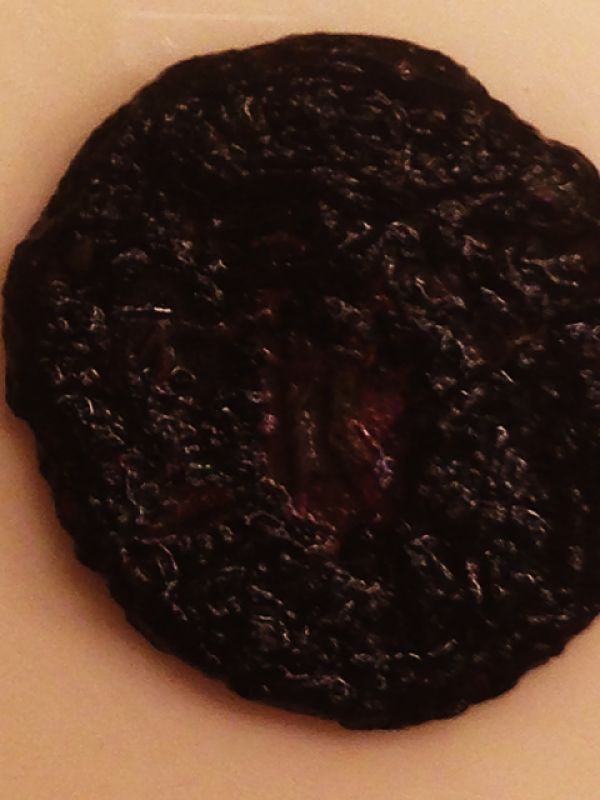 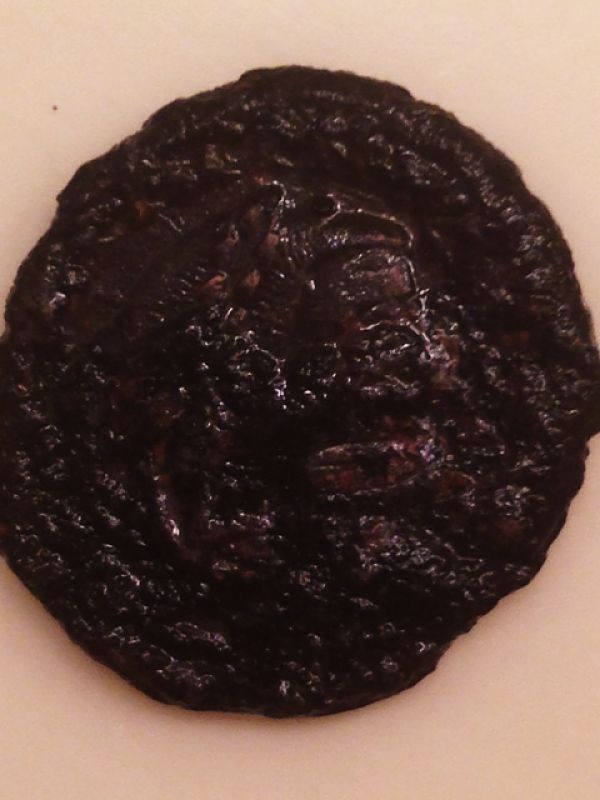 |
|
Pillar of the Community
United Kingdom
3626 Posts |
Impossible to say without better photographs, do you have the diameter in mm and the weight in grams? At first glance I wonder if it is a follis of someone like Maximianus or Diocletian.
|
|
New Member
United States
18 Posts |
I guess my question is not so much about the identification yet but how should I go about cleaning this specific coin?
|
|
Pillar of the Community
United Kingdom
3626 Posts |
Soak, brush, soak, and keep going.
|
|
Pillar of the Community
United States
5010 Posts |
what pish said.
when you brus it is "stuff" coming off? or when wet and your rub it with fingers does stuff come off? if no, move up to toothpick and see if you can get gunk to yield.
|
|
New Member
United States
18 Posts |
I'm assuming it's dirt because when scrubbing with a brush or "testing" with my finger nail it comes off. When I initially put the coin in water particles started to come off. I'm assuming it will be a long process of soaking in distilled water and perhaps seeing if I can carefully use a toothpick to scrape off dirt.
Thanks!
|
|
Pillar of the Community
United Kingdom
3626 Posts |
Some coins clean up quicker than others, it depends upon the composition of the crud. Some can take months, some years. Patience is your best friend. Remember to change the water when it becomes cloudy.
|
|
Pillar of the Community
Spain
629 Posts |
each coin has his own proper method to be cleaned...
We need Images to give advice
|
|
Pillar of the Community
United Kingdom
1587 Posts |
With the coin pictured I would personally go straight to oil. Soak and pick, soak and pick, soak and pick. Another method with a coin of that type full of crud but with good detail underneath it, to try and break the crud from the surface, is to cool it down as much as you can then heat it up. Because the scuzz on the coin doesn't expand as much as the metal coin, a lot of the scuzz loosens from the metal surface. I used to buy bulk loads of uncleaned romans and have had great results doing that. Once the bulk of crap is removed, soak and pick, soak and pick.
You will never soar like an eagle if you hang around with turkeys.....
|
|
New Member
United States
18 Posts |
Another question: is lemon juice recommended for removing dirt from silver coins? Does lemon juice only work removing dirt from silver or can it work on cleaning other metal coins? Right now I tried it on a broken Roman silver and (what appears to be?) an Ottoman silver coin, and it actually removes the dirt.
|
| |
Replies: 14 / Views: 1,619 |
|










 Posted 05/23/2015 1:43 pm


