Heritage Auctions - One of the most often-offered Ancient Greek coins is the famous silver
tetradrachm of Alexander III the Great, king of Macedon 336-323 BC and conqueror of much of the world known to the Greeks by the age of 25. We present here a beautiful example of this important issue, the first true world coinage, struck during the lifetime of the great warrior-king.
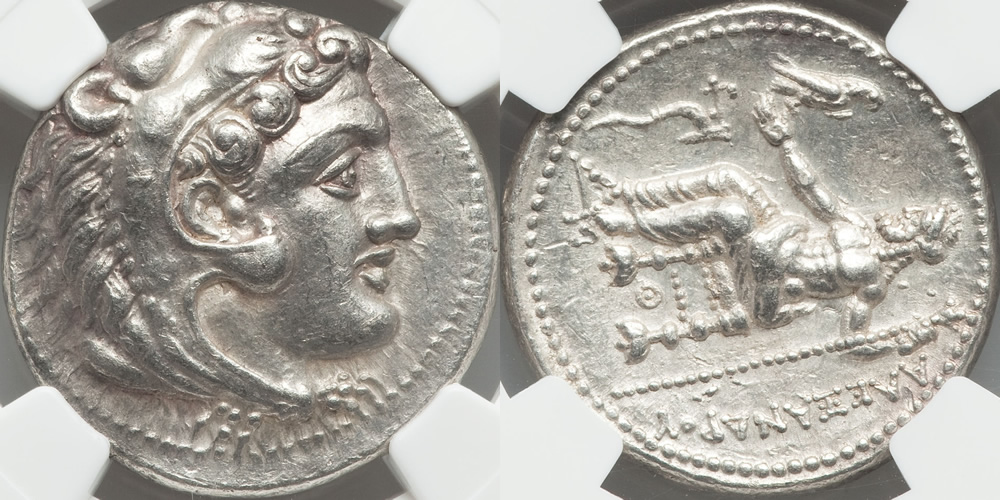
Like a flaming meteor, Alexander the Great blazed a brilliant trial across the Ancient World during his 13-year reign and left three major civilizations profoundly transformed in his wake. The son of the brutal but capable King Philip II of Macedon, who unified most of Greece under his command, Alexander came to the throne upon his father's assassination in 336 BC and immediately launched into a career of conquest that took him to the very ends of the known world. Using the invincible army his father had assembled and trained, Alexander attacked the gigantic Persian Empire and defeated its king, Darius II, in three titanic battles between 335 and 332 BC. Unsatisfied with simply plundering the Persian realm and returning to Macedon, Alexander spent the next eight years driving his army steadily eastward, into the deserts of Arabia, the rugged mountains of Afghanistan, and the jungles of India, founding new cities populated by Greek veterans in his wake. A true visionary, he sought a fusion of cultures and peoples, exhorting his soldiers to take wives from the local native populations and adopt Persian and Indian modes of dress.
Leading his army from the front rank and often delivering the decisive cavalry charge, Alexander showed himself to be utterly fearless in battle and one of the greatest tacticians of all time. He also suffered numerous near-fatal wounds. His army swept all resistance aside and doggedly joined in his vision quest.
When Alexander
inherited the Macedonian throne, the kingdom was in debt to the tune of 500 talents (a talent equaling 6,000 silver drachms). He had to borrow another 800 talents to finance the Persian expedition, but it soon began paying colossal dividends as, one-by-one, he seized control of Persian-ruled cities with substantial treasuries in silver and gold. The royal treasury at Susa, for example, contained 50,000 talents; that of Persepolis, 120,000; thus these two cities alone yielded up enough silver for over a billion silver drachms. The Greeks had never seen such material wealth, nor even imagined it could exist. Much of this plunder Alexander minted into coins to pay his conquering soldiers, many of whom became immensely rich.
The design of Alexander's silver coins depicted on the obverse a young head of Heracles wearing the skin of the Nemean lion, and on the reverse a muscular figure of Zeus enthroned to left, holding on his outstretched hand an eagle, his sacred bird. Neither image was unprecedented: A similar head of Heracles was used by Alexander's father Philip II on gold fractions, and the figure of Zeus seems to be modeled on a very similar depiction of the Phoenician god Ba'al found on coins struck in Cilicia shortly before Alexander's conquests. On Alexander's silver coins, the facial features of Heracles grow increasingly to resemble those of the great conqueror himself. The propaganda message was unmistakable: Alexander was the new Heracles, greatest hero of them all, leading a unified Greece against the "barbarian" Persians, with the blessings of none other than Zeus himself, king of the gods.
Alexander chose the Attic weight standard, with a silver drachm weighing 4.3 grams, for his new coinage, which circulated throughout mainland Greece and the former Persian territories of the East. A silver tetradrachm, or four-drachm piece, weighed about 17.2 grams. This was a truly Imperial coinage, struck at dozens of mint cities scattered around Alexander's rapidly growing Macedonian Empire. While the overall design, weight and fineness of the coins remained consistent, the originating mint identified itself with a set of distinctive symbols, letters or monograms. This particular example was struck at the important mint of Tarsus in Cilicia toward the end of Alexander's lifetime, 324-323 BC.
Curiously, coins circulating within Macedon itself retained a lighter standard of just over 14 grams to the tetradrachm; these coins continued to use the old design of Philip II. Alongside the silver issues, Alexander also coined enormous numbers of gold staters, each weighing about 8.6 grams; the design of these bore a helmeted head of Athena on the obverse and the winged figure of Nike, goddess of Victory, on the reverse. Smaller fractions also were struck in large numbers to facilitate trade; larger denomination coins, silver decadrachms and gold distaters, were issued to mark special occasions.
The conquests of Alexander and the coining and circulation of Persia's hoarded wealth set off a worldwide economic revolution. In addition to opening up new routes to the Orient, international trade now became immensely easier with a common system of exchange. The foundation of so many new cities, notably Alexandria in Egypt, and the spread of the Greek language and ideas brought a burst of prosperity and creativity that reverberated for centuries.
Alexander seemed to desire a never-ending campaign of conquest and expansion. But reaching the wide Ganges river and glimpsing the peaks of the Himalayas beyond, his men finally mutinied and refused to go any further. The long march through the brutal Gedrosian desert devastated his army and further weakened him, but ultimately only added to his legend. Reaching Babylon in 323 BC, Alexander rested from his travels and planned further conquests to the west. But after a bout of hard drinking, he fell ill and died 12 days later on June 10 or 11, 323 BC, just shy of his 33rd birthday. Whether his battered body had simply given out or succumbed to foul play remains a mystery to this day. His mystique, charisma and the titanic achievements of his 13-year reign ensured his place among the gods. Indeed, his name is still spoken with hushed reverence in many far-flung corners of the realm he conquered.
This coin is featured our
Weekly World and Ancient Coin Auction, closing June 11, 2015.









 Posted 06/04/2015 4:44 pm


