Here are a few posts that may help:
https://goccf.com/t/102786https://goccf.com/t/160751Uncirculated
The word "uncirculated" means exactly what it says, the coin has not been in circulation, however "ordinary" uncirculated coins often have bagmarks, edge knocks and other small scuffs and imperfections.
Uncirculated "specimen" coins issued specially for collectors are often more carefully produced and handled, so they may be better than ordinary coins mass produced for circulation, but may still have some small imperfections.
Proof
Proof coins are specially produced to a much higher standard of finish. Originally, proofs were intended as pre-production samples. As a printer would produce a small number of "proof" copies for checking and approval, so a mint would produce proofs for approval by the mintmaster, the monarch, and for other purposes. When coin collecting began to become popular about two centuries ago, a larger number of proofs were sometimes made for sale to collectors. This has developed enormously in the past few decades, and most countries, but not all, produce proof coin and sets every year or on special occasions.
Different Proof Finishes
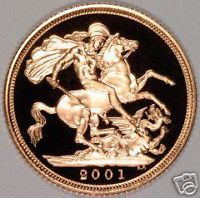
Not all proofs are the same. The most common understanding of proof is that the flat background parts of the coin have a highly polished mirror finish, and the raised parts of the design have a matt finish, giving a higher level of contrast between the two. This is achieved by sand-blasting the die, the hardened steel punch with which the blank coins are struck, to give a matt finish, followed by giving the raised parts of the die a highly polished surface, usually by polishing them with diamond powder. The coin blanks themselves are usually produced to a higher quality of finish before striking. Proof coins are usually double struck at lower striking speeds, to give a higher and sharper definition. They are usually produced on a special machine, and may be hand, rather than mechanically fed into and extracted from the coining press. They are usually individually inspected, and packaged. A proof coin should provide an excellent specimen, and its quality should approach perfection.
Some proof coins are made with an all matt finish, as for example the 1902 Edward VII Coronation proof coins, while others are produced as "reverse proofs", i.e. with the raised parts polished and the background matt.
PROOF:
UNCIRCULATED:
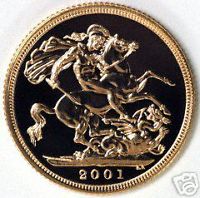
The background of both coins looks a very dark chocolate brown, but in real life they are yellow. The contrast between matt and polished surfaces shows up very well on the proof coin and this allows fine details to be seen more easily, whereas on the uncirculated coin, the raised design is also slightly polished, and this results in it being more difficult to distinguish the details of the design from the background.










 Posted 06/10/2015 8:46 pm


