



Coin Community Family of Web Sites Join Thousands of Coin, Bullion, & Money Collectors
Join Thousands of Coin, Bullion, & Money Collectors 300,000 items to help build your collection! Specializing in Modern Numismatics Royal Canadian Mint products, Canadian, Polish, American, and world coins and banknotes. Coin, Banknote and Medal Collectors's Online Mall Royal Estate Auctions - $1 Coin AuctionsVancouvers #1 Coin and Paper Money Dealer


Username:
Password:
Save Password
Forgot your Password?


This page may contain links that result in small commissions to keep this free site up and running.

Welcome Guest! Registering and/or logging in will remove the anchor (bottom) ads. It's Free!

Looking For Examples: Cast Pitting Vs Legitimate Pitting

To participate in the forum you must log in or register.
Author Previous TopicReplies: 8 / Views: 10,430Next Topic  
New Member

United States
8 Posts
 Posted 07/12/2015  09:08 am Show Profile   Bookmark this topic Add jfk33 to your friends list Get a Link to this Message Number of Subscribers
Title says it all. I love this site and have learned a lot about identifying coins, but I'd like to learn a bit more about identifying fakes. A pretty common feature on some of the lowest grade coins is extensive pitting. I have read that this can be attributed either to casting or to corrosion, but that there is a difference between the two. Initially I thought, "why on earth would anyone fake a $3 or $4 coin," but it turns out people will fake just about anything if they can make money on it. Thanks in advance!
Valued Member
United States
69 Posts
 Posted 07/12/2015  09:37 am  Show Profile   Bookmark this reply Add tenacious to your friends list Get a Link to this Reply
Pitting caused by casting can take the form of casting bubbles. Bubbles are round and leave round pits. Natural corrosion tends to leave pits of irregular shapes.
So round pits can be a sign of casting and irregular shaped pits are a good sign.
But I imagine there can be exceptions to the rule.
Pillar of the Community
Kamnaskires's Avatar
United States
7066 Posts
 Posted 07/12/2015  10:54 am  Show Profile   Bookmark this reply Add Kamnaskires to your friends list Get a Link to this Reply
It's a great issue you raise, jfk33. I've often struggled with this...that is, determining whether I'm seeing legit pitting/porosity on a coin versus evidence of casting. I've seen some coins that were condemned based on what I thought (and still think) may have been pitting.

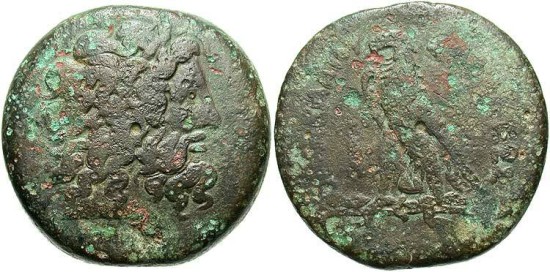
I've heard some say that a basic difference to look for is whether the pits/holes are distributed evenly over the entire surface of a coin (supposedly an indication of casting), versus in a confined area (supposedly indicating it's legit corrosion). But I've seen plenty of fakes where the bubbles were confined, and legit coins - like this one - where the pits were evenly distributed...so that theory doesn't always hold true:
Looking-For-Examples:--Cast-Pitting-Vs-Legitimate-Pitting

Note in the image above that the pits are more or less round too...so while perhaps pits may often be less circular than bubbles, there can be exceptions.

Obviously any assessment needs to be based on the whole picture: soft details? flow lines? evidence of filing? weight? notorious seller? are there any casting pearls (basically bubbles in relief), etc.
Pillar of the Community
pishpash's Avatar
United Kingdom
3626 Posts
 Posted 07/12/2015  1:30 pm  Show Profile   Bookmark this reply Add pishpash to your friends list Get a Link to this Reply
If you have a look under the different categories on this page, you will find a wealth of information

https://www.forumancientcoins.com/fakes/

Pillar of the Community
United States
3443 Posts
 Posted 07/12/2015  2:25 pm  Show Profile   Bookmark this reply Add FVRIVS RVFVS to your friends list Get a Link to this Reply
Bubbles in casting tend to be seen as "pearls" on the surface of the coin. The bubbles are created in the lost wax process when the 'investment' is mixed with water. A substance like Plaster of Paris is used to form the mold around a wax copy of the item. The process leaves no edge seams but requires the wax piece to be on a wax sprue which forms the channel through which the molten metal is later poured.
The bubbles in the plaster often cling to the surface of the object and are usually removed by a vibratory procedure. Most bubbles will let go and plaster uniformly cover the surface. It is almost impossible to remove all the micro bubbles and in areas of great detail they are most often found.
The tell tale sign of bubbles are tiny spheres usually in areas where they can cling to surrounding surface. The flat fields are usually clear of them.

Holes in the actual metal are most often caused by impurities in the metal. When the metal being cast is melted (usually in excess of 2000 degrees F) oxidation occurs and the surface need be cleared of 'slag' floating on the molten metal. When the metal is actually poured either centrifugal force (spinning it) or by placing the hot (wax free) investment on a vacuum pump will draw out any gases inside. Bubbles created in the actual pouring of the metal are usually large and irregular.
The 'bubbles' most likely to be seen on the surface are the 'pearls' which sit like tiny orbs.
Bubbles inside the metal are caused by impurities and tend to be concentrated around the sprue area. In complicated casting operations there may be more than one sprue. This gives better casting results but requires that more than one (now) metal sprue be cut and the surface area repaired.
New Member
United States
8 Posts
 Posted 07/12/2015  8:26 pm  Show Profile   Bookmark this reply Add jfk33 to your friends list Get a Link to this Reply
Awesome, thanks everyone!
New Member
United States
2 Posts
 Posted 05/18/2018  04:26 am  Show Profile   Bookmark this reply Add 209guy to your friends list Get a Link to this Reply
Great topic . I have a 2003 maine quarter that has some pitting on it and on both sides and would like some info on how to post it . I looked over how to post pictures but it didnt work . please help thank you
Moderator
Learn More...
echizento's Avatar
United States
23731 Posts
 Posted 05/18/2018  07:39 am  Show Profile   Bookmark this reply Add echizento to your friends list Get a Link to this Reply
209guy Welcome to the community. You should post your coin in the Modern US coin section for the answer your looking for.
Pillar of the Community
DavidUK's Avatar
United Kingdom
2624 Posts
 Posted 05/18/2018  07:43 am  Show Profile   Bookmark this reply Add DavidUK to your friends list Get a Link to this Reply
Porosity caused by incorrect temperature of silver during casting resembles little pin holes everywhere. The same can be seen occasionally on genuine coins where the melting process to form the blank caused tiny air bubbles in the mix.

The tip off for me has usually been the lines left by cutting the rubbers off the pattern when lost wax casting. It leaves fine lines circumnavigating usually close to or on the edge of the coin.

A thorough forger can cure either issue, burnishing or running silver across the surface, cleaning up casting lines etc. Then there may be indications of that like rounded smooth edges, unnaturalness to the finish or flan cracks.

I am not an expert on identifying forgeries and can make errors like anyone else but I know to listen to my gut and never rely on a single indicator... its when everything is taken in its entirity you can form an opinion, the abscence of casting evidence after all doesn't prove something real.

If somebody wants to discuss the effects of electrolosis/interaction between coin and soil and how the metal migrates I should be interested to know exactly what evidence that leaves and whether is can be reproduced fruadulently.
  Previous TopicReplies: 8 / Views: 10,430Next Topic  

To participate in the forum you must log in or register.


Disclaimer: While a tremendous amount of effort goes into ensuring the accuracy of the information contained in this site, Coin Community assumes no liability for errors. Copyright 2005 - 2026 Coin Community Family- all rights reserved worldwide. Use of any images or content on this website without prior written permission of Coin Community or the original lender is strictly prohibited.
Contact Us  |  Advertise Here  |  Privacy Policy / Terms of Use

Coin Community Forum © 2005 - 2026 Coin Community Forums
It took 0.3 seconds to rattle this change. Forums