Coin Community Family of Web Sites Join Thousands of Coin, Bullion, & Money Collectors
Specializing in Modern Numismatics Royal Canadian Mint products, Canadian, Polish, American, and world coins and banknotes. Royal Estate Auctions - $1 Coin AuctionsVancouvers #1 Coin and Paper Money Dealer 300,000 items to help build your collection! Coin, Banknote and Medal Collectors's Online Mall Join Thousands of Coin, Bullion, & Money Collectors


Username:
Password:
Save Password
Forgot your Password?


This page may contain links that result in small commissions to keep this free site up and running.

Welcome Guest! Registering and/or logging in will remove the anchor (bottom) ads. It's Free!

Why Are Some UK Coins Magnetic?

To participate in the forum you must log in or register.
Author Previous TopicReplies: 3 / Views: 3,700Next Topic  
Press Manager
Learn More...
CCFPress's Avatar
United States
1420 Posts
 Posted 07/22/2015  1:39 pm Show Profile   Bookmark this topic Add CCFPress to your friends list Get a Link to this Message Number of Subscribers
The Royal Mint - From time to time we're asked the question, 'Why are some coins magnetic?' It's one of those interesting facts that you seem to just stumble across. I discovered it when a loose coin stuck to the back of a fridge magnet in a drawer! So, let's take a look at the science behind it and some fun facts we found along the way.
Why-Are-Some-UK-Coins-Magnetic?

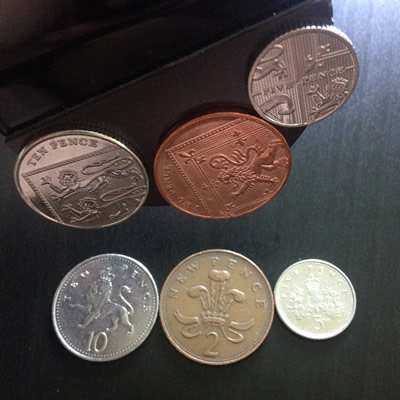
If you were to take a magnet to the 'smaller' coins in your change today, you will find that some of them stick. What, I suppose, is interesting about this is that only some of the coins are magnetic. Why aren't all of them?

A quick Google search will uncover the official explanation, which can be found on both royalmint.com and The Royal Mint Museum's website. In short, the composition of 1p and 2p coins was changed from bronze to copper-plated steel in 1992 and the composition of 5p and 10p coins was changed from cupro-nickel to nickel-plated steel in 2011. The common denominator? Steel.

The 'Copper' 1p and 2p coins were traditionally made from a bronze alloy of copper, tin and zinc. However, since September 1992 they have been made from copper-plated steel. Both types are the same colour, weight, diameter and design and circulate together, but it's the new copper-plated steel coins that are attracted to magnets. The iron content in the steel core is what makes them magnetic.

Since January 2012, the 'Silver' 5p and 10p coins have also been made from a plated steel, in turn making them magnetic. While they changed more recently than the 'coppers', you will actually find that a higher percentage of 5p and 10p coins are magnetic. This is because in 2013 The Royal Mint began a programme to recover old 5p and 10p coins from circulation. Since then some 330 million of the new plated steel coins have been issued in their place.

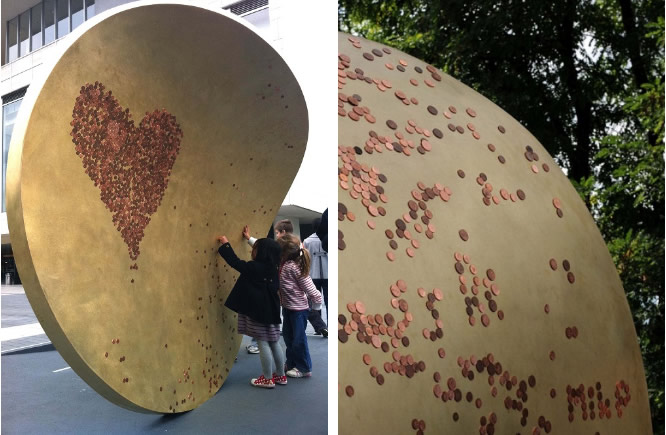
As people have discovered the magnetic property of the coins in their change, many have tried experimenting to see how far they can push the boundaries of what can be done with them.
Why-Are-Some-UK-Coins-Magnetic?
This sculpture called 'Drop' by Paul Cocksedge, created in 2010, is magnetic and encouraged passers-by to attach
their unwanted pennies to its surface in aid of charity. Photos by Susan Smart, courtesy of Paul Cocksedge Studio


When plated steel coins are attached to a magnet, the coins themselves become magnetized as the magnetic force travels through them. With a strong enough magnet you're able to attach coins to each other and 'dangle' them and some amazing feats of balance and ingenuity can be achieved.

Pillar of the Community
chequer's Avatar
Canada
4227 Posts
 Posted 07/22/2015  1:45 pm  Show Profile   Bookmark this reply Add chequer to your friends list Get a Link to this Reply
Love the sculpture!
Pillar of the Community
aardspeed's Avatar
921 Posts
 Posted 07/22/2015  5:37 pm  Show Profile   Bookmark this reply Add aardspeed to your friends list Get a Link to this Reply
...nice sculpture, just don't go near it with your cellphone, camera or any electronic device!!
Moderator
Learn More...
Sap's Avatar
Australia
16830 Posts
 Posted 07/22/2015  7:12 pm  Show Profile   Bookmark this reply Add Sap to your friends list Get a Link to this Reply
I recall reading a New Scientist magazine article, back when the copper coins transitioned to steel in 1992. The change was not well publicised and most people were unaware of it. A science teacher, wishing to demonstrate how some metals are attracted to magnets while others aren't, had just finished telling the class that "this copper coin, for example, won't stick to a magnet" when, much to his astonishment and embarrassment, it did.
Don't say "infinitely" when you mean "very"; otherwise, you'll have no word left when you want to talk about something really infinite. - C. S. Lewis
  Previous TopicReplies: 3 / Views: 3,700Next Topic  

To participate in the forum you must log in or register.


Disclaimer: While a tremendous amount of effort goes into ensuring the accuracy of the information contained in this site, Coin Community assumes no liability for errors. Copyright 2005 - 2026 Coin Community Family- all rights reserved worldwide. Use of any images or content on this website without prior written permission of Coin Community or the original lender is strictly prohibited.
Contact Us  |  Advertise Here  |  Privacy Policy / Terms of Use

Coin Community Forum © 2005 - 2026 Coin Community Forums
It took 0.29 seconds to rattle this change. Forums


