


Coin Community Family of Web Sites Join Thousands of Coin, Bullion, & Money Collectors
Royal Canadian Mint products, Canadian, Polish, American, and world coins and banknotes. 300,000 items to help build your collection! Coin, Banknote and Medal Collectors's Online Mall Specializing in Modern Numismatics Vancouvers #1 Coin and Paper Money Dealer Join Thousands of Coin, Bullion, & Money Collectors Shop for APMEX Bullion on eBay!


Username:
Password:
Save Password
Forgot your Password?


This page may contain links that result in small commissions to keep this free site up and running.

Welcome Guest! Registering and/or logging in will remove the anchor (bottom) ads. It's Free!

NGC Certifies Extremely Rare 1809 Bank Of Guernsey 5 Shilling

To participate in the forum you must log in or register.
Author Previous TopicReplies: 5 / Views: 2,697Next Topic  
Press Manager
Learn More...
CCFPress's Avatar
United States
1420 Posts
 Posted 01/13/2016  5:40 pm Show Profile   Bookmark this topic Add CCFPress to your friends list Get a Link to this Message Number of Subscribers
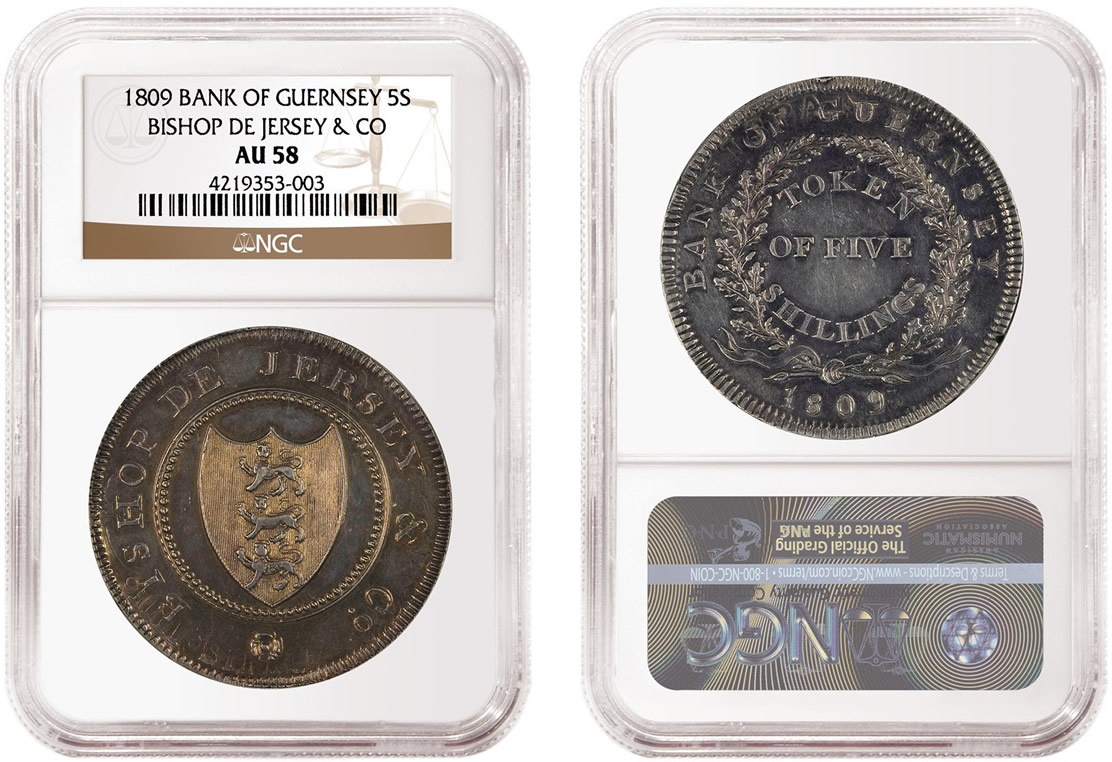
NGC - A collector recently submitted a rare 1809 Bank of Guernsey 5 Shilling, which was graded NGC AU 58.

The 1809 Bank of Guernsey 5 Shilling Token (or Crown—the British name for a 5 Shilling silver coin) issued by Bishop, de Jersey & Co. is considered to be one of the rarest crowns in the world. An estimated six to seven examples are believed to still exist of this coin. One was recently submitted to NGC where it received a grade of NGC AU 58.

NGC-Certifies-Extremely-Rare-1809-Bank-Of-Guernsey-5-Shilling

A small island in the British Channel near France, Guernsey primarily used French coinage in commerce prior to 1800. In the early 19th century, Abraham Bishop and Henry de Jersey, who were traders and silversmiths, joined together to form a private bank called Bishop, de Jersey & Co. Following their success in issuing banknotes, Bishop, de Jersey & Co. decided to issue coins.

The Bishop, de Jersey & Co Bank of Guernsey Crown was struck at the famed Soho Mint of Boulton & Watt in Birmingham, England. The dies were engraved by Thomas Wyon (the elder) and the coins were struck over circulating Spanish 8 Reales. They were assigned the value of "token of five shillings" and were dated 1809.

Guernsey, however, was not enthusiastic about the privately issued coins and moved quickly to ban them. An ordinance dated October 2, 1809, forbade the circulation of these coins and made all privately struck tokens illegal. The Bank of Guernsey Crowns were quickly removed from circulation and melted. Two years later, the Bank of Guernsey failed.

These rare pieces were the first silver coins issued for Guernsey and the only silver coins struck until 1972. This NGC AU 58 example is the first to have been graded by NGC.
Pillar of the Community
Learn More...
ChildOfTheWheat's Avatar
United States
5828 Posts
 Posted 01/13/2016  5:43 pm  Show Profile   Bookmark this reply Add ChildOfTheWheat to your friends list Get a Link to this Reply
Wow, that sure is a pretty coin! Very interesting read, thanks for posting!
New Member
Rugrats2001's Avatar
United States
31 Posts
 Posted 01/13/2016  6:50 pm  Show Profile   Bookmark this reply Add Rugrats2001 to your friends list Get a Link to this Reply
That's an awesome looking piece with a cool history, but really, it isn't a coin and wasn't authorized by the government. It was no more a coin than a Condor token was.
Valued Member
China
106 Posts
 Posted 01/13/2016  10:42 pm  Show Profile   Bookmark this reply Add nicolashsing to your friends list Get a Link to this Reply
Nice coin!Awesome!
Pillar of the Community
austrokiwi's Avatar
2087 Posts
 Posted 01/14/2016  12:19 am  Show Profile   Bookmark this reply Add austrokiwi to your friends list Get a Link to this Reply

Quote:
................ but really, it isn't a coin and wasn't authorized by the government. It was no more a coin than a Condor token was.


I do not understand your point? It is a numismatic item it is rare valuable and most importantly it is historically significant. No where in the original post is it referred to as a coin.

I believe you are incorrectly applying late 20th century thinking to an early 19th century environment. At the time these tokens were produced the silver content was what made the money not the label. Banks issued bank notes( hence the name) legally and the law regarding the issuing of "coin" was not as well developed as it is today. Indeed this token might well be a milestone in the evolution of modern coinage principles and laws
By the,apparent, tone of your comment I understand you would not regard the 1933 gold $20.00 piece to be a coin... as it was not authorized to be issued.

Edited by austrokiwi
01/14/2016 12:27 am
Pillar of the Community
swamperbob's Avatar
United States
5362 Posts
 Posted 01/14/2016  10:08 pm  Show Profile   Bookmark this reply Add swamperbob to your friends list Get a Link to this Reply
Great coin - I have always wanted to see one of these in person. It is beautiful!
  Previous TopicReplies: 5 / Views: 2,697Next Topic  

To participate in the forum you must log in or register.


Disclaimer: While a tremendous amount of effort goes into ensuring the accuracy of the information contained in this site, Coin Community assumes no liability for errors. Copyright 2005 - 2026 Coin Community Family- all rights reserved worldwide. Use of any images or content on this website without prior written permission of Coin Community or the original lender is strictly prohibited.
Contact Us  |  Advertise Here  |  Privacy Policy / Terms of Use

Coin Community Forum © 2005 - 2026 Coin Community Forums
It took 0.22 seconds to rattle this change. Forums
