






Search CCF Members
eBay Tools
eBay Coin Search Engine
eBay Coin Categories
All eBay Categories
eBay / CCF Member List
eBay / CCF Member Sales
Popular Items
Error Coins
US Error Coins
US Cheap Coins
US Hot Coins
US Most Watched Coins
Aussie Cheap Coins
Aussie Hot Coins
Aussie Most Watched Coins
Canadian Cheap Coins
Canadian Hot Coins
Canadian Most Watched Coins
Ancient Cheap Coins
Ancient Hot Coins
Ancient Most Watched Coins
World Cheap Coins
World Hot Coins
World Most Watched Coins
eBay Coins By Type
eBay Coins By Year

|
|
This page may contain links that result in small commissions to keep this free site up and running.

Welcome Guest! Registering and/or logging in will remove the anchor (bottom) ads. It's Free!


 Posted 12/16/2015 1:36 pm


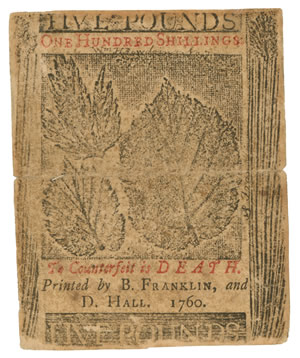 Despite the hopes of Benjamin Franklin and other promoters of the paper money experiment, the viability of the system was consistently threatened on two fronts. The first was the temptation that seemed to inevitably lead governments to print more money than could be covered by the treasury. The second was counterfeiting. The latter can be illustrated by the fact that the initial authorized issue of paper money was made by the colony of Massachusetts Bay in December 1690. The notorious counterfeiter Robert Fenton was brought up on charges for passing altered notes the following spring. The battle between authorities and counterfeiters was joined in earnest as the size and scope of paper money emissions expanded in the eighteenth century.


