










 Posted 12/18/2015 08:38 am


Quote:
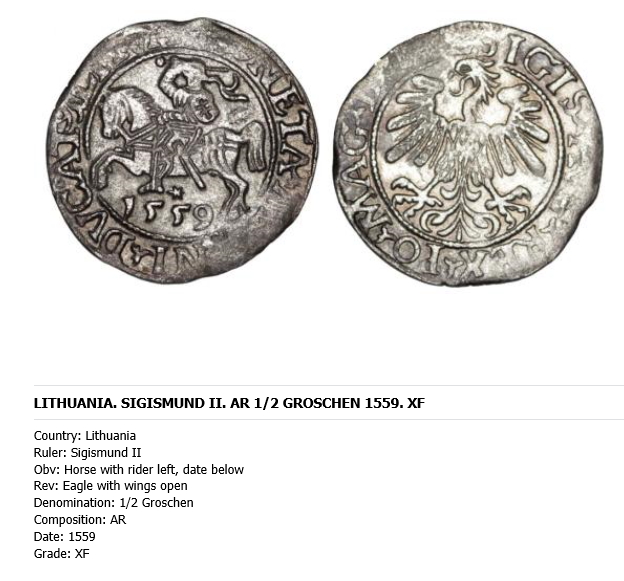
The reverse has what appears to be the Polish eagle, as I understand it the countries were interlinked at the time.
The reverse has what appears to be the Polish eagle, as I understand it the countries were interlinked at the time.
Correct. The Polish-Lithuanian Commonwealth was a union between the Kingdom of Poland and the Grand Duchy of Lithuania, which lasted from 1569 until final partitioning in 1795. It was a "personal union" under the crown, kind of like how England and Scotland were prior to 1707: two countries, two governments, two coinage systems, one king. At the time the coin was issued, it was one of the largest countries in Europe, covering most of what we now call Poland, Lithuania, Latvia, Belarus and Ukraine.
However, the Polish-Lithuanian monarchy was unusual for modern European monarchies in being genuinely "electoral". Rather than a permanently hereditary succession, when a king died a new king was elected by the nobles - and even foreign nobles were considered eligible candidates. And unlike the "elections" in Hapsburg Austro-Hungary, the son of the previous king was not necessarily the front-runner.
Once foreign powers realised that they could game the system to get a king of their own choosing elected, however, Polish independence was doomed. Nations such as France, Prussia, Russia and Austro-Hungary would set up armed camps and intimidate the nobles: "Vote for our guy, or else!". And the "or else" did happen, several times, resulting in the so-called "partitioning" of the country, as losers of the election would march in and simply annex a piece of the country in retaliation.
Your coin is from the Lithuanian half of the country, as indicated by the Lithuanian emblem (the horse and rider) and the Latin legend on that side: MONETA MAGNI DVCAT LITV, "money of the Grand Duchy of Lithuania".
Don't say "infinitely" when you mean "very"; otherwise, you'll have no word left when you want to talk about something really infinite. - C. S. Lewis


