| Author |
 Replies: 28 / Views: 3,589 Replies: 28 / Views: 3,589 |
|
|
|
Moderator
 Canada
10473 Posts |
Questions arise when the catalogues change their wording...
"Discovery follows discovery, each both raising and answering questions, each ending a long search, and each providing the new instruments for a new search." -- J. Robert OppenheimerContent of this post is licensed under a Creative Commons Attribution-NonCommercial 3.0 Unported License. See: http://creativecommons.org/licenses...0/deed.en_USMy eBay store
|
|
Pillar of the Community
Canada
2845 Posts |
Montgomery, frankly it frustrates me that there is so much ambiguity surrounding Canadian numismatics in general. Why that might be I have no idea but I suspect it's caused by a lack of a strong and united organization leading the hobby, caused by too many egos in the way. TPGs, prominent Canadian publications, major dealers each going whatever direction they choose. Something so simple such as $2 cased RCM collector dollars issued over 40 years ago and yet there's disagreement over what to label to call the finish? If I was just entering this hobby I might be inclined to shake my head and just walk away.if major players can't build consensus, where does that leave the typical collector - shrouded in the same ambiguity. Anyway...I do have a minor personal vested interest in that I've spent countless hours studying and documenting my collection. I'm the type of person who relies on reference material as opposed to "he or she said". So I'm going to make this a project (thank you CPP for the inspiration!) and take a second closer look. I've chosen the year 1971 because that's the year with the largest quantity of samples that I have to work with. These were all originally purchased new by my father. He worked in the post office until he retired in the mid 70s and I strongly suspect he bought all the excess RCM coins and sets rather than sending back whatever didn't sell as he collected other coin as well. Source: 2 Prestige Sets (2 nickel dollars in each) = 4 1 Custom Set 5 Uncirculated Sets 1 MS circulated 4 cased nickel dollars TOTAL = 15 1971 nickel dollars 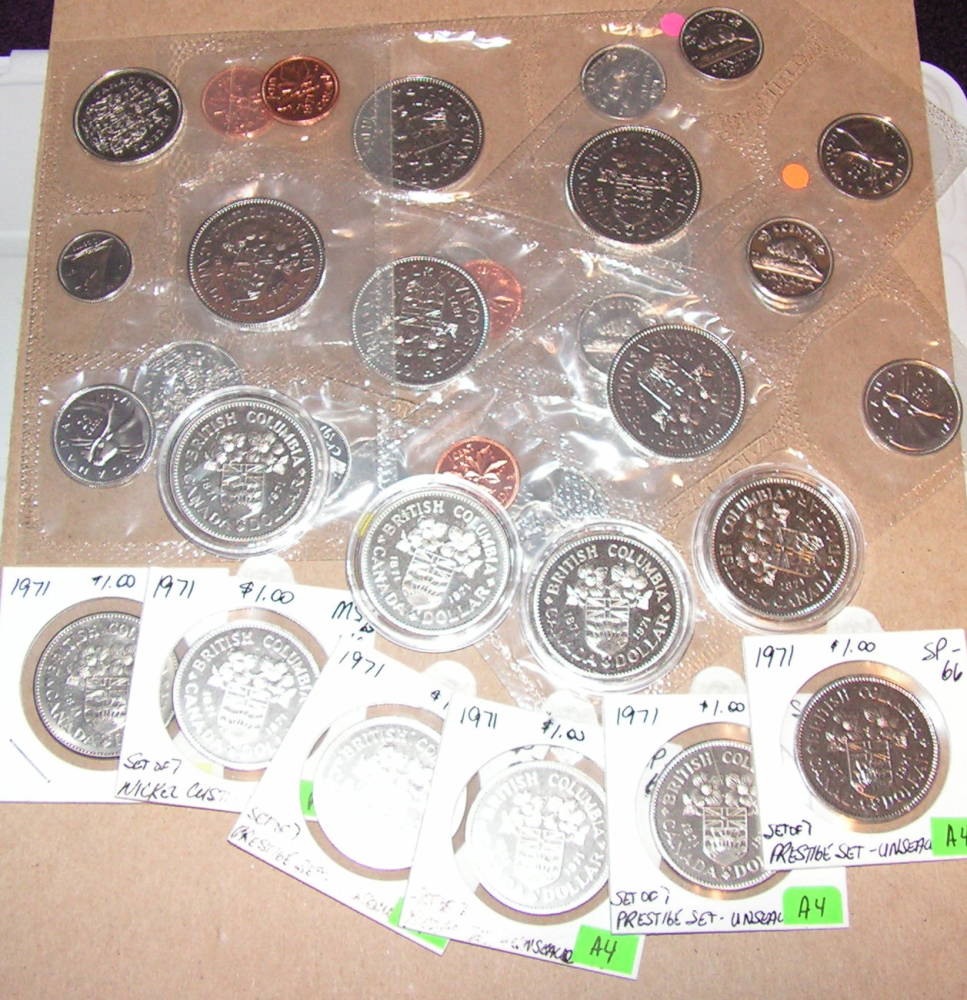 Later... |
|
Pillar of the Community
Canada
2845 Posts |
Quote:
Questions arise when the catalogues change their wording...
Very true but I can't help but wonder that the reason for the change was because Charlton corrected a past mistake. The other reference source that I rely upon is Dr James Haxby and his book "Striking Impressions". He also writes that in the '70s until 1977, other than the 1970 VIP set, the Prestige Set "the finest set available" was the only specimen (double stuck) set issued by RCM. It wasn't until 1977 that the 7 Coin Nickel Custom Set (double penny) became upgraded to a Specimen set. However he doesn't comment specifically on the cased single dollar. Adding: page 271 -- Dr Haxby goes on to say that in 1977, the "regular" set (phiofilm), the "Custom set" (square case) were changed so that all three sets including the Presitge Set, "received the same quality double-stuck coins". Edited by wildflowerAB
02/16/2016 12:55 pm
|
|
Moderator
Canada
10473 Posts |
Quote:
If I was just entering this hobby I might be inclined to shake my head and just walk away.if major players can't build consensus, where does that leave the typical collector - shrouded in the same ambiguity. I see it more like a challenge... you have a puzzle, but are not given all the pieces... When you dive neck-deep into a series you not only want to collect, but study, you will find a whole world of ambiguities... 1971 is a fairly easy year to differentiate the PL strikes, they tend to be weakly struck like the business strikes. 1974 is another easy year... but try 1978... the reverses in the PL strikes are "soft" and even in the specimen strikes appear to be the product of over polished dies. Same goes for the specimen strike for the 1979 nickel dollar, the RCM literally used that obverse die until the bitter end.... I think it is the deteriorating quality of the dies, that probably caused the change in nomenclature. Specimen dies first struck the coins, then some of those same dies struck the PL coins... (none of this is documented in any RCM report, however). "Discovery follows discovery, each both raising and answering questions, each ending a long search, and each providing the new instruments for a new search." -- J. Robert OppenheimerContent of this post is licensed under a Creative Commons Attribution-NonCommercial 3.0 Unported License. See: http://creativecommons.org/licenses...0/deed.en_USMy eBay store
|
|
Pillar of the Community
Canada
2845 Posts |
Quote:
When you dive neck-deep into a series you not only want to collect, but study, you will find a whole world of ambiguities...
What I view as ambiguity is caused by what appears to be conflict and disagreement that the typical collector is well beyond resolving. But I have a question. In that Charlton Standard Catalogue is a leading Canadian publication, J and M and Collonial Acres large dealers, and you and others who have devoted intensive effort into research, why is there not consensus between all forementioned parties on something as simple as the finish on a $2 cased nickel dollar issued by RCM during the 1970s? Because there's obviously not, that is what's broken..... |
|
Moderator
Canada
10473 Posts |
There is one consensus between all those you listed... they are businesses, and are in the business of making money with money.... Very few coin dealers ever contribute to numismatic research (publications)... Charlton Press is now owned by a coin dealer, make no mistake that they are in the business of selling books. Several of us have lobbied for corrections to the catalogue over the years... with limited success. That is where the CN Journal (publication of the RCNA) fills a nice niche... "Discovery follows discovery, each both raising and answering questions, each ending a long search, and each providing the new instruments for a new search." -- J. Robert OppenheimerContent of this post is licensed under a Creative Commons Attribution-NonCommercial 3.0 Unported License. See: http://creativecommons.org/licenses...0/deed.en_USMy eBay store
|
|
Valued Member
Canada
395 Posts |
I'd love to hear corrections to the catalogue because frankly for most of the average collectors this is the best source of information.
|
|
Pillar of the Community
Canada
1751 Posts |
@ wildflower I believe Dr. Haxby is also a member of this forum. I have read his postings in the error section. It would be great if he would weigh in on this discussion. Especially since he has written many books.
|
|
Valued Member
 Canada
435 Posts |
It's hard to understand that everybody here talk about the same subject with different angle of knowledge base on what they read. This is my personal opinion. We see with this discussion that informations is not linked on a central book (or magazine). Charlton is good in general and specially for the pictures, CCN for the Trends, RCNA journal for more deep informations on a precise subject wich is good to know but not cover in the Charlton. Now try to explain that to a new collector. For this information, go in that publication but for this other point try this other one. It would be helpfull for everybody to have a revised book with a flexible approach to correct the informations in it and avoid confusion over the years. This would be good for new and old collectors. |
|
Pillar of the Community
Canada
2845 Posts |
Well Montgomery, I hope this is helpful but I think I get it.... An interesting study! First I think it's helpful to reflect back on history. In the mid 60s RCMs Numismatic Division was moved from Ottawa to expanded premises at Hull because of the demand for hugely popular uncirculated mint sets. Upon Canada's Centennial in 1967 the first cased sets were offered to the public, an ambitious project at the time. At that point silver coins were also discontinued. The mint encountered difficulty with the changeover to nickel particularly in 1968 and 1969, numerous errors and anomalies in the uncirculated sets. By 1970 the problems with nickel were becoming resolved and so began the minting of cased sets and coins to the public. Looming in the near future was the 1976 Montreal Olympics. At one time the Canadian Govt believed the full cost could be paid by the sale of collector coins to the public, as it turned out it covered only 10% of the cost. However in the preceding years it's reasonable to assume collector coins and sets served as experimentation to some extent. What I noticed in my 1971 samples: Prestige Set - without a doubt the highest quality. Heavily frosted effigy resembling the old Victorian style of Specimen sets. If the term "Proof-Like" hasn't already been used for Uncirculated Sets, the reference would've been most appropriate. Nickel dollar - Prestige Set 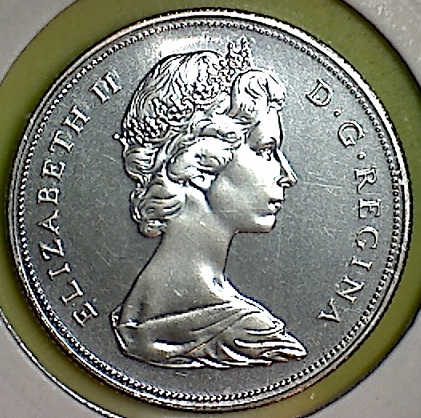 7 Coin Custom Set - I only have one set with one nickel dollar, but it's also frosted. In fact it looks exactly like that of the Prestige Set. I don't know one nickel dollar is an anomaly or not. The difference in original cost between the two sets was $6.50 and $12.00. Uncirculated Sets - quite typical, a few here and there are somewhat frosted but nothing close to the Prestige nickel dollars. Most are BU. Cased nickel dollars - the 4 are all BU, brilliant relief against brilliant background, highly polished appearance and possibly double struck. Definitely a prelude to the BU silver dollar series. However I do notice one from 1970 that is quite different, deep cameo similar to the Prestige set. Therefore it's reasonable to assume at the time RCM processes did not achieve consistent standards and cased nickel dollars and therefore Custom Sets are not always BU. In their priority of filling orders, if the mint had extra coin minted for Prestige sets and it's also not surprising if some Specimen coin got tossed into other sets or cases as well, who would care. Cased nickel dollar (bad photo, oh well) 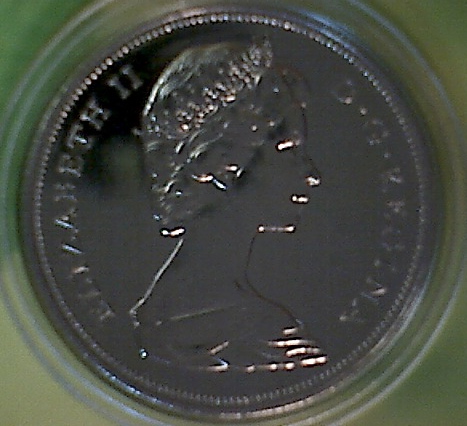 Circulated - typically BU. Therefore, in general, considering cased nickel dollars are not similar in appearance to that of Prestige Sets/Specimen, it makes sense to me that it would be confusing to refer to both as Specimen. On the other hand, the BU appearance of cased nickel dollars is alike that of Uncirculated Sets (PL or MS-NC) -- although higher quality -- so that's probably why it's referred to as PL (MS - NC) by Charlton and others. Seems the most logical manner of classification to me as well. However to sum it up, I think the confusion arises due to various types of strikings in one year including BU and possibly double struck BU without enough categories to properly fit them in, coupled wth lack of consistency in what's commonly referred to as Specimen or Proof-Like. Edit to add a couple photos. Edited by wildflowerAB
02/17/2016 11:16 am
|
|
Pillar of the Community
Canada
2845 Posts |
Quote:
Why else do you see so many 1970 ICCS graded specimen dollars, compared to the other denominations, which were only issued in VIP Specimen sets).
I may know the answer to this question, without proof of course, but I've noticed it mentioned elsewhere that regardless of the source of 70s heavy cameo nickel dollars, whether it be Prestige, cased or PL, TPG has a tendency to grade them all as SP. That would seem logical to me, considering the lack of set standards occurring in that era. Just adding a thought, if this is true it would be TPG's version of "look at the grade/quality of coin, not the packaging"! Edited by wildflowerAB
02/17/2016 11:47 am
|
|
Moderator
Canada
10473 Posts |
Bear in mind that Prestige and Double Penny sets were not made in 1970...
"Discovery follows discovery, each both raising and answering questions, each ending a long search, and each providing the new instruments for a new search." -- J. Robert OppenheimerContent of this post is licensed under a Creative Commons Attribution-NonCommercial 3.0 Unported License. See: http://creativecommons.org/licenses...0/deed.en_USMy eBay store
|
|
Pillar of the Community
Canada
2845 Posts |
Quote:
Bear in mind that Prestige and Double Penny sets were not made in 1970...
True. I notice in 1970 my cased dollars are of both types, no consistency during the '70s appears was the standard. In pliofilm sets as well, the occasional cameo. I'm interested in your opinion of my analysis of the various types of 1971 nickel dollars. |
| |
Replies: 28 / Views: 3,589 |






 First Page


 Posted 02/16/2016 12:21 pm


