| Author |
 Replies: 14 / Views: 1,579 Replies: 14 / Views: 1,579 |
|
|
Pillar of the Community
United States
3362 Posts |
I have spent several days searching for an image of this coin and I have been unsuccessful. Does anyone have an image you would be willing to message to me or post here in this thread?
|
|
|
|
Moderator
 United States
56855 Posts |
|
|
Pillar of the Community
 United States
3362 Posts |
Thanks, John. I think this came up in your search because the the terminus a quo date is also 441! The coin I am searching for should have a REV with a cross inside a wreath.
|
|
Moderator
United States
56855 Posts |
Edited by John1
02/16/2016 2:54 pm
|
|
Pillar of the Community
United States
1047 Posts |
I don't have this RIC volume, but according to the spread sheets, the only difference between RIC 441 and 442 is that 441 has a legend break "DN THEODO-SIVS PF AVG ". It seems it would be hard to tell as coins of this era and type are usually made with such low quality. Anyways, this one was listed as RIC 442 (no legend break) but at least the mint mark is legible 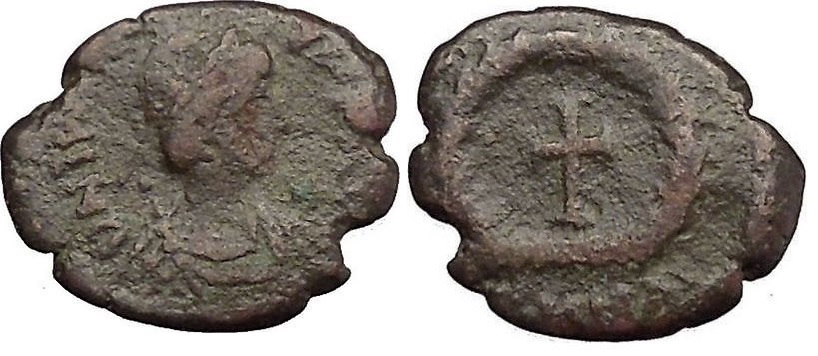 Edited by Biancasdad
02/16/2016 4:42 pm
|
|
Pillar of the Community
United States
3362 Posts |
I am not at home with my computer and notes right now, but with a coin with a mintmark which is incomplete, I am trying to use other features to attribute. I am noticing significant differences in the shape and composition of the bust and its features. For example the size of the bust itself and especially the size of the nose and relative position of the eye. Is my assumption legitimate - that all 441s should be the same, as should all 443s, etc.?
|
|
Moderator
United States
23731 Posts |
Thought I might of had one, but the ones I have are all 444's.
|
|
Pillar of the Community
United States
3362 Posts |
|
|
Pillar of the Community
United States
949 Posts |
Quote:
Is my assumption legitimate - that all 441s should be the same, as should all 443s, etc.? While the general features of the design will be the same, unless two coins are from the same pair of dies they will not be identical, even when from the same mint. I would not expect the details on your coin to match the details of anything you find online or printed. But if you just happen upon a die match, then they will be as close as their die states will allow. That's pretty much the picture for ALL ancients. |
|
Pillar of the Community
United States
3362 Posts |
Thanks for the comment on this. I suspected that it certainly would not be the kind of consistency we see with modern coins. Quote:
While the general features of the design will be the same I take this to mean at least that the bust size will be more or less the same. I am finding quite a significant variation on the sizes of RIC X 441 through 453. Enough that it seems to me to be indicative for the purpose of attribution. I will go to work on posting some images of what I am talking about a little later. I am also finding it interesting that not a single image of RIC X 441 has surfaced. I have spent hours of online searching for one and have even asked here if anyone has one or knows where it exists. This is my first foray into ancients, and I am finding them quite fascinating. |
|
Pillar of the Community
United States
949 Posts |
Quote:
I take this to mean at least that the bust size will be more or less the same. Actually, no. For Late Roman Bronze, at various times and issues, they might use bust size as a way of differentiating rulers and in some issues the mints themselves. So unless you know the pattern for the bust size(s) in an issue, you should remain open for the possibility of some variety. I have not studied these Theodosian bronzes that way so cannot comment on what you are finding or hope to find. When I said "general features of the design" I was referring to the kinds of devices or motifs one might find for a particular issue, but not necessarily the manner of their execution. A bust, yes. But not always the direction it faces, or what it wears on the body or in the hair. Or a wreath, yes. But not how it is made or tied. A wolf and twins, perhaps, but not the manner of its hair, or the use of extra devices around or above it. And so on. The more mints in operation at one time, the more variations on a theme one will find for any given issue. Some of it done intentionally to differentiate mint products, and some of it simply due to differences in die cutting. |
|
Pillar of the Community
United States
3362 Posts |
Thank you. Great information! I know it is probably obvious to most on this forum, except to this new comer. Here is the coin I have been trying to attribute and my current thinking. Please offer corrections or alternatives! In the absence of an image of RIC X 441 (finding that could change my thinking, of course) I believe this is RIC X 447B or a variant thereof.  My coin has the split Obverse Legend: DN THEODO-SIVS PF AVG My coin does not have an X or a Chi Rho in the jewel of the wreath on the Reverse This leaves only 4 possibilities: RIC X 441, 444, 447A or 447B. RIC X 441 has no image available for comparison; 444 has a medium head and small nose; 447A: the 2 parts of both the stipes and the patibulum of the cross are approximately equal and the nose is of a medium size; 447B has the Reverse Cross quite similar and compares quite favorably with and overlay. The Obverse of 447B also compares quite favorably with an overlay with the exception being that the eye on my coin is about one eye diameter more towards the bridge of the nose than the reference coin I found. (See: http://www.wildwinds.com/coins/ric/...us_II/t.html ) My coin is either 447B or one of the copies made by the local barbaric tribes after the collapse of the western empire (See the Brescello Hoard here: http://www.museobiassono.it/Italian...oduzione.php ) This might explain the slightly different position of the eye. However I do not quite understand whether that difference is enough to affect the attribution. I should think that they eye location is not enough to affect the attribution, especially because the design of the Reverse cross on the coins from the Brescello Hoard is substantially different than my coin and 447B. 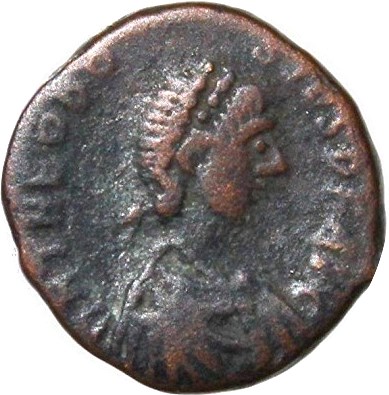 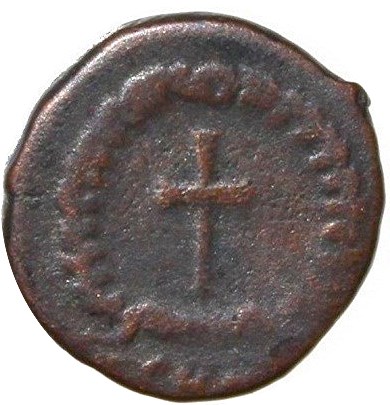 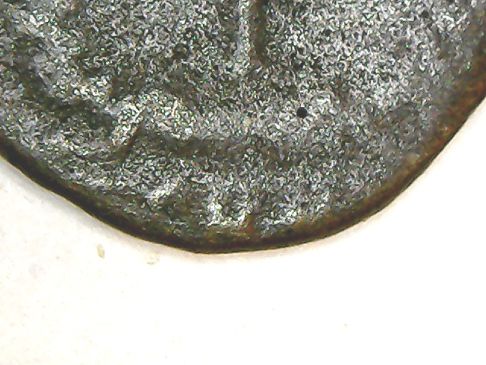 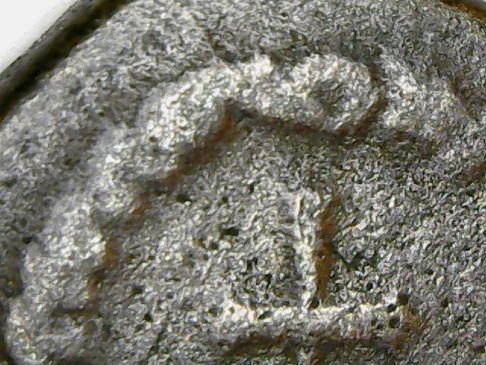 |
|
Pillar of the Community
United States
949 Posts |
This got interesting. Sorry for the long report. Before I say more, let me observe that I don't see any of the kind of legend blundering so common to barbarous imitation, despite the crudity of the obverse portrait. Nor does your coin appear on a reduced module as the barbarous pieces usually do. I will treat your coin as a product of one of the bona fide Roman mints.
You have the right idea in how to approach this problem, but now let us tweak it. I will take a slightly different starting point, which will let us rule out RIC X #444 on another ground.
In the RIC X catalog one finds listings for coins of this type from 7 mints. The configuration of the mint mark on your coin seems to follow a SMXX type of configuration.
Only three mints follow that pattern: Heraclea, Nicomedia, and Cyzicus. Other marks styles are: TESA, CONS, ANTA, ALEA, none of which look like good candidates to me.
Of the first three, all have obverses with the "T1" inscription pattern, i.e. with the DO-SI break.
These three correspond to
441 - Heraclea, one officina only (SMHA)
447 - Nicomedia, officinae A and B (SMNA)
449 - Cyzicus, officinae A and B (SMKA)
If you are satisfied that the presence of a mark in the circle at the top of the wreath is a feature of this reverse at Cyzicus, as Wildwinds reports it, then your coin is either from Heraclea (441) or Nicomedia (447). Without a clear mark I would normally say that I don't think you can narrow it down beyond that, and certainly not to differentiating the two officinae of the same mint (which sometimes can be done stylistically, but not in this case, I think). But there is more.
I think I now know why you're having trouble finding an image of RIC X 441. There is something odd about that listing. Kent gives the footnote, "Confirmation of mint-mark required." According to the location reference that listing is supposedly based on a coin in the Dumbarton Oaks collection (Location = DO), not the British Museum, with a specific reference to the 1992 catalog by Philip Grierson and Melinda Mays, Catalog of Late Roman Coins in the Dumbarton Oaks Collection and in the Whitmore Collection. However, when you go to the DO catalog, which illustrates everything it lists, including coins only partially attributed, you do not find either an illustration nor an attributed listing for Heraclea among the AE4 of this type for the period 408-419 AD, or any other period. What you do find is a summary listing in table 33 (p. 140) for all AE4 of this type for the broad period 408-450, and there appears a listing reference for a coin from Heraclea with an unbroken obverse legend. There is an empty slot for a corresponding reference to a coin with a broken obverse legend. Moreover, the listing they do provide is not a reference to a coin in the Dumbarton Oaks collection, but rather to item #2004 in the book Late Roman Bronze Coinage (LRBC)[which Kent helped write]. When you check that listing in LRBC the description code T22B is indeed for a coin with an unbroken obverse legend, and this is both cited and illustrated in RIC X as #442. However, that is the only listing in Dumbarton Oaks for this AE4 from Heraclea. So the reference to a coin like #441 is questionable altogether. I may have missed it somehow, but from what I did see, there is no apparent basis for the claim that such a coin even exists.
I would recommend that you disregard #441 entirely, and attribute your coin to one of the officinae at Nicomedia.
Edited by lrbguy
02/17/2016 1:44 pm
|
|
Pillar of the Community
United States
3362 Posts |
WOW! What a fantastic piece of writing/research! That is just amazing! Thank you so much! It gives me quite a volume of material to digest! It explains so much!
|
|
Moderator
United States
23731 Posts |
Excellent piece of research.
|
| |
Replies: 14 / Views: 1,579 |
|







 Posted 02/16/2016 1:38 pm





