Sorry I couldn't get back to you yesterday, but I was called away. There are some interesting matters here to which your questions call attention.
@echizento
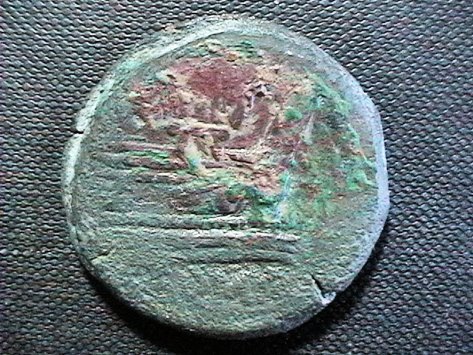
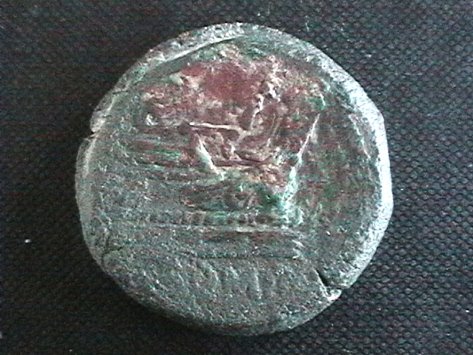
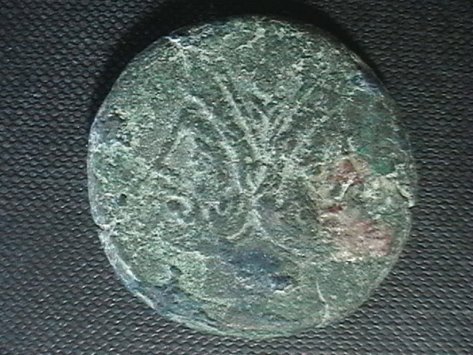
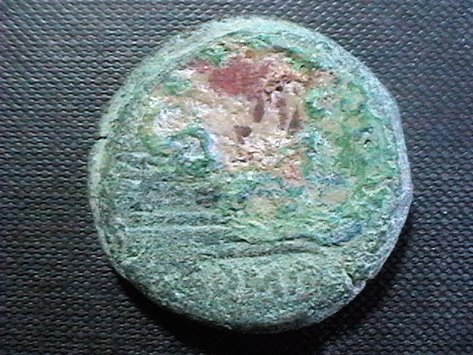
Ron, until your coin has been cleaned far enough to reveal which moneyers marks it contains, you will not be able to get a clear fix on its dating. Allow me to comment first on David's coin, and also mine, to set the pattern and then come back to yours.
@DavidUK
You are correct that the semis is tariffed at half an As. I would be interested in learning the weight and diameter of your coin.
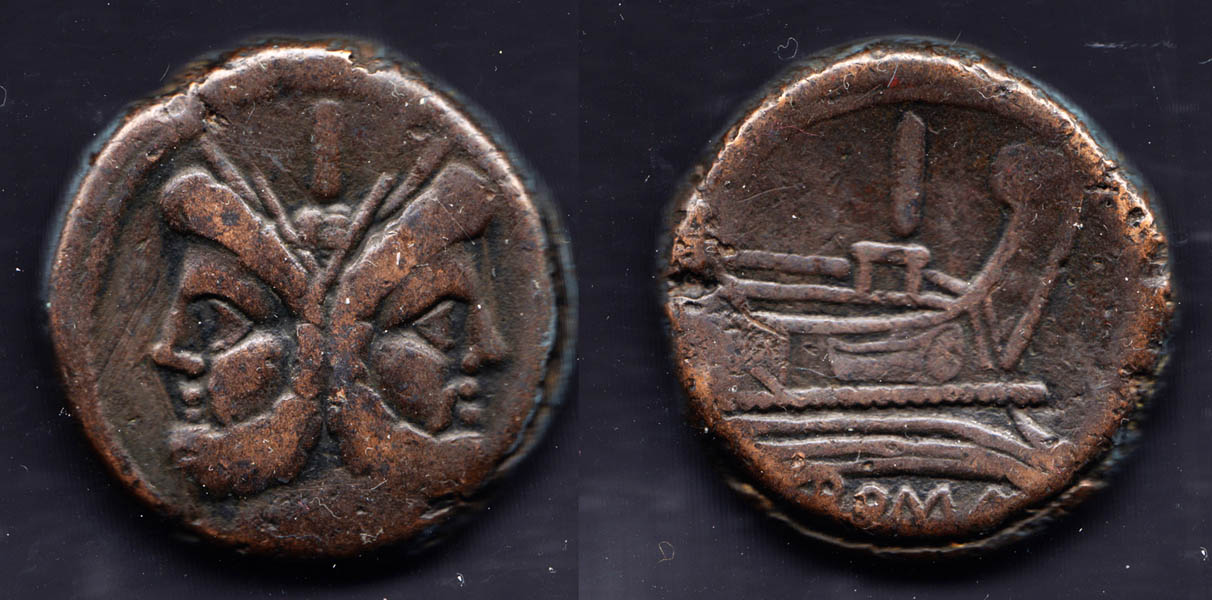
I have made a brightened image of your coin and set it in horizontal mode parallel to mine to point out certain features more easily. This As weighs 38.45 gm, and measures 33mm across. It is also quite thick at 5.2 mm.

These pictures were not done to a common scale, so we cannot tell anything about relative coin sizes based upon them.
For these coins the reference of choice is Michael Crawford,
Roman Republican Coinage. The Crawford number on my coin is 56/2 which is described as an anonymous bronze As with obverse laureate head of Janus; above,
| . The reverse is a prow, r.; above,
|. The mint is Rome and dates to "after 211 B.C."
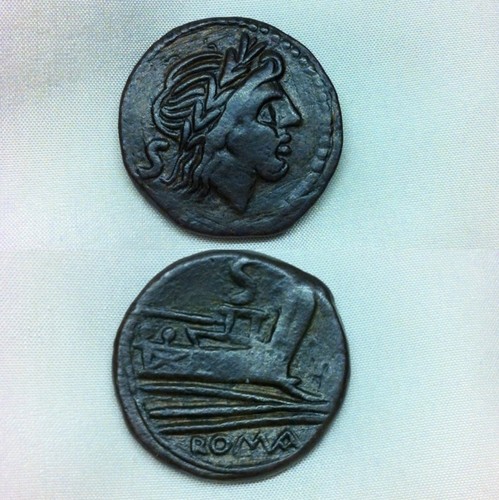
David's coin is from the same series with the following description in Crawford: number 56/3 a Semis with obverse laureate head of Saturn r.; behind,
S. The reverse is a prow r.; above,
S.
Crawford provides illustrations for a couple of examples of each. The imagery on the As is pretty much as expected, but the obverse bust on the Semis was a bit of a surprise to me. Normally the figure of Saturn is heavily bearded and bears the appearance of age (being the mythic father of Jupiter). However, David's coin appears beardless and quite youthful, and I did not recognize it. However, Crawford illustrates a bearded and beardless visage for Saturn as examples of 56/3, so there should be no doubt about either the authenticity of the coin or its early attribution. These coins are roughly contemporaneous with the transition from the Victoriatus to Denarius in silver from and after 211 BC. They are some of the first coins made according to the sextantal standard, which means 6 asses to the Roman pound (libra). [Crawford's conclusions laid to rest the confusion about that which had arisen from conflicting reports by other scholars who preceded him.]
Note that the vertical stroke mark
| on the As is replaced in both positions by an
S on the Semis. It should be evident that these are the distinguishing marks of value for each piece. It is the absence of any further symbols, monograms, or altered design features that narrows the attribution of these coins to the earliest period of Republican struck coinage. Subsequent coin producers (moneyers) added details in the empty spaces above and before the prow, often repositioning the marks of value in the process. Crawford has arranged his catalog to give at least a relative chronology for the appearance of the various distinguishing marks of the longs series of moneyers which followed. He groups coins in all metals according to this progression.
This then gets us to the problem with dating your coin, Ron. As I said above, until you know what marks it has, you cannot date your coin. Worse yet, you cannot be guided in your restoration by a known configuration. As you remove the encrustation on your coin, you need to be alert to the possibility of design elements in unusual configurations and locations so that you do not remove what ought to stay. This creates a chicken-and-egg problem, since you can't tell what mark to look for until you see it clearly. If the encrustation were merely an accretion (stuck on) then you could excavate the layers stratigraphically and reveal the design. But in all likelihood, some of the points of coverage have altered the underlying metal, making it harder to recognize when you are cutting into a design feature.









 Posted 03/25/2016 9:53 pm