









 thailand1-1.jpg
 thailand1-2.jpg
 thailand2-1.jpg
 thailand2-2.jpg


 Posted 02/24/2008 08:08 am


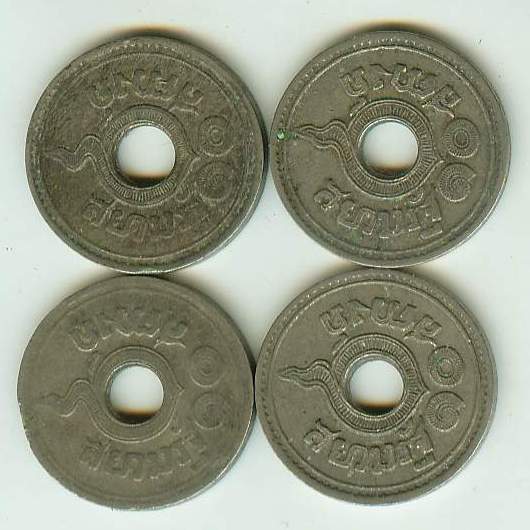
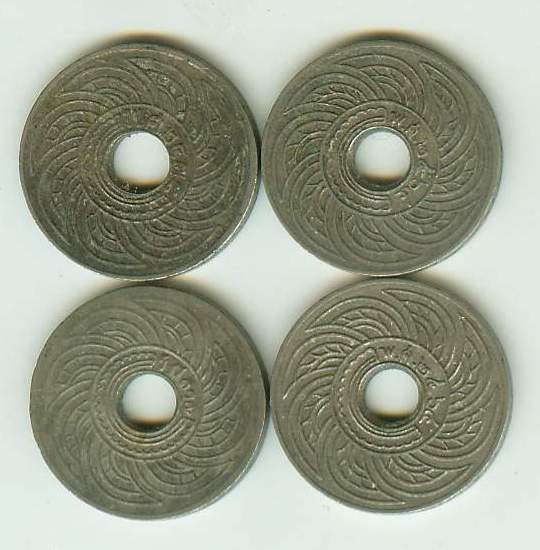
First, the top two pics (10 satang):
The two on the right appear to be both dated 2464 in the Buddhist Era calendar (= 1921 AD), the the commonest date for these, judging by the mintages. The one at upper left is a bit blurry, but appears to be 2478 (= 1935); the fourth digit is too smudged to read, but the third digit is definitely a "7", and there was only the one date appearing on 10 satang in the 2470's.
The one on the lower right is earlier, because the date is only 3 digits long. The four-digit Buddhist Era calendar was only introduced on the coinage in 2456 (1913). Before that, the three-digit Bangkok Era calendar was used on coins with otherwise almost identical design instead. This one seems to be dated 129 (= 1910).
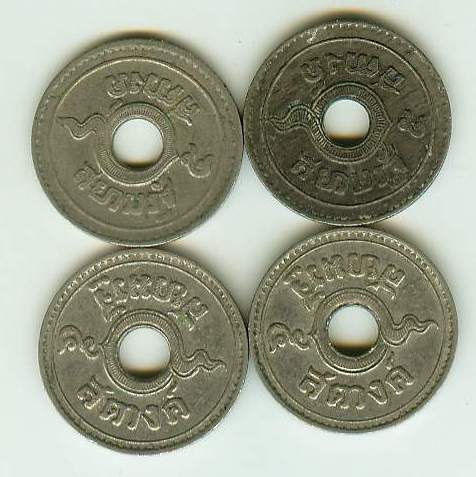
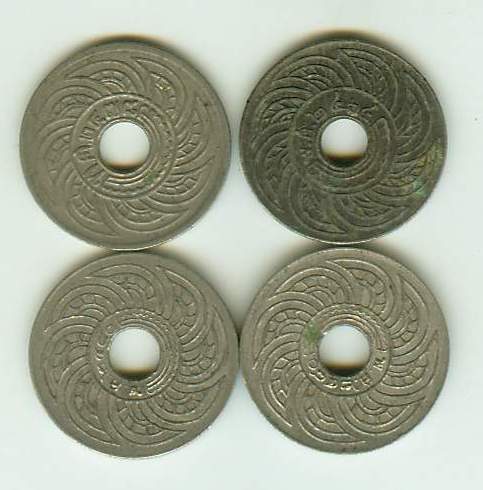
On to the next two pics, with the 5 satang coins.
Top left: BE 2478 (= 1935), Top right is BE 2464 (= 1921), the two bottom ones are BE 2480 (= 1937).
The two on the right appear to be both dated 2464 in the Buddhist Era calendar (= 1921 AD), the the commonest date for these, judging by the mintages. The one at upper left is a bit blurry, but appears to be 2478 (= 1935); the fourth digit is too smudged to read, but the third digit is definitely a "7", and there was only the one date appearing on 10 satang in the 2470's.
The one on the lower right is earlier, because the date is only 3 digits long. The four-digit Buddhist Era calendar was only introduced on the coinage in 2456 (1913). Before that, the three-digit Bangkok Era calendar was used on coins with otherwise almost identical design instead. This one seems to be dated 129 (= 1910).
On to the next two pics, with the 5 satang coins.
Top left: BE 2478 (= 1935), Top right is BE 2464 (= 1921), the two bottom ones are BE 2480 (= 1937).
Don't say "infinitely" when you mean "very"; otherwise, you'll have no word left when you want to talk about something really infinite. - C. S. Lewis


