| Author |
 Replies: 23 / Views: 12,273 Replies: 23 / Views: 12,273 |
|
|
|
Valued Member
Australia
205 Posts |
Hi Ow3qa,
If not too late you should return it to the person you bought it from.
If you cannot do that and you are certain it is electrum, then get someone to melt it down. There will be one less fake coin in the world and you will have precious metal you can hold onto or use for something e.g. jewellery.
The coin you bought is one of the most commonly faked coins. Fake coins are what scares people away from this hobby.
However if you have an interest in collecting ancient coins, stick around, and you'll learn about how to safely buy ancient coins from reliable places.
Hope to see you here again.
Peter
|
|
Bedrock of the Community
Australia
21792 Posts |
Any coin dealer worth his salt will not destroy fake coins. They can form an educational reference collection in learning how to be familiar with them, so the the coin dealer can defend his business from unscrupulous pushers of fake coins. That is the reason why I maintain a reasonably large 'black' collection of fake coins as well. Just make sure that you know and understand that acquisitions to a 'black' collection, are indeed fake. A black collection is one of my main defensive weapons against fake coins. I will not leave myself open to attack, if I know how use fake coins against those who try to sell them.  |
|
Valued Member
Australia
205 Posts |
That's a good point where decent coin dealers / collectors are concerned.
However fakes which are not marked as fakes or copies always have the potential of re-entering the market which is not a good thing.
Fakes turn people away from this hobby and regrettably major auction sites act like bystanders and let it happen even when known sellers of fakes are reported to them.
|
|
Bedrock of the Community
Australia
21792 Posts |
The manufacturers of fake coins never mark their products as fake. That would be counter productive to their own dishonesty.
|
|
Valued Member
Australia
205 Posts |
Of course! I've never seen a fake sold as authentic marked as such lol!
But I've seen coins sold as "reproductions" and not marked so.
Then you have coins identified as fakes, kept in someone's possession and if not clearly labelled as fakes can easily make their way back into the market place one day.
Edited by greekandromancoins
03/16/2017 7:26 pm
|
|
Bedrock of the Community
Australia
21792 Posts |
Morally, I have a problem with my 'black' collection of fake coins. I have to ensure that the best and most deceiving pieces do not find their way back into the numismatic market place. I have an arrangement with one of Australia's leading coin dealers, that they get them gratis, when my collection has to be disposed of in my dying years. THAT would satisfy me.   The very obvious fakes will most probably be thrown into the recycle rubbish bin. Lower grade satisfaction. In the meantime, they have an honest job of work to do. |
|
Pillar of the Community
United States
7067 Posts |
Interesting conversation. With apologies to Ow3qa (the OP), whose thread is in danger of being hijacked: In printmaking there is a tradition of the "cancellation proof." When a printmaker has finished his or her edition of prints from a matrix - typically a metal etching or engraving plate - he or she mars the surface of the plate with an "X" or other scratches, then prints the final proof, documenting the end of the series. The idea is that the marred surface precludes future reuse. (It's a historical practice that today's tech can work around, of course - via photomechanical processes). A Degas cancellation proof of an engraving here: 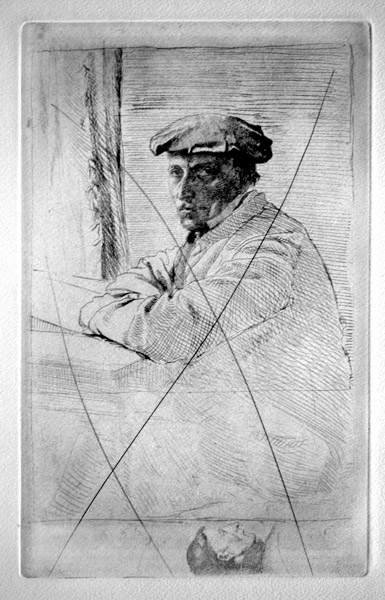 Why don't keepers of black cabinets simply scratch (deeply) "FAKE" onto the surface of their coins? Granted the scratches could be smoothed away, but that might be more effort than potential resellers of the fakes might be willing to put forth in the future. And the smoothing they'd have to do would perhaps be evident and off-putting for potential future buyers. "FAKE" on the surface would not mar a coin so much that it loses its educational value. The coin's features would still be evident to use for spotting similar fakes. Just a thought. |
|
Bedrock of the Community
Australia
21792 Posts |
Most fake ancient coins are obviously fake, and are easy enough to distinguish, when their picture is posted, here in the CCF.
All that is needed is a bit of experience. A 'black' fake reference collection helps.
Edited by sel_69l
03/18/2017 12:19 am
|
| |
Replies: 23 / Views: 12,273 |








 First Page


 Posted 03/16/2017 06:29 am


