Julia Soaemias Bassiana (180 - March 11, 222) was a Syrian noblewoman and the mother of Roman emperor Elagabalus who ruled over the Roman Empire during her son's reign. She was the younger daughter of Julia Maesa and niece of Julia Domna, the two formidable women of the Severan period who played a decisive role in Roman politics of the times. Soaemias was also the mother of the emperor Elagabalus.

Just as his grandmother and her sister were two of the most strong willed, ambitious, and powerful women in Roman history, Elagabalus was a weak and irresponsible emperor. He was more interested in pursuit of sexual excesses and pleasure than ruling the huge Roman empire and building a stable government.
Julia Soaemias was at once the tool of her mother's political ambitions and the victim of the Roman people's outraged reaction to Elagabalus' abuses. She did nothing to influence her son to govern well, but joined in the scandalous behavior by shamelessly taking a series of lovers in full public view herself.
Elagabalus had a succession of boyfriends. He even went so far as to take a "husband" in a formal wedding ceremony. Elagabalus also took and quickly divorced three wives. One of these ladies was a Vestal Virgin, symbol of the home and motherhood sacred to the Roman people. This act shocked even the jaded Roman upper classes, and helped to bring about the boy emperor's downfall. Elagabalus considered his role as high priest of the sun god to be more important than his role as Roman emperor.
In A. D. 222, Julia Maesa finally decided to do away with her daughter and grandson before the army raised up a general in one of the provinces to the throne. She had Elagabalus adopt his thirteen year old brother and make him heir to the throne. The boy , Bassianus, seemed to be the exact opposite of Elagabalus and was well - liked by the soldiers of the Praetorian Guard. Maesa persuaded Elagabalus to give his brother a greater role in governing the empire so that he could devote more time to serving his god. Elagabalus soon grew suspicious of his brother, though. When it seemed that Elagabalus was going to have Bassianus murdered, the Praetorians invited the boy, his mother Mamaea, and Maesa to the safety of their camp. The frightened Elagabalus tried to work out a bargain, and the angry soldiers allowed him to remain emperor only if he gave up the worst of his male favorites who occupied important government posts. However, when he refused one day to appear in public with Bassianus, the Praetorian Guard lost all patience. They raised the boy Bassianus to the purple and he became the Roman emperor Severus Alexander. They rampaged through the palace searching for Elagabalus and found him and Julia Soaemias in each others' arms hiding in a palace privy, clinging to one another in fear. The soldiers quickly killed the pair. They dragged the corpses of the seventeen year old Elagabalus and his still-beautiful but hated mother through the streets of Rome to the shouts and derision of the people. After they unsuccessfully tried to dispose of the bodies in a city sewer, they weighted both of them with stones and cast them into the Tiber.
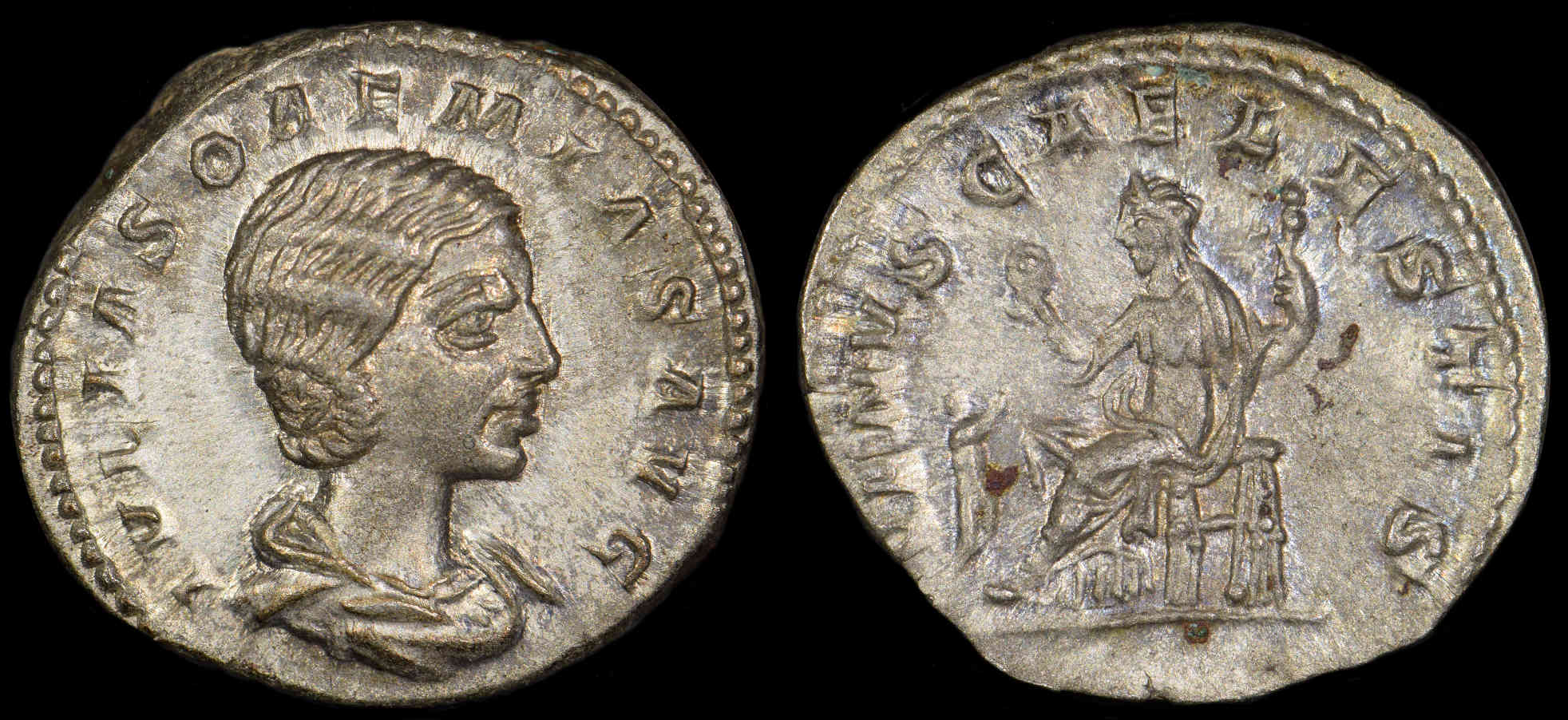
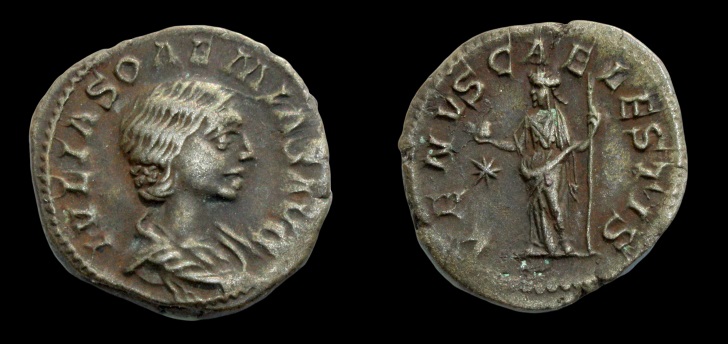
Denarii for Soaemias were in production only for 218-222. There are two obverse inscriptions and 4 reverse types. By far the most common obverse inscription is IVLIA SOAEMIAS AVG which arcs continuously without break from lower left to lower right (see example above). Here it is used with the standing VENVS CAELESTIS, Venus draped standing left holding apple in outstretched right hand, and vertical staff/scepter in left. With a star in the middle right field.
The long inscription type IVLIA SOAEMIAS AVGVSTA is less commonly seen, and is associated only with the IVNO REGINA reverse type (the only type with which the shorter obverse legend is NOT associated.)

In this the figure of Juno stands facing right, with a staff/septer held vertical in her right hand and the figure of the palladium stands on her outstretched left hand. The Palladium was a religious icon that was derived from the Greeks and figured in the Illiad as an icon sacred to Troy that had to be stolen by the Greeks in order for the city to be taken. Eventually it made its way to Rome where it was kept with the most sacred iconic images of the Romans. When the ever controversial Elagabalus transferred the most sacred relics of Roman religion from their respective shrines to the Elagabalium, the Palladium was among them.





 Posted 05/22/2017 6:41 pm