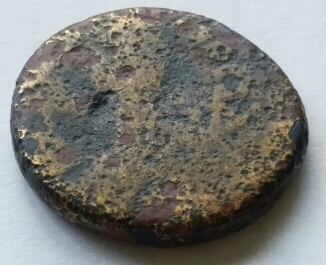
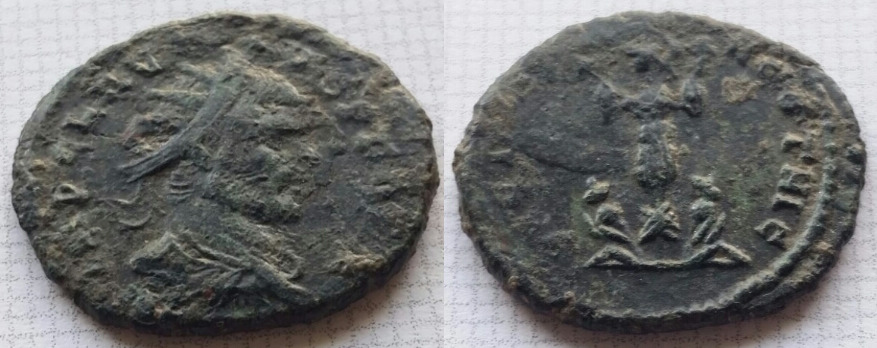
I get a lot of my coins from bargain bins or other cheap purchases, but I'm legitimately not sure which of them are the most historically significant. And a few of the obvious candidates were bought for well over $5.
But there's that one coin that I keep having a mini-lecture about every time I show it off. If perhaps only because said mini-lecture is the only way to explain
why I like that coin so much, because there's not really that much to look at on it...
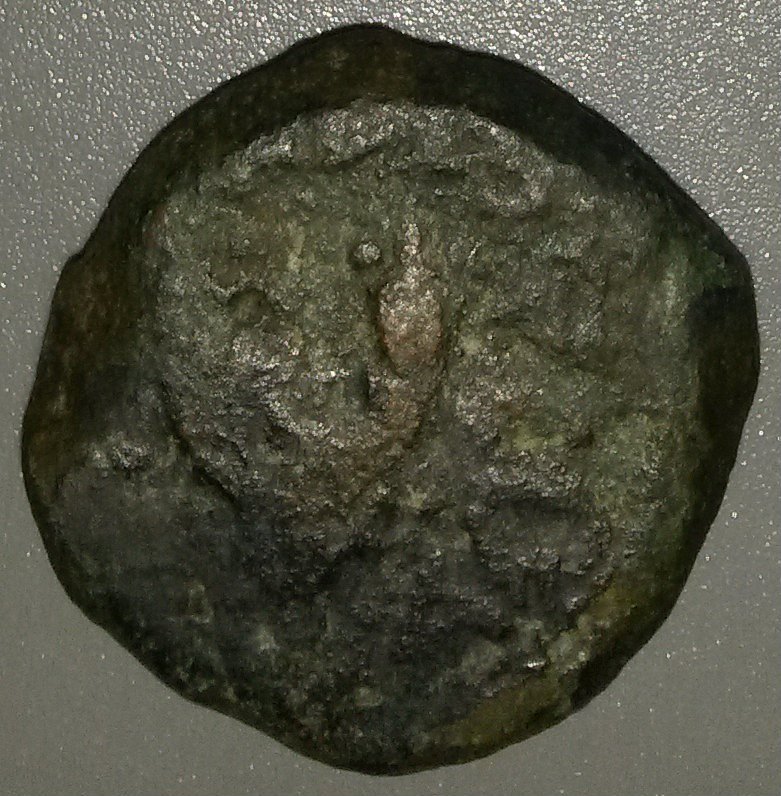

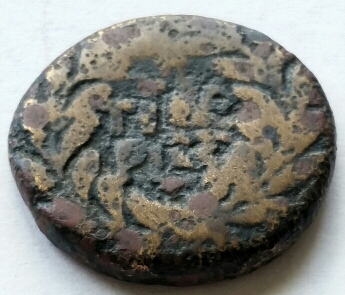
Kingdom of Judea, Hasmonean dynasty, Mattathias (Mattatayah) Antigonus, AE 8 prutot, ca. 40-37 BC
Hendin 1162 (formerly 481),
Numista 108817; 24x22 mm, 13.85 g
Bought from a 150 ruble (~$2.5) bargain bin at Hobby Market in Moscow
(The following text is mainly based on what I usually say at the mini-lectures, plus a bit of making it up as I go; which admittedly is how said mini-lectures tend to work in the first place.
As such, I apologize in advance for any resulting historical errors.)
(I also apologize in advance for the style. For some reason I'm not in the mood for writing it out properly.)
Anyway, the Hasmonean dynasty - you've heard of the Hasmonean dynasty, right? No? That's the Kingdom of Judea, no, not
that Kingdom of Judea, the other one, besides, that one's actually the Kindgom of Judah... whatever.
Founded by the Maccabees, which you
might have heard about, because they're in the Bible. I think. Haven't read it in years.
Anyway, they're the ones who finally got independent from all the Persians and the Macedonians and the Seleukids, in around the second century BCE, and they kind of just were there for a while.
Then the Romans came in and tried to make it part of the Empire, um, I'm not sure, it might have still been the Republic at that point? And they didn't quite get it, and they tried again, and again, and eventually they got all tired of it and just came in with a huge army.
And leading that army was Herod the Great; you've definitely heard of
that guy.
So anyway, about the coins. The Hasmoneans didn't really normally make any big coins, only small copper ones, like the lepta - you've heard of leptas, right? That one is definitely in the Bible.
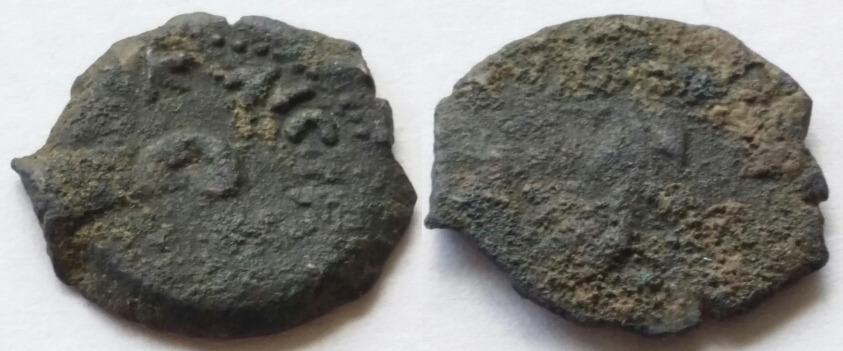
I think I have one of those here, though it might be actually two leptas, not sure, and it has a lot of very small letters on it that I can't read so I'm not sure what they actually say.
(It's from the same bargain bin, so it's stored in the same ziploc bag, and thus when I'm showing this coin I usually can show that one too. Should take a pic of it someday - it seems to be either an overstrike or a double strike, and I can't read enough of it to tell.
For the record, it weighs 2.02 grams, so it's a prutah, but I could hardly expect most of the people I showing it to to know what a prutah is, while they
can usually get "two leptas", especially since that's what the Biblical quote says in the first place.)
Anyway, the Hasmoneans only made small coins, but then the Romans came in. The Romans never really were much about small copper, not until the fourth century anyway - which is another story entirely - but they sure did like their big copper.
So when Herod started conquering Judea, he also started making new coins for it with his name, and he didn't just make the normal coins of like one lepta and two leptas, but he also made much larger coins, all the way up to
sixteen leptas.
And at the time, the previous ruler of Judea had just died, so they got a new one, Mattatayah Antigonus. I mean, Mattatayah was his Hebrew name and Antigonus was his Greek name, not sure why he had two, but whatever.
And apparently Mattatayah Antigonus decided that Herod's new huge coins were actually a nice idea, because he ended up making some huge coins of his own.
So he continued making the old small coins of one lepta and two leptas, and he also made new large coins of eight leptas and sixteen leptas, same size as Herod's coins, but with his own designs, and with his name, yes, both of them, one on each side. They mostly didn't actually fit. It's a common problem with ancient coins.
And this coin you see here? Mattatayah Antigonus, sixteen leptas. You can see how thick it is. They had to make special casting lines for the planchets, and then they broke the planchets off the lines before striking them, and it wasn't very even, so this one ended up with those two little bumps where the line was, see? Very interesting coin.
So, as you probably can guess, Herod ended up winning. It took about three years, approximately from 40 to 37 BCE, because the Jews of Mattatayah Antigonus
really didn't like being conquered by the Roman, um, still not sure if it was already the Empire by that point but it might as well have been either way, but Herod did have a much larger army, so basically he won.
And that means Mattatayah Antigonus only ended up reigning for three years, most of which he was frantically trying to defend his country from Herod's army. So his coins are kind of uncommon, especially the new larger ones, though I think the smaller ones were too, don't recall exactly.
Anyway, Herod won, and kept ruling until he died in 4 BC, yes, I know that doesn't work, that's because Christ wasn't actually born in 1 CE, if he really existed, I mean, but someone got the calendar wrong in like the 6th century and it stuck.
Herod was succeeded by a relative, forgot who exactly, and I think he was also called Herod so it's a bit confusing, and then there were a few others, I don't recall much about them.
Then eventually around 70 CE the Jews got totally tired of being under the Romans and rebelled, and it didn't really work out for them because the Roman Empire, definitely the Empire by then, got an even more huge army and basically destroyed everything, including the Second Temple, by the way. But that's a completely different story entirely.
...Yes, I know, this huge rant, um, I mean mini-lecture, is probably full of assorted historical errors. (Also it's in terrible style.)
In particular, it makes zero mention of Parthia, because I only found out about their involvement while researching stuff for this post today.
But yeah, last ruler of independent Judea before Herod came in, or, rather,
while Herod was coming in? And a new huge denomination apparently made to compete with Herod?
It's hard to get
more historically significant than that. Not on the level of my collection, anyway.







 First Page
 Previous Page


 Posted 08/29/2018 11:51 am