| Author |
 Replies: 9 / Views: 5,270 Replies: 9 / Views: 5,270 |
|
|
New Member
United Kingdom
13 Posts |
I've have recently begun searching through my great-grandfather's huge world coin collection when I came across this. It has an ottoman name on it and some Arabic writing but is roughly cut and I think may be a fake. If anyone knows what it is or has any thoughts I'd be very grateful. 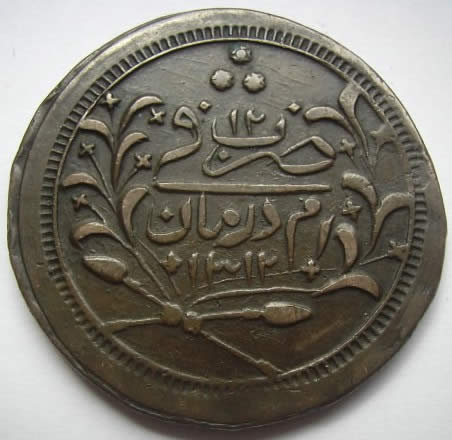 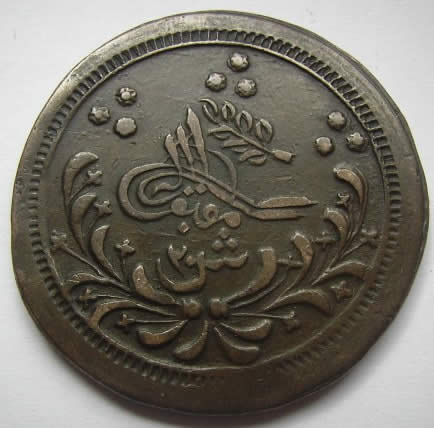 Edited by Sap
05/08/2008 04:33 am
|
|
|
|
Pillar of the Community
United States
5318 Posts |
I agree with your sentiments...I'm far from an Ottoman expert, but something about this says modern repro (in particular the denticles and relief detail).
Judging by the inscription, I'll guess it's supposed to be an Egyptian Ottoman coin...and perhaps made locally for the tourists?
Edited by KurtS
05/06/2008 3:48 pm
|
|
Moderator
 Australia
17005 Posts |
I can't read the mint name. I'm not sue if it's supposed to be gibberish, or simply my poor Arabic reading skills.  The date is blundered, too. I can't tell if that's supposed to be 1212, 1312 or 1412. But the denomination beneath the rather crudely drawn toughra is "20 qirsh" - which is supposed to be a largish sized silver coin. That, plus the generally crude rendering, makes me almost certain it's some kind of imitation. Don't say "infinitely" when you mean "very"; otherwise, you'll have no word left when you want to talk about something really infinite. - C. S. Lewis
|
|
New Member
 United Kingdom
13 Posts |
Thats pretty much what I thought, I thanks anyway!
|
|
Pillar of the Community
United States
645 Posts |
It's supposed to be Sudan-Omdurman mint 20 Piastres. 1312(12) KM#15, struck in copper, silver washed copper or billon.
Krause notes many die varieties exist, but this one is so crude I'd be very surprised if it were authentic.
|
|
Moderator
Australia
17005 Posts |
Looks like it was my poor Arabic skills, then. Didn't think of looking under Sudan.  It actually looks a fair enough example, compared to the picture in Krause of KM# 15. These coins were struck towards the end of the Mahdist regime, and are indeed quite crude. CV for a genuine KM#15 AH 1312 is $20 in VF. So the main reasons left for considering it fake is the metal; it should look more billon (black-grey) than coppery brown, and the generally smooth, cast-like appearance. These coins are normally found as crudely struck as they are crudely designed. Personally, I think it warrants a silver test just to be sure. If it comes up even slightly silver, I'd suspect it was in fact genuine. Don't say "infinitely" when you mean "very"; otherwise, you'll have no word left when you want to talk about something really infinite. - C. S. Lewis
|
|
New Member
United Kingdom
13 Posts |
Thanks again Sap and DCH you've been a great help!
|
|
Pillar of the Community
United States
5362 Posts |
123heather321 Just saw the post and wanted to put in my Two Cents. Unless the coin is pure copper, which I doubt, it is in my opinion real. Die style is correct and the die work is consistent with other Sudanese coins in my collection. Billion is a VERY difficult metal simply because it is not a standardized alloy. I have billion coins that could pass for copper. The color varies widely but looks OK to me. The punch used to make the planchet looks like it was VERY dull. That is the ONLY feature that makes this coin look a bit odd. It appears that the first pressing was very shallow and left an impression. I have seen that on other low value Ottoman era coins.
|
|
Pillar of the Community
United States
5318 Posts |
OK...I think I'll just stop commenting on coins I know nothing about. |
|
New Member
United Kingdom
13 Posts |
Swamperbob, many thanks you've also been a great help!
|
| |
Replies: 9 / Views: 5,270 |
|










 Posted 05/07/2008 03:42 am


