The creation of the mint house
A few months before the Leicester mint paper promulgated in 1586, the West Frisian cities tried to get permission from the States-General for the creation of a coin house. They sent the pensioners of Enkhuizen, Dr. François Maelson, to The Hague to obtain approval for their plans. His journey was in vain because the States General did not intend to allow a second coin house in Holland. Subsequently, on August 4, 1586, a new minting legislation was introduced which became known in the form of a poster. This new mint leaflet is called Leicester's coin leaflet. In this poster it became clear that in Holland and West Friesland together only one mint was to be active. However, the West Frisian mint was created. This shows that in the beginning, the States-General and the States of Holland had not yet had much power and influence over major and important (commercial) cities.
The deputies of Alkmaar, the capital of the Northern Quarter, decided that the newly created mint should be established. The commissioned councils of West Friesland, however, resided in Hoorn and decided that the mint had to be established there. It was decided on August 8, 1586, that the mint would go to Hoorn for three years and after three years to Alkmaar and Enkhuizen. That same day, Balthasar Wijntgens, then a coin master in Overijssel, was accepted as the new coin master of West Friesland. Already in 1587, Hoorn, Enkhuizen and Medemblik concluded a covert agreement for "eternal days" cooperation. It was agreed that the mint would be protected by al means to secure the coinage for West Friesland. In August 1589 the mint had to be moved to Alkmaar. When this date was getting closer, the three West Frisian cities began in March 1589 a dirty politics game. The underlying thought was to keep the mint in West Friesland. At the meeting of the committees, they submitted a proposal to reduce the number of members of the college to five. As a reason, they incurred cost savings. According to their proposal, Alkmaar, Hoorn, Enkhuizen and Medemblik would have one member, and the cities Edam and Monnickendam together had one member (Purmerend had no right at all to attend the college). The actual purpose of this proposal was to reduce the influence of Alkmaar (and other cities). After a three-year political strike, an agreement was reached in July 1591, where the three West-Frisian cities received a majority in the college of committed councils, leaving Alkmaar completely out of the question of the minting. During the scribble over the West Frisian coin, Alkmaar tried to get permission to open a coin house for the Groningen market, but that didn't went well.
The mint offices
The city of Hoorn has held its mint since its inception in 1586 until 1603. She was located there in the buildings of the St. Catharinian monastery. The street would later be called the Munt Street. Only in 1603 the mint moved to Enkhuizen. She was located here in a building on the old Westerstraat 125 opposite Sint Gomarus or Westerkerk. Prior to that time, this residence had been assigned since 1425 to the confessor of the nuns of the nearby women's monasteries. The mint had to share the building with the Admiral Men. A few years later, in 1611, the property was completely furnished for the minting because it would return to Enkhuizen on a regular basis. From 1619 the coin went to Hoorn and Enkhuizen every turn.
Medemblik was the smallest and least important city of the three West Frisian mints. This has not always been the case in the past. Medemblik is the oldest city of the three (city rights in 1288). In a letter owritten on 26 June 985 is already spoken of Medemblik. King Otto III gave Count Ansfried a share of the profits from the mint in Medemblik. However, no coins have yet to be found from this period, which are found to be issued in Medemblik. However, a lot of pennies of Floris V still exist from the period 1290-1296. There are types with markedly the place of origin on the backside: MONE MEDEMBLEC. This is also the last medieval coinage known in Medemblik. Almost 400 years later, the city once again got a coin house within its walls. Despite agreements made with Hoorn and Enkhuizen, Medemblik only received the coin house for the first time in 1655. Jan Jansz, de Zee, the mayor's son, received the honor to issue the first Ryksdaalder(Dollar). In the city, only the name Muntstraat remembers that once the mint was located here. In 1665 it was decided that the mint would change city every ten years. The mint has thus produced until May 1, 1796, as a mint of West Friesland. After that date, she became a second Dutch mint that produced for the Batavian republic. Finally, in 1809 the mint was finally closed and the inventory was sold publicly.
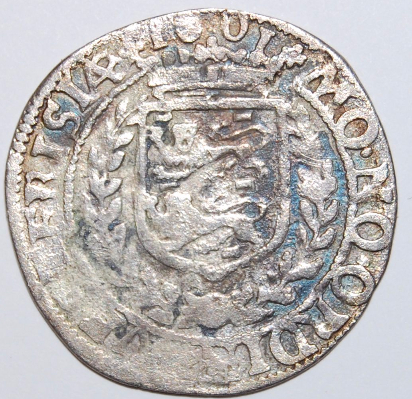
Obv: West Frisian coat of arms within a surrounding made out of leafs.
Legend: MO.NO.ORDIN: WEST.FRISIAE. 1601
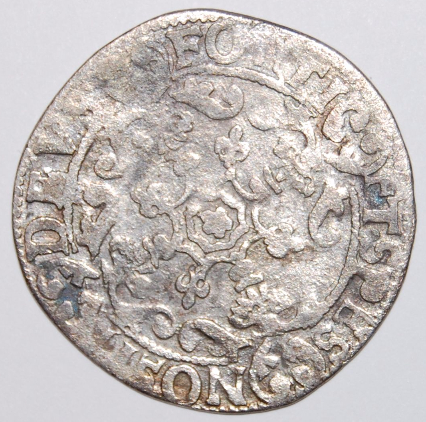
Rev: Decorated cross shaped figure
Legend: DEVS FORTIET SPES NOSTR
Diameter: 31mm
Mass: 3,96 gramm
 *** Moved by Staff to a more appropriate forum. ***









 Posted 10/28/2017 5:46 pm


