Excellent work conserving that SCD, TNG!!
Here is my latest add.
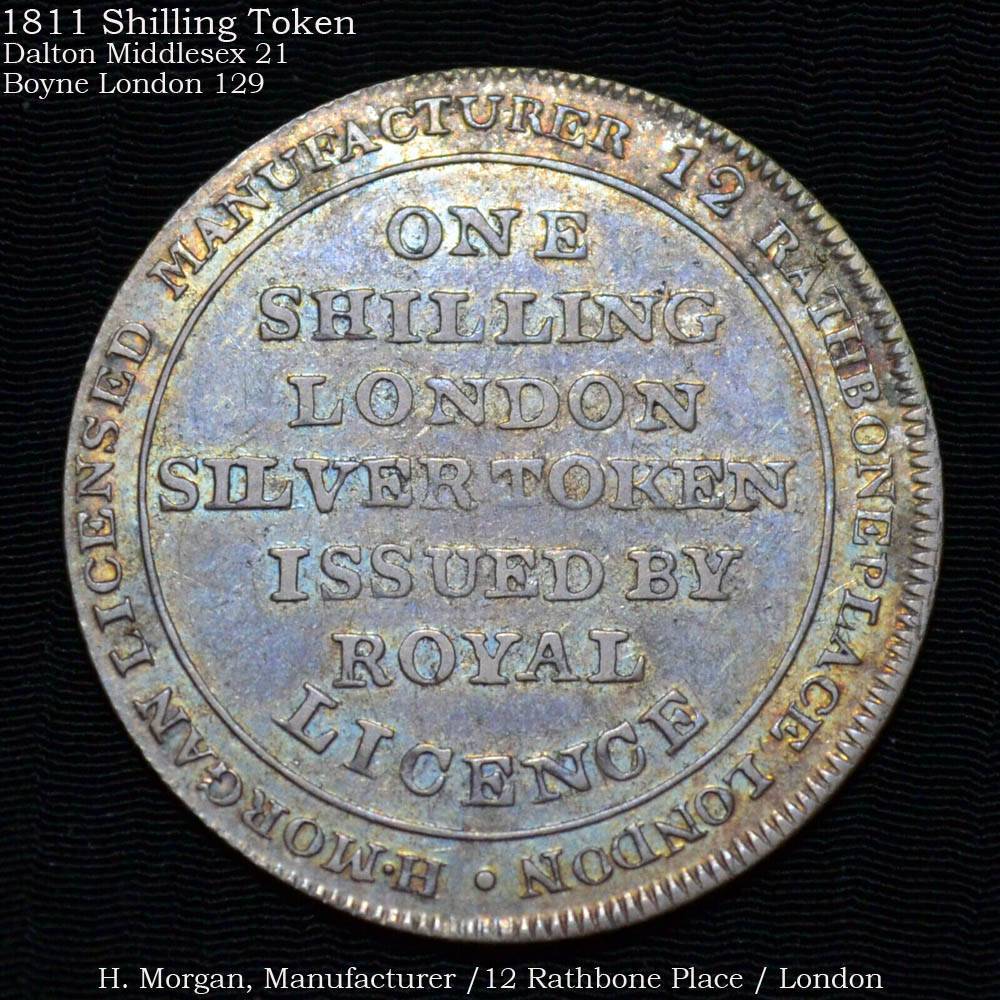
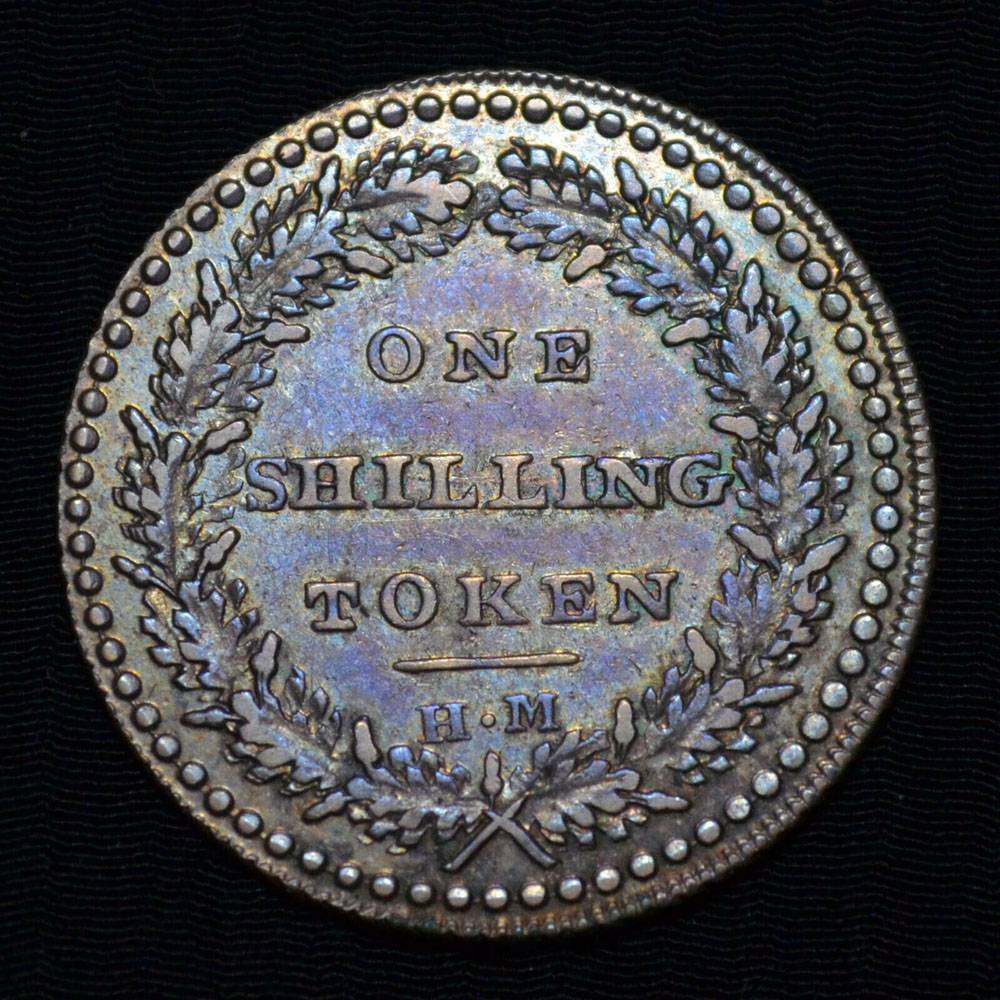
This silver shilling token was struck in London by "Henry Morgan", a prolific die-cutter and manufacturer of tokens for businesses and merchants to use. Dalton provides several original advertisements such as this one dated 12 October 1811:
Quote:
TOKENS OF SILVER for the convenience of Change, of an elegant and highly approved design, suited to general circulation, are made and sold by ROYAL LICENCE and AUTHORITY, and Dies for Tokens, engraved according to any wished for Design, by directing to H. M., Die Cutter and Medallist, No. 12, Rathbone Place, London.
N.B. Tokens will be sent free of every expence, in return for a remittance, and all letters must be prepaid, or will be returned unopened to the General Post Office.
This particular token was an advertisement itself; the so-called "Morgan's Shilling" turns up as an issue for quite a few other places (including Wales) with a city arms design or a local merchant's information. Morgan's firm advertised that they would strike tokens in any design for pretty much anyone, and apparently, this offer was well-received.
The only problem with all of this is that "Henry Morgan" may, or may not, have actually existed. He may have been a real person, but may have also been a collective fake name used by two or more scammers operating out of the area, or even an identity created by other (real and respected) token makers as a front to issue counterfeit tokens.
Numismatic author Andrew Wager published a book on this precise issue in June 2008 and documents his research and detective work quite thoroughly. I won't spoil the book here.
When these early issues were struck (1811) the weight and assay supported the denomination; however, drama was soon to follow. Prominent local merchants and tradesmen, including other die-makers, accused Morgan's firm of manufacturing and issuing large numbers of counterfeits of other firms' (legitimate) tokens. Underweight, debased, and altered tokens were becoming more and more prevalent, shaking the public's confidence in the entire token system, and "H. M." seems to have been the source. In some cases, the more egregious counterfeits even featured entirely fictitious (but plausible) entities and businesses, with nonexistent addresses, making "redemption" impossible. Not that he was the only one -- a number of enterprising crooks caught on quickly to the profitable idea of melting down regal copper and silver coinage and striking debased or underweight tokens.
Dalton notes that the outcry resulted in public censure and a strident warning to Mr. "Morgan" that the deception was known, and that if the manufacture of these debased tokens continued, the names of the individuals behind the crooked tokens would be made public -- no idle threat, with penalties ranging from penal transportation to death by hanging if convicted. Not surprisingly, perhaps, into 1813 Mr. "Morgan" and his firm apparently decided to get out of the token business.
The public furor created by this debacle -- as well as similar issues with counterfeit copper merchant tokens and the mass melting of older regal and Soho copper coinage to strike new private tokens -- was one of the factors that would lead to the resumption of regal coinage in 1816 (for silver issues) and 1821 (for copper issues.)
 References:
Dalton, R. "The silver token-coinage mainly issued between 1811 and 1812"
Wager, A. "The Mystery of Henry Morgan: A Numismatic Detective Story"







 First Page
 Previous Page


 Posted 02/24/2019 3:22 pm