| Author |
 Replies: 35 / Views: 12,972 Replies: 35 / Views: 12,972 |
|
|
|
Pillar of the Community
Australia
3841 Posts |
Will you be editing the information about the Russo-Korean Bank coins? It does make sense now considering that the bank was shut in 1899 and these coins were struck in 1901.
Edited by gxseries
01/29/2018 11:23 pm
|
|
Valued Member
 Korea, Republic Of
489 Posts |
Quote:
Will you be editing the information about the Russo-Koran Bank coins? It does make sense now considering that the bank was shut in 1899 and these coins were struck in 1901. Yeap! I can't add it to the video itself, but I'll add it to the description. Spreading the good work of Korean coins! |
|
Valued Member
United States
413 Posts |
I really enjoyed your video on Korean coins!
I just have one wee question for you: Is yang (I think I got this word right) same as won or similar to China's yuan and Japan's yen?
Is yang far worth more than won? Or it is simply a historical currency that has no equivalent in current Korean currency?
Thanks!!
PS I have googled this but do not get much information that I am satisfied with. :(
|
|
Pillar of the Community
Australia
3841 Posts |
The equivalent of a Chinese yuan and Japanese yen is meant to be the Korean hwan. 1 hwan coin was released in 1888 but was proven to be very unpopular. 1 hwan is the equivalent of 5 yang. In 1892 5 yang coin was struck (mintage of less than 20,000) and in the following year, 1 hwan coin was struck. For some reason only 77 of the 1 hwan coin remain and the rest was melted. It was soon replaced by the Japanese yen coin. It is most likely that the Korean mint struggled to strike enough coins at a budget. While 1 won is supposed to be equivalent of 5 yang or 1 hwan - they never really existed / circulated at the same time. More information can be read here: https://en.wikipedia.org/wiki/Korean_currencyMy partial coin collection http://www.omnicoin.com/collection/gxseriesMy numismatics articles and collection: http://www.gxseries.com/numis/numis_index.htmRegularly updated at least once a month. |
|
Valued Member
United States
413 Posts |
@gxseries,
Thank you for your informative post. It does not really answer my question.
I tried to open the link you posted but I could not get it to open?
Hopefully, Lembafc could be able to help us out.
The reason for asking this question is that some Korean drama programmes (or shows) keep mentioning yang or nyang. I know Koreans did use mon coins like Chinese, Japanese and Vietnamese did.
Hence, my question....
Thank you for your kind efforts to answer my question.
|
|
Pillar of the Community
Australia
3841 Posts |
This is odd. If you copy and paste the link, it works fine. Maybe CCF's redirection is not working properly. To explain why it is no longer mun, the old currency mun had to go as the public had little faith in their own currency. It was well known that some mints were defrauding the public by melting down good quality copper coins to cheap debased coins. It is speculated that one good quality coin was melted down to make THREE coins at the same face value. The denomination yang was only introduced in 1892 and disappeared by 1902 when Korea's currency slowly favored Japan. The real difference is with the yang is that silver is introduced in the mix for general circulation and this at least raised the public's perspective of having 'good quality coinage'. 1 yang is supposed to be in the techical weight of 5.2g of 90% silver 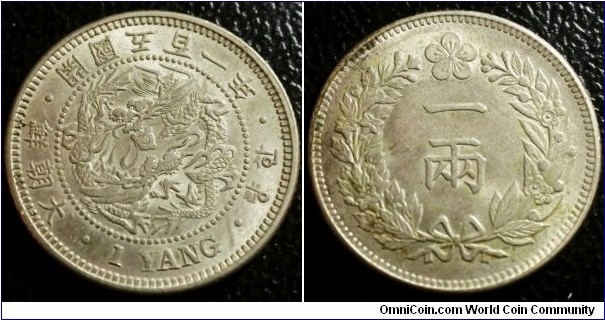 The 5 yang coin (1 hwan) is struck in similar composition as of a Japanese 1 yen coin that circulated at that time. I believe 1 yuan is around the same weight / composition as well. 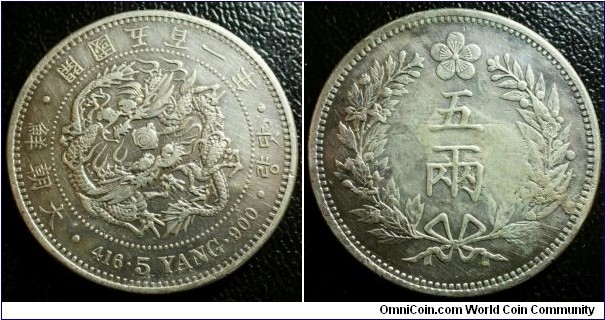 My partial coin collection http://www.omnicoin.com/collection/gxseriesMy numismatics articles and collection: http://www.gxseries.com/numis/numis_index.htmRegularly updated at least once a month. |
|
Valued Member
Korea, Republic Of
489 Posts |
Although gxseries is killing these questions for you, I think you are talking about the Korean dramas with a setting based in the Dynasty. Thus, I think the 'yang' you are talking about is nowhere near as valuable as the 'won' since the won didn't exist then.
Korean currency is broken down into insanely fractionized(not a word I know) coins. During the Joseon period, 20kg of rice was bought with 1 Yang(Niang). NOT the 1 Yiang you see in the pictures, however. 1 Yang is broken down into 10 Jeon, which was then broken down into 100 Pun. So in the Korean dramas they are talking about big bucks when they mention the Yang. Imagine that one Yang can pay for 20kg or rice. That is a lot of money back then.
When coins transition out of Joseon Dynasty and into the Korean Empire/Japanese occupation, I am well outside of my safe zone. There was just too much going on in the period between the end of the Joseon Dynasty until Liberation; especially with regards to currency.
|
|
Bedrock of the Community
United States
12477 Posts |
Quote:
Korean currency is broken down into insanely fractionized(not a word I know) coins. That's part of what makes it difficult to follow (along with other systems!). Also, I think that the most acceptable word is fractionalized. I could be wrong, but it sounds the best to me.  In Memory of Crazyb0 12-26-1951 to 7-27-2020
In Memory of Tootallious 3-31-1964 to 4-15-2020
In Memory of T-BOP 10-12-1949 to 1-19-2024
|
|
Valued Member
Korea, Republic Of
489 Posts |
I should try to research hard into this and make a video that connects all of the currencies together. LOL
Thanks, you are right. Its fractionalized.
|
|
Valued Member
United States
56 Posts |
|
|
Valued Member
United States
56 Posts |
There are 2 varities of the 5 Mun, besides the white metal stuff. One minted in Yr 495 and 497
|
|
Pillar of the Community
Australia
3841 Posts |
The coin dated 1886 is a pattern whereas the 1888 5 mun was struck for circulation. 1888 5 mun coin 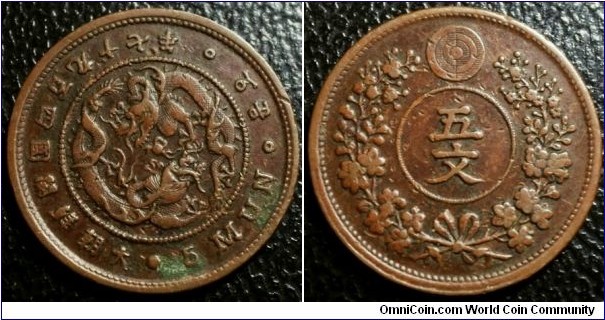 My partial coin collection http://www.omnicoin.com/collection/gxseriesMy numismatics articles and collection: http://www.gxseries.com/numis/numis_index.htmRegularly updated at least once a month. Edited by gxseries
01/31/2018 8:58 pm
|
|
Valued Member
Korea, Republic Of
489 Posts |
I just.... I want all of them. I am super excited for the Hwadong Auction up in March.
|
|
Valued Member
United States
413 Posts |
@ Lembafc, thank you for answering my question re: nyang. Yes, you are correct about the Korean drama shows (or programmes) from Joseon era. I do not watch them much but I often wondered how much valuable nyang was, etc... I do know all about the mon or mun (similar to cash in China). I wanted to make a sense of nyang.
@ gxseries, I was able to clink on the link you posted here next day. I had read this wiki before. I was not satisfied with the information. That's why I asked the question especially when Lembafc posted a video about old Korean coins from Joseon era.
Thank both of you for taking time to answer my enquiry!! Appreciate it very much!
|
|
Valued Member
Korea, Republic Of
489 Posts |
@Carrigna, I am glad you found the info you needed. :) I very much love Joseon and Goryeo Dynasty coins and have thousands of them, so if you ever have any questions, ask away~~
|
| |
Replies: 35 / Views: 12,972 |








 First Page


 Posted 01/29/2018 8:26 pm


