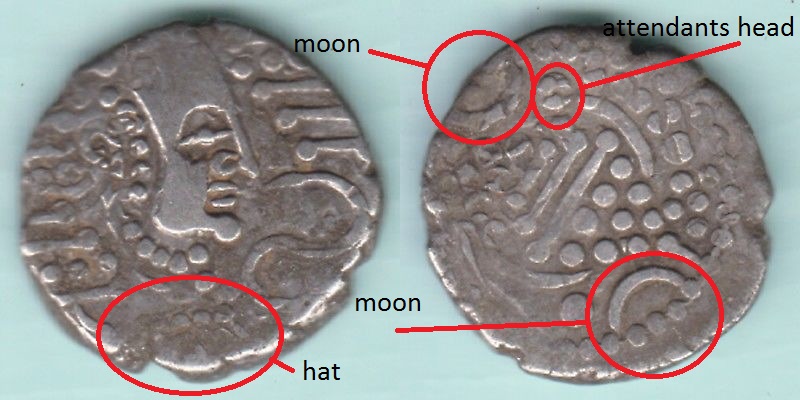
Exactly right, Paul! Thanks for making that illustration; I haven't had much time in front of my computer lately.
I do however, have access to a pen and post it notes!
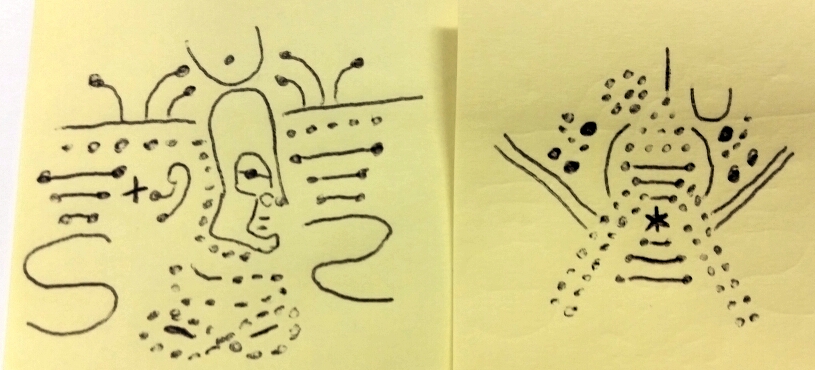
I sketched up this quick approximation of the die; it's not fully to scale because I am not a good artist, but the gist of it is there.
The question of the "hat" is tricky for these. At some point very early in the series, some king (or celator) decided to ditch the Peroz-style winged skull cap for
an awesome winged sombrero! 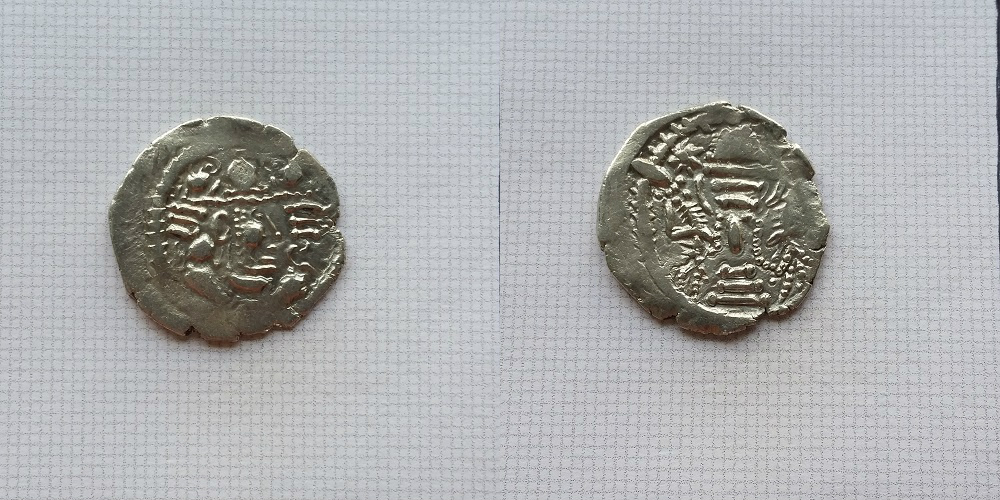
The hat itself was lost, but the sombrero brim was retained to the bitter end; the wings merging with the brim as those weird crescent shapes. The orb above the head (a prominent feature of the Peroz drachm) was also retained to the end, although not many coins show it until it's just a very small dot and crescent.
At any rate, you can very prominently see the rim of the original strike where the curvy part of the rear ribbon should be on the obverse. Note part of the wing at the edge of the flan. Using that as a baseline, what you have circled as the hat is the orb (somewhat obscured by the necklace of the second strike) and a very faint ghost of the original portrait can be seen beneath that, the eye and lips obscuring the ear of the second strike somewhat.
The reverse is basically just the flame and bowl of the fire altar flipped around.
And @Ron, it does indeed look like a Hun portrait; that's the great mystery with these coins.
That the originator of these coins were some sort of Hunnic tribe is fairly clear; after all they owned and controlled most of the Peroz drachms out there. Maheshwari argues that the originator of the first coins were the Gurjuras, which he calls a kingdom or tribe that originated in central Asia and were subservient to the Hepthalites and/or Alchons. The Alchons were driven from India in the mid 6th century, but the Gurjuras (perhaps because they did not loot temples for treasure?) blended with the population. He argues that was the basis of the "Indianization" into the Gadhaiya coins.
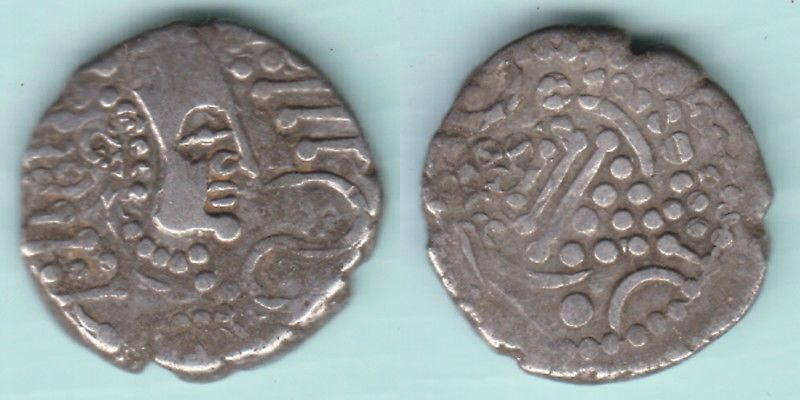
Any way, while all Inso-sassanian coins have pretty weird looking heads, this series in particular stands out. There isn't much artistic basis for the elongated cranium, so I believe they reflect an
actual preference for infant head-binding, at least among the ruling class... this was very widespread in central Asia, but I haven't been able to find any literature on how common it was in India. It is not reflected in the artwork of the period, at any rate.









 Posted 02/07/2018 5:37 pm