Two of my major purchases at this year's annual coin show here in Brisbane were these two coins, bought from two different dealers and from nations at opposite ends of the ancient world from each other, but together they tell a story of ancient trade routes.
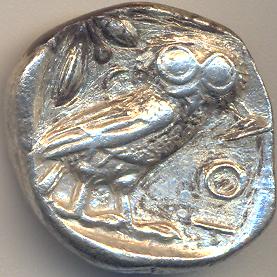
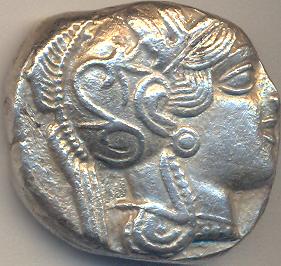
First up, is an example of the famous "owl" tetradrachm of Athens, circa 430 BC. This coin was one of the world's first "
Trade dollars", widely accepted throughout the ancient world. Hoards of them have turned up in Egypt, where the concept of "coins" was slow to catch on; each and every one found in such hoards has been treated as bullion, gouged and cut so the Egyptian merchants could assure themselves they were solid silver.
Fortunately, my example was spared such indignity, but it has been somewhat harshly cleaned, as evidenced by the scour marks on the reverse field. It was presumably covered in tough encrustations, or possibly even corrosion, after being buried for over 2000 years.
Secondly, is a drachm of the Sabaeans, an Arabian tribe living in what is now Yemen, southern Arabia. A land that most Greeks would have regarded as, if not at the Ends of the Earth, then a lot closer to the Ends than they themselves were. This was the homeland of the biblical Queen of Sheba, who visited King Solomon.
Their first coins were copies of Athenian tetradrachms. The early designs were quite good copies, too. The only "local modification" the Sabaeans made was adding a mark of denomination on the obverse: the lightning bolt shaped "scar" on "Athena's" cheek is a Sabaean letter-numeral, indicating this is a 1 drachm piece; other letters were used for half, quarter and eighth-drachm pieces.
The use of Athenian designs on coins struck 2000 miles away from Athens (as the crow flies) demonstrates the extent of ancient trade routes in those days; the Sabaeans reaped great profit from acting as middlemen between the ancient civilisations of Europe and India. Yet while the Sabaeans copied the design of the tetradrachm, they didn't copy the fabric. The Sabaean drachm was closer in weight, size and shape to the Persian siglos, rather than an Athenian drachm.
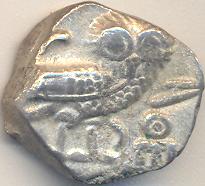
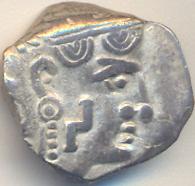
Pictures made with HP 3770 scanner at 300 dpi, and should be at the same scale as each other.
Don't say "infinitely" when you mean "very"; otherwise, you'll have no word left when you want to talk about something really infinite. - C. S. Lewis







 Posted 05/27/2008 3:04 pm





