| Author |
 Replies: 7 / Views: 1,287 Replies: 7 / Views: 1,287 |
|
|
Valued Member
Belgium
54 Posts |
Hello fellow collectors, What do you think of this example. Cleaned or not? The edge has some white/greyish residue in between the "reeds". I dipped a qtip in acetone and tried it on a small part of the rim because from experience I know that residue from copper cleaning agents get clogged in those spaces. Once the acetone evaporated, light white/greyish spots appeared. You can also see some in the A of LA and around the LD of LEOPOLD. The coin doesn't really look like a very harshly cleaned example. There is some lustre and I don't really see a lot of hairlines which sometimes is a bit harder to detect on copper coins compared to silver ones. But I know there are some collectors here who have a wonderful eye for detecting cleaned coins :) Thanks! 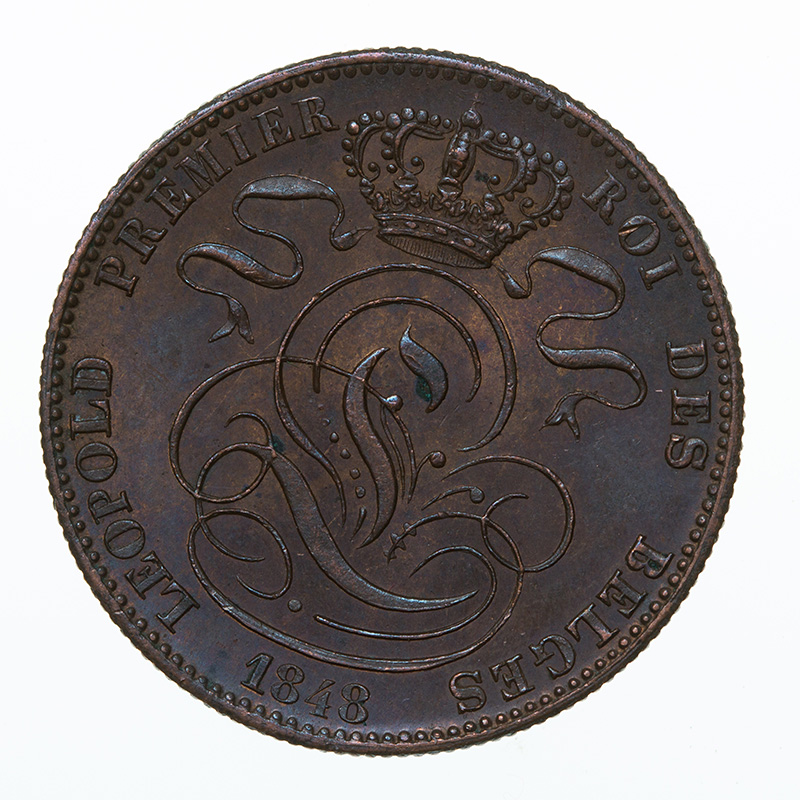 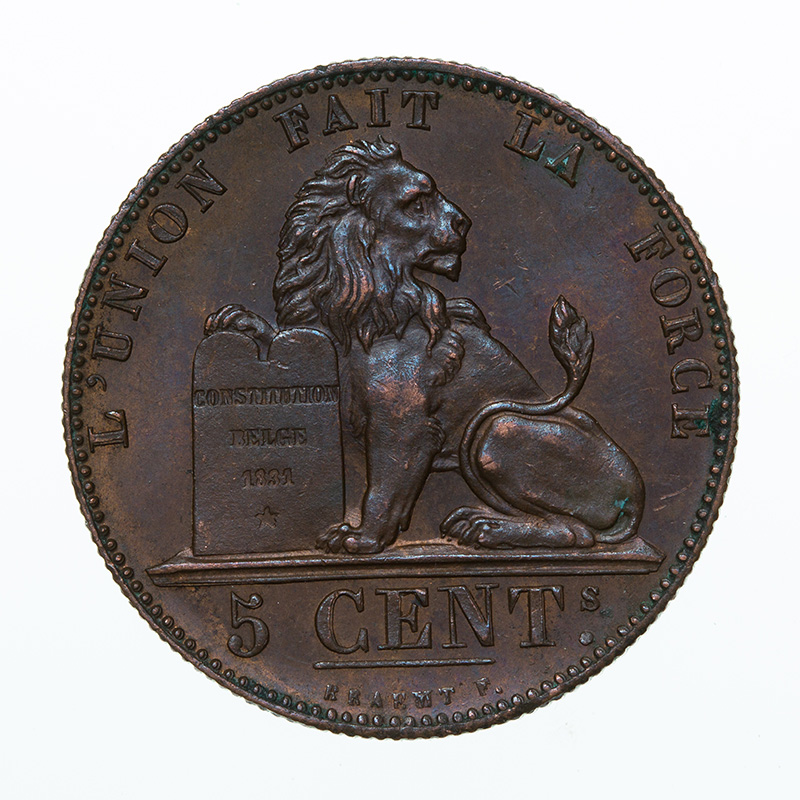 Edited by jagoedo
05/16/2018 04:08 am
|
|
|
|
Pillar of the Community
 United States
6514 Posts |
I am not an expert. Compared to the couple of examples of cleaned copper coins I've seen on this site, this one does not appear to be. Perhaps because it was done very well or not at all. Someone that knows much more than I will be along shortly .  |
|
Bedrock of the Community
Australia
21792 Posts |
I don't think it has been cleaned.
|
|
Pillar of the Community
Australia
1333 Posts |
I dont believe it has been clean, however not an expert on this type, copper oxides can appear on coins naturally. Maybe you feel that the coin has a strange tone (rainbow) that only appears in one direction. I have no idea what is the cause, but have seen that tone on a couple of copper coins, note I know what an actual tone coin looks like (usally effects the surface of coins but in wouldnt just appear in one direction)?
|
|
Valued Member
 Belgium
54 Posts |
Thanks for the comments Well it's not because of the toning. The toning looks fine to me. It's more because of the white/greyish residue between the reeds on the edge of the coin which I mostly find on cleaned coins because you can't get those reeds properly cleaned after applying a cleaning agent. I'll add 2 more pictures to clarify what I'm talking about 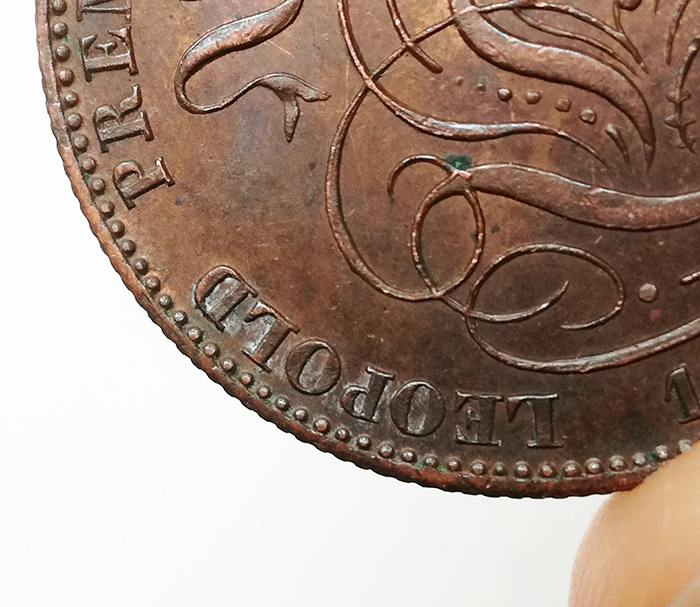 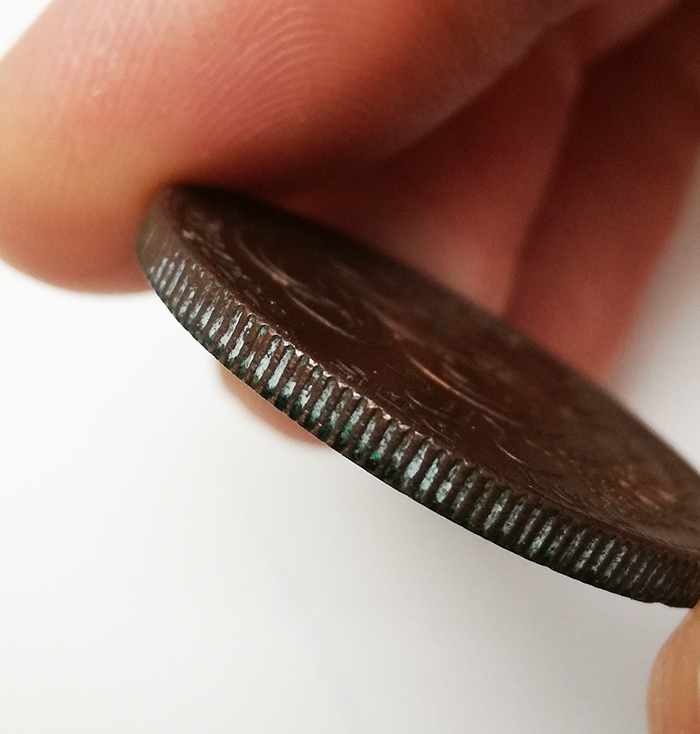 Edited by jagoedo
05/17/2018 02:09 am
|
|
Bedrock of the Community
Australia
21792 Posts |
A mild form of bronze disease (verdigris).
It should be easily passivated by treatment with Verdicare.
Import a bottle from United States.
Not a serious problem (yet).
This coin sufficiently valuable to be worth saving from the damage that verdigris can cause.
|
|
Valued Member
Belgium
54 Posts |
Thanks for the tip. You think it will remove those spots from the coin? Does acetone react with verdigris because it only shows after applying acetone. From what I've read acetone should not react with verdigris.
As far as I know verdigris does not cause damage on itself? Or am I mistaken?
ps. tried to remove the residue inside the reeds (wont try it on the coin surface) and works very well with a tooth pick so I think it's something else than verdigris?
Edited by jagoedo
05/17/2018 1:51 pm
|
|
Bedrock of the Community
Australia
21792 Posts |
OK to remove powdery verdigris from the edge reeding with a wooden tooth pick or tooth brush, but do not do this anywhere else on the coin.
If it is not verdigris, giving it a long acetone bath is certainly a try. Acetone will remove dissolve organic substances. There is no guarantee that acetone will make any difference in this case, but it won't do any harm.
The problem with some organic substances, is that over time, they can form organo-metallic complexes, which can disturb the surface of the coin.
This is why, for instance, fingerprints remain as permanent stains on a coin. The natural oils in human skin are acidic.
Proceed after that with Verdicare.
Edited by sel_69l
05/17/2018 7:51 pm
|
| |
Replies: 7 / Views: 1,287 |
|






 Posted 05/16/2018 06:43 am





