| Author |
 Replies: 29 / Views: 7,073 Replies: 29 / Views: 7,073 |
|
New Member
Canada
20 Posts |
Hi All, Like a few others who joined recently, I was for many years a member of Canadian Paper Money Forums and a contributor to the Serial Number Database. It is a shame that these valuable resources are no longer available to the collectors. There is a possibility that the CPMF/SNDB sites will be purchased from the current owner and resurrected, but I am not sure this will happen. In the meantime, I would like to ask the members who keep track of prefixes to report any new prefixes in this thread. The listing of most recent polymer prefixes is included below. If you see a new prefix, please add a post and include a scan or image if possible. Thanks!  |
|
|
|
Moderator
 Canada
10476 Posts |
 to CCF!! I will probably subscribe (bookmark) this thread, and while I do not collect paper money, I find the prefix rarities fascinating... "Discovery follows discovery, each both raising and answering questions, each ending a long search, and each providing the new instruments for a new search." -- J. Robert OppenheimerContent of this post is licensed under a Creative Commons Attribution-NonCommercial 3.0 Unported License. See: http://creativecommons.org/licenses...0/deed.en_USMy eBay store
|
|
Moderator
United States
196100 Posts |
to the Community! |
|
Pillar of the Community
Canada
2636 Posts |
Great idea (will do)
thanks
W2W
|
|
Bedrock of the Community
Canada
24885 Posts |
To the Forum. |
|
Valued Member
Canada
258 Posts |
What is the significance of the green, red and black colouring of the prefixes?
|
|
Valued Member
Canada
116 Posts |
Quote:
What is the significance of the green, red and black colouring of the prefixes? I assume the green is the starting prefix for the date/series/signature combination and the red is the last prefix. The black is the range of prefix within the start to ending prefixes. That is why current issues are not in red, but in black suggesting more prefixes to be issued In reality, the colors could be orange purple and yellow... It was the posters choice of color font... As for listing new prefixes...a great idea :) |
|
New Member
 Canada
20 Posts |
That is exactly right, friedsquid. Green is known (in most cases confirmed by the BOC) first prefix and red is the last prefix for each variety. If the last prefix is not marked with red, it is simply the last known prefix.
|
|
Valued Member
Canada
258 Posts |
Thanks for the response.hmm, haven't been collecting prefixes..... yet. Might have to start looking at banknotes differently than before.
|
|
Pillar of the Community
Canada
1928 Posts |
I don't really collect paper currency anymore I still like to follow it. I used to like the replacement type bills but lost interest when they got rid of the X markers. Great idea I might jump back in. |
|
Valued Member
Canada
116 Posts |
Quote:
Thanks for the response.hmm, haven't been collecting prefixes..... yet. Might have to start looking at banknotes differently than before. Just to put my Two Cents in....If you do start collecting prefixes I suggest in trying to obtain the tough ones (short runs/changeovers etc) as they are the ones that have value and collectability. I have known too many collectors collecting every prefix to later discover that they are only worth face value.. Of course if investment doesn't matter then go for it... Edited by friedsquid
05/19/2018 10:56 am
|
|
Valued Member
Canada
116 Posts |
Quote:
I don't really collect paper currency anymore I still like to follow it. I used to like the replacement type bills but lost interest when they got rid of the X markers.
Great idea I might jump back in Just to clarify, the asterisk replacements " * " were in the 54 series and the "X" notes were later. As for the modern day replacements in the Journey series they are within confirmed ranges that can be found in the Charlton Canadian Paper Money Catalogue. These replacements can be sheet replacements or Single Note Replacements (also known as SNR's). As for these, they can be very pricey for the tougher ones. The one thing many collectors of replacements do not understand is that many older replacements are extremely easy to find as they were easily identified and hoarded by not only collectors but bank employess and other other handlers... Common ones can be found at most dealer stores or tables at shows.. Modern day replacements due to the way they are found are not easily identified and many times once confirmed and catalogued new prefixes are out. It is usually the brickers that find these notes and usually are in the best condition before they actually get into public hands and circulate... Edited by friedsquid
05/19/2018 11:02 am
|
|
Valued Member
Canada
111 Posts |
perhaps a centrally organized spreadsheet/google doc that is publicly accessible maybe the best way to collect and display the information. thoughts?
|
|
Valued Member
Canada
116 Posts |
Quote:
perhaps a centrally organized spreadsheet/google doc that is publicly accessible maybe the best way to collect and display the information. thoughts? all the information is already available in the Charlton Canadian Government Paper Money Catalogue...it can be bought or in some cases be found in some libraries... And it is updated each year... Unless someone has an immense amount of time on their hands it would be a big endeavor to take on... |
|
Pillar of the Community
Canada
2636 Posts |
Quote:
If you do start collecting prefixes I suggest in trying to obtain the tough ones (short runs/changeovers etc) as they are the ones that have value and collectability. I've posted a chart of what I know to be the change-overs and short prefixes from data I've collected over the past few years. Please take this info with a grain of salt (its a guide only) and should not be taken for investment purposes. For instance, at one point M/C HBG $5 notes were thought to be very rare but then BOC released millions (so they were not rare at all). 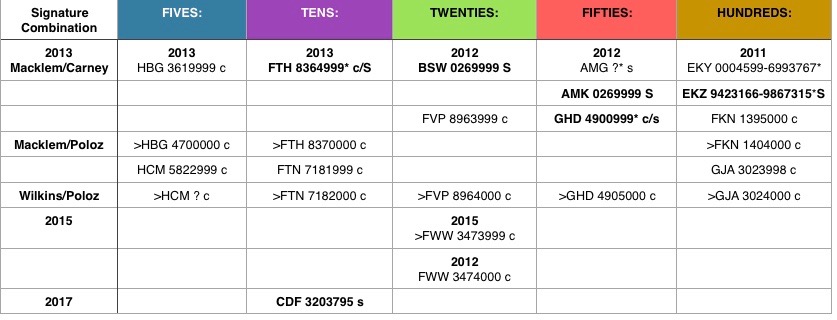 S S = Short & likely rare prefix [bold] s = short but undefined (how rare) prefix c/S = Change over & likely short rare change over (few high/low ranges) [bold] c/s & * = Change over & possible short ranges reported [bold] c = typical change-over prefixes > serial numbers greater than # reported ?= unknown I cannot recall the actual # of $50 AMG so left it with ? but I believe it may be 1.5 million number range |
|
Valued Member
Canada
111 Posts |
shouldn't the bank of canada have this information available?
|
| |
Replies: 29 / Views: 7,073 |





 Posted 05/17/2018 6:03 pm





