About a year ago, in the late spring or early summer of 2017, I took this little kopek - a bargain bin find likely bought earlier in 2017 - to the kitchen to take a good photo in natural sunlight.
However, the moment I tried to take the pic, the smartphone I was using as a camera went "plup!" and shut down. I put it on the charger, went to the computer, and forgot about the coin for an hour.
When I finally remembered and returned, the stack of assorted objects I set up for the photo had already been knocked down, and the tiny silver coin was nowhere to be seen.
...I checked all over the mess of stuff on the kitchen floor, but couldn't find the coin. Each time we tried to clean that part of the floor, we looked for the coin, but never found it.
Until today, when the coin was accidentally found, about four feet from where I thought it was supposed to be, but still just fine, as if nothing ever happened to it at my home.
I proceeded to put it in a ziploc bag (specifically choosing one of higher quality) - but not before, finally, making some smartphone photos...
As I've mentioned, I believe that this coin is overstruck (that is, struck twice with different die sets). So I made two photos of each side, corresponding to each strike.
I also believe that it is probably from the Novgorod issue of Boris Godunov (both reverses could be attributed to this series). As such, I'm using the numeric die designations and catalog numbers listed on
this page (in Russian).
I hope that this would be enough for the gurus here (or, if there aren't any, somewhere else) to attribute both strikes of this weird coin...
Strike 1, obverse
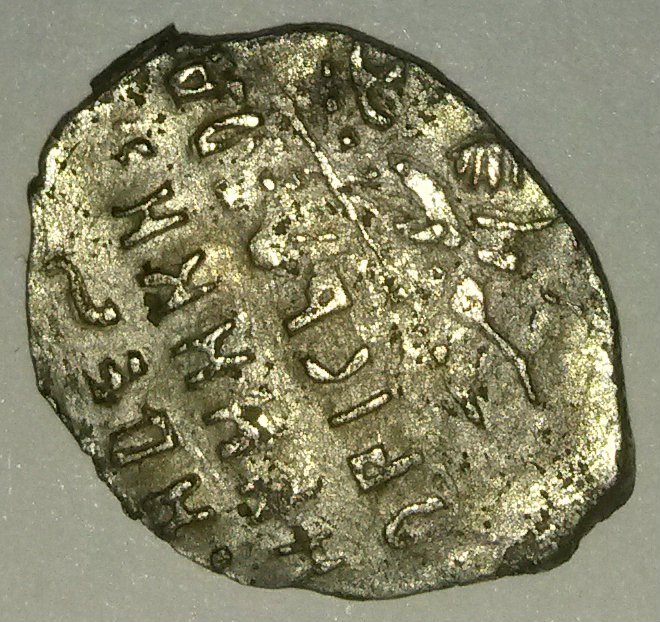
I... honestly have no idea which die this is; it's not much like any of the obverse dies for the period I think the strike is from.
My tentative guess is obverse 2 (7108 AM = 1599/1600 AD), but it could easily be something completely different entirely.
Strike 1, reverse

The spelling ICθE in the third line and the location and shape of the C-shaped letter above it (which is actually the right half of a K) uniquely identifies this strike as reverse 2; assuming that the obverse identification is right, this makes the full strike KG 209.
Strike 2, obverse
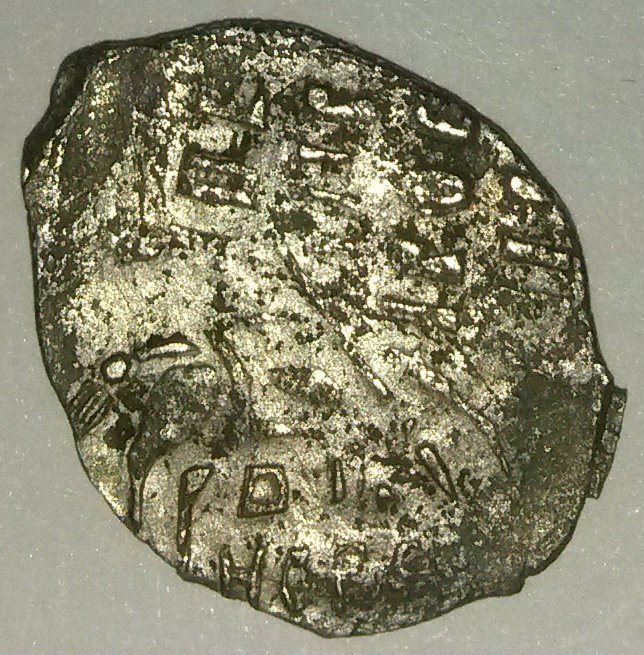
In this case, the date is almost fully visible; it appears to be B/HOPθ, i.e. 7109 AH (1600/1 AD).
Specifically, this is probably the rarer obverse 5 (with the large θ).
Strike 2, reverse

The third line is (almost) fully visible here, as OPICb[θE]OΔ (the Δ looks like an A).
The only reverse with such a line is reverse 4, making the full strike KG 217.
...TL/DR: wire kopek overstrike, 3 of the 4 dies involved (probably) attributed but the last one uncertain.
Also I lost this coin a year ago but finally found it today.
I'm considering posting it to one of the Russian coin forums... as soon as I actually get registered on any!
In the meantime (and probably after that too), you can enjoy it on CCF.
Incidentally, I'm legitimately unsure which subforum this belongs to; one of the strikes is (apparently) from 1599/1600, and the other from 1600/1.
I've decided to post it here for the moment, to be possibly moved to the Ancient & Medieval subforum by admins later.
(Oh, and almost forgot: 15x12 mm and 0.65 grams. Would've mentioned this earlier, but there wasn't really any good place to insert that

)










 Posted 06/16/2018 4:56 pm


