| Author |
 Replies: 11 / Views: 1,553 Replies: 11 / Views: 1,553 |
|
|
Bedrock of the Community
Canada
24885 Posts |
|
|
|
|
Pillar of the Community
 United States
6514 Posts |
Huh. That sounds pretty cool. I wonder if the US would ever consider such a move (as I was typing I realized the answer was a firm 'not in a million years'). My only concern would be durability, but I assume that they must be able to take circulation abuse. Thanks for sharing Dorado.
Edited by chafemasterj
06/26/2018 10:44 am
|
|
Valued Member
United States
333 Posts |
This is interesting news. I'll have to keep these in mind and get them when the price cools down a bit.
|
|
Moderator
 United States
196278 Posts |
Very interesting. I never knew about these.
|
|
Pillar of the Community
United States
8056 Posts |
I wonder ... Is the polymer part a true concentric ring that passes completely through the coin, or an inlay? The photos of the earlier colored rings on the 5 eu coins look like true rings, but the photo of this coin in the link appears to show the reverse (metallic) design showing through the polymer, suggesting an inlay.
Either way, an interesting design.
|
|
Pillar of the Community
Germany
995 Posts |
Quote:
Is the polymer part a true concentric ring that passes completely through the coin, Yes, it is a true concentric ring. Three (out of five) coins of the 2018 issue with light from a window behind the coins. Each German mint has its own color. 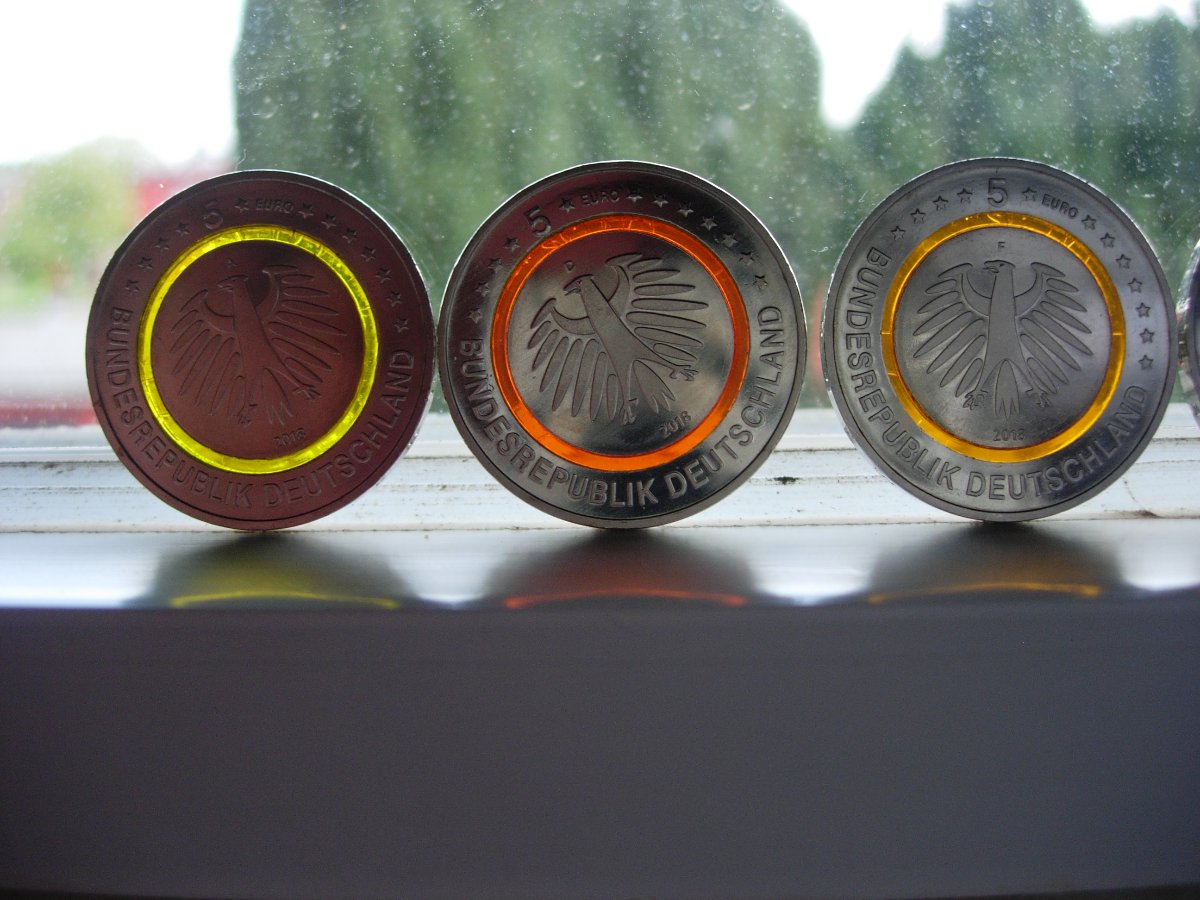 This picture shows the coin flat on a piece of paper with no light source behind them. 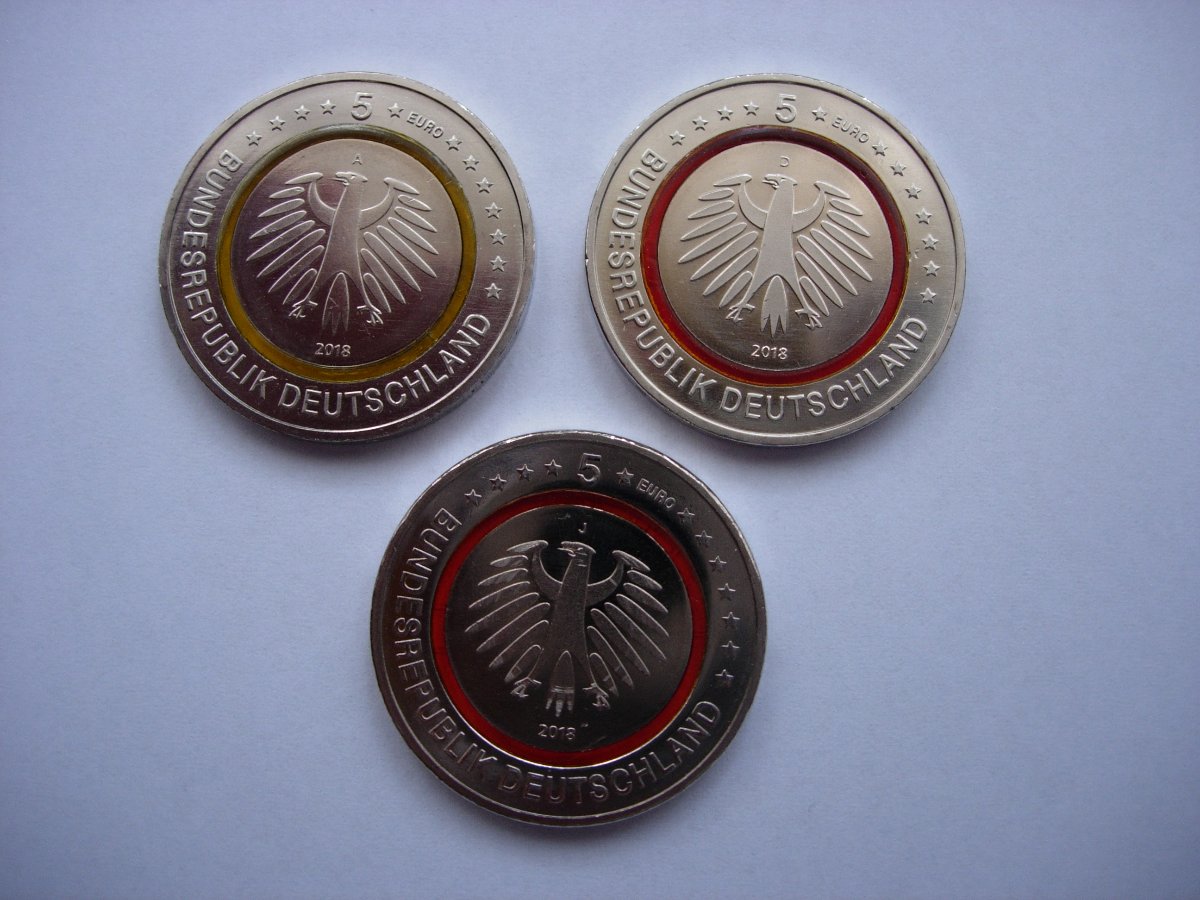 The €10 polmer-ringed coin is a blatant attempt to milk collectors. Edited by redlock
06/27/2018 08:33 am
|
|
Pillar of the Community
United States
8056 Posts |
Quote:
Yes, it is a true concentric ring. Thanks @redlock. Nice photos, and I like the concept of using color for mintmark on the 5 euro coins. In the link posted by Dorado for the 2019 10 euro coin, it looks like the design of the mountains is visible through the polymer ring. But perhaps this is just an artist's depiction, and not a picture of an actual coin. From your comment, what is the price of the 10 euro coin? |
|
Pillar of the Community
Austria
566 Posts |
I still wonder who buys those coins.
|
|
Moderator
United States
196278 Posts |
Quote:
Yes, it is a true concentric ring. Three (out of five) coins of the 2018 issue with light from a window behind the coins. Each German mint has its own color. Wow! That looks really nice. Thank you for sharing these examples.  |
|
Pillar of the Community
Germany
995 Posts |
The polymer-ringed €5 are minted in two conditions: Stempelglanz (which should be considered ''unc'') and Spiegelglanz (which should be considered ''proof-like''). The polymer-ringed €10 will also be minted in these two conditions. The three €5 in the picture above are ''unc.'' The unc coins are sold for face value at the 35 Bundesbank offices and some commercial banks, usually ''Sparkassen'' and ''Volksbanken'' until supply runs out. Bundesbank branches had a ''one coin per customer and day'' policy, which has been (mostly) enforced; the dispensing at commercial banks depended on how much they got allocated. Mine sold two per account holder and day (if you don't have an account you won't get one). And yes, I have seen people being turned away because they hadn't an account. Moreover, each commercial bank and Bundesbank office intially got one mint-mark only. Later in the dispensing other mint-marks showed up. But I can tell you there has been a lot of trading and swapping going on in German coin collector circles these last few weeks. The proof-like coins have to be pre-ordered at the ''Verkaufsstelle für Sammlermünzen der Bundesrepublik Deutschland (VfS)''. This year the price for one coin was €15,80 (IIRC). So, the polymer-ringed €10 unc coin will be available for €10 at the Bundesbank offices and some commercial banks. The coins are first put together, then the motif is minted. So, the polymer-ring gets its share of the motif. Look at the tree: 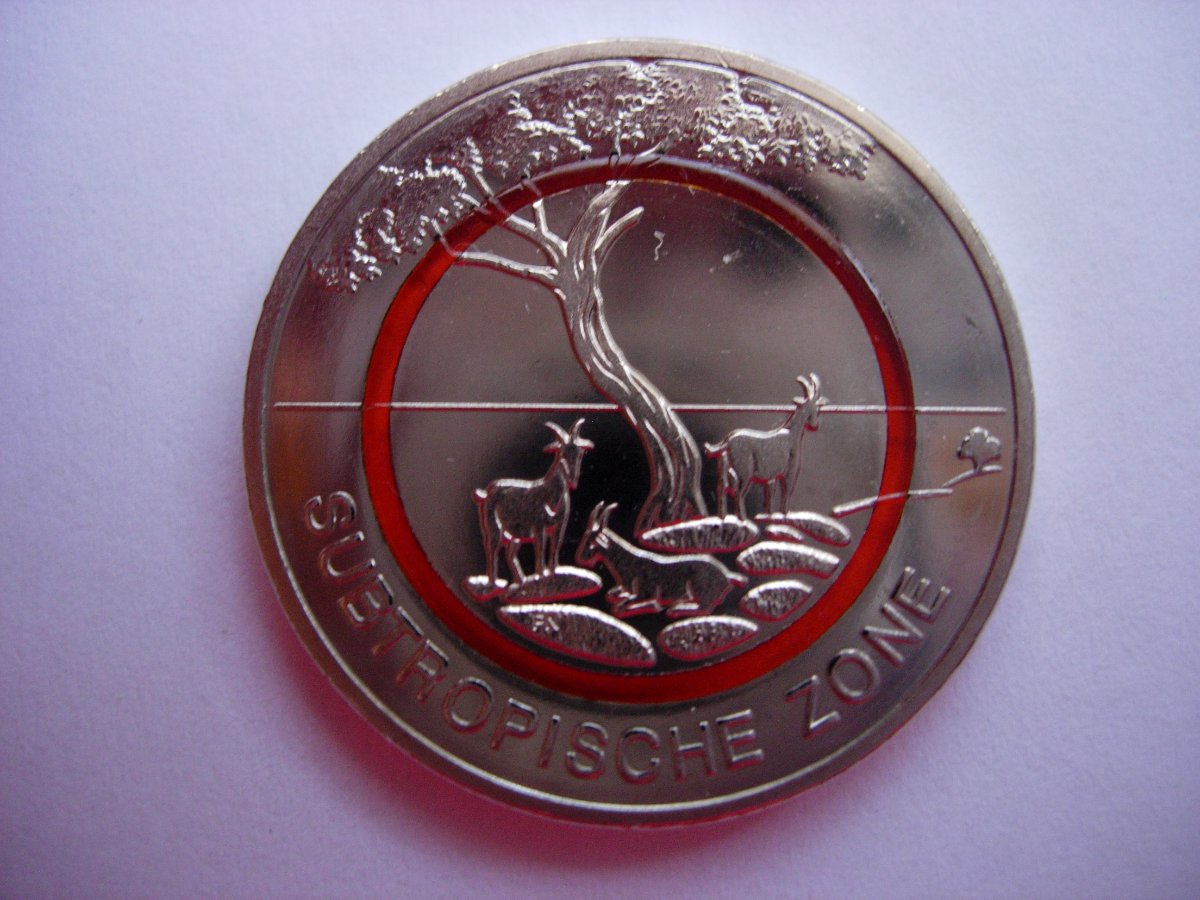 Who buys these coins? Well, people who collect German coins  Edited by redlock
06/27/2018 2:23 pm
|
|
Moderator
United States
196278 Posts |
Thank you for the explanation. I have to admit that if I happen find these at the next coin show I will probably buy some. |
|
Pillar of the Community
United States
8056 Posts |
@redlock, thanks for the explanation. Very creative approach to coinage!
I worked in the polymers industry for many years (I have colleagues in Ludwigshafen and Hoechst), so the idea of combining metals and polymers is very interesting.
|
| |
Replies: 11 / Views: 1,553 |
|







 Posted 06/26/2018 11:44 am





