





 First Page
 Previous Page


 Posted 09/01/2025 3:31 pm


Spanish Colonial Mint at Potosi, Alto Peru (now, Bolivia), & mint-worker Les Dyxia ...
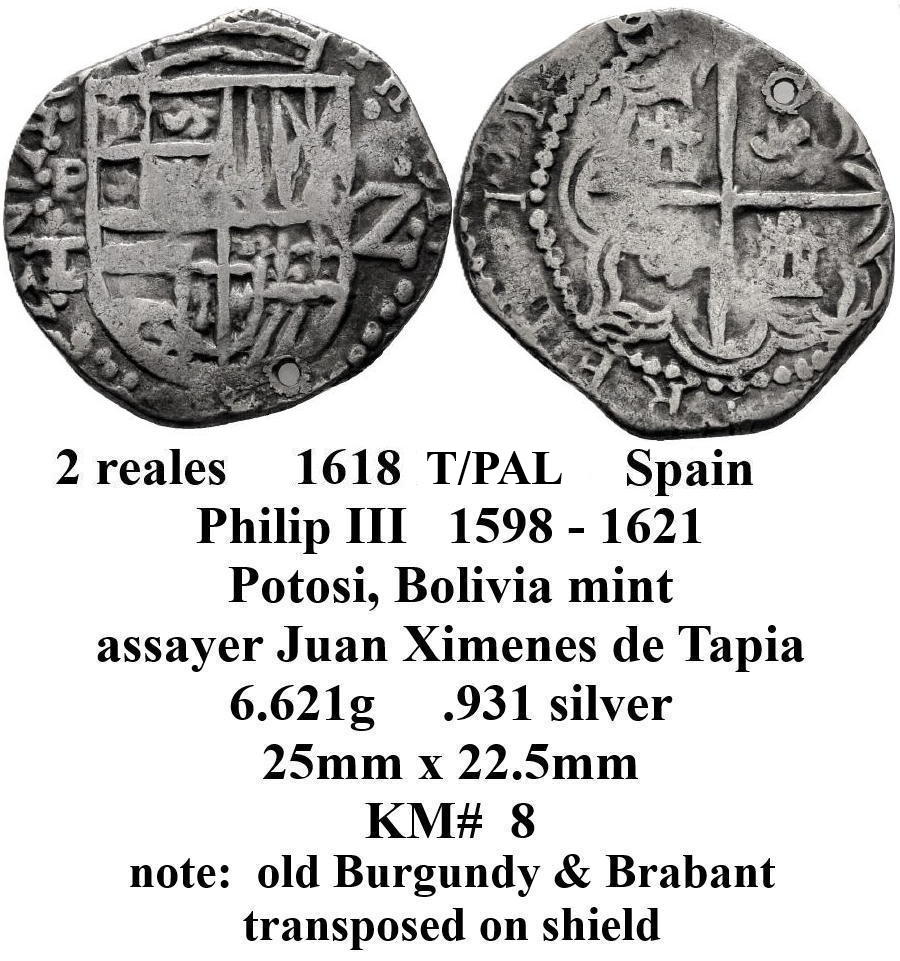
...in the year 1618, assayer Juan Ximenez de Tapia took control of the Potosi mint ( records of this time-frame are sketchy & debatable at best ) ...
...an acting assayer (lieutenant) "PAL" was also working the mint at this time. His cobs are very rare, being struck only in the year 1618, with most examples having been recovered from the famous wreck "Atocha" ...
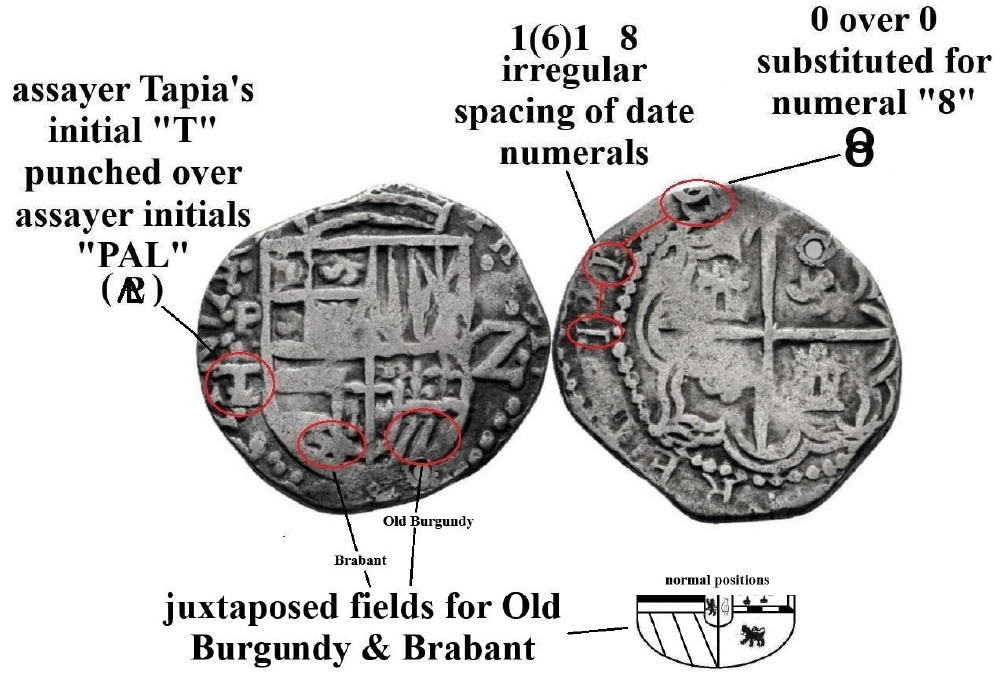
...Tapia's early tenure, 1618 - 1622, was marked by cobs produced with features juxtaposed, missing, & date numerals randomly applied, in no certain order ... i.e: "116Z" or "1Z61" for 1621 ... 16ZII for 1622 ... "Z" representing the (denomination 2 reales) numeral "2" (normal in European continental coinage, 1500-1700, but "Z" for "2" only found on the New World coinage of Potosi, 1618 - 1649)
...at Potosi, date numerals on cobs were placed on the cross side edge, normally between 9:00 - 11:30 ... but, at Potosi, between 1618 - 1622, numerals could sometimes appear anywhere between 8:00 - 3:00 ...
...all of this poor placement of details & numerals are believed to be the work of a dyslexic mint worker (hence: Les Dyxia, my favorite guy) ... I find his work fascinating, & a challenge to attribute ...
...I bought this cob (MA SHOPS) because of the nice detail (for this era) & the great big, honkin' "Z", which just seemed out of place ... on the cross side, I noticed " Les' " fine work with the numerals, so I bought it (thinking it was a 1620, with the 0s double struck, or, possibly, a 6/0 strike)...
...after receiving & studying the shield details, it was obvious that the 2 bottom-most fields were juxtaposed ... an error that was / is yet unrecorded ... until now ...
...I sent a pic to Dan Sedwick, excited about this discovery. He replied, impressed, & noted that what I thought was an over-strike (0/6 or 0/0) was actually two 0s used to make the numeral "8", nailing the date at 1618, & the over-strike assayer mark T/PAL ("....the rest of the coin matches for 1618.. " per Dan...)
...(the usage of 0 over 0 for an 8 is not that uncommon on colonial cobs, as punches often broke, or wore out, & the mint had to "make do" with what was available...) ...
...well, I'm stoked at possibly having a very rare, here-to-fore undocumented error from my favorite mint guy, "Les Dyxia" of Potosi ...
...in the year 1618, assayer Juan Ximenez de Tapia took control of the Potosi mint ( records of this time-frame are sketchy & debatable at best ) ...
...an acting assayer (lieutenant) "PAL" was also working the mint at this time. His cobs are very rare, being struck only in the year 1618, with most examples having been recovered from the famous wreck "Atocha" ...
...Tapia's early tenure, 1618 - 1622, was marked by cobs produced with features juxtaposed, missing, & date numerals randomly applied, in no certain order ... i.e: "116Z" or "1Z61" for 1621 ... 16ZII for 1622 ... "Z" representing the (denomination 2 reales) numeral "2" (normal in European continental coinage, 1500-1700, but "Z" for "2" only found on the New World coinage of Potosi, 1618 - 1649)
...at Potosi, date numerals on cobs were placed on the cross side edge, normally between 9:00 - 11:30 ... but, at Potosi, between 1618 - 1622, numerals could sometimes appear anywhere between 8:00 - 3:00 ...
...all of this poor placement of details & numerals are believed to be the work of a dyslexic mint worker (hence: Les Dyxia, my favorite guy) ... I find his work fascinating, & a challenge to attribute ...
...I bought this cob (MA SHOPS) because of the nice detail (for this era) & the great big, honkin' "Z", which just seemed out of place ... on the cross side, I noticed " Les' " fine work with the numerals, so I bought it (thinking it was a 1620, with the 0s double struck, or, possibly, a 6/0 strike)...
...after receiving & studying the shield details, it was obvious that the 2 bottom-most fields were juxtaposed ... an error that was / is yet unrecorded ... until now ...
...I sent a pic to Dan Sedwick, excited about this discovery. He replied, impressed, & noted that what I thought was an over-strike (0/6 or 0/0) was actually two 0s used to make the numeral "8", nailing the date at 1618, & the over-strike assayer mark T/PAL ("....the rest of the coin matches for 1618.. " per Dan...)
...(the usage of 0 over 0 for an 8 is not that uncommon on colonial cobs, as punches often broke, or wore out, & the mint had to "make do" with what was available...) ...
...well, I'm stoked at possibly having a very rare, here-to-fore undocumented error from my favorite mint guy, "Les Dyxia" of Potosi ...
Edited by mrwiskers
09/01/2025 4:06 pm
09/01/2025 4:06 pm


