I don't actively collect or even seek out coins of the Indian Princely states anymore, but sometimes a coin is interesting enough that it warrants an exception. This one was just too interesting and odd to pass up!
India, State of Jammy & Kashmir
Maharaja Pratap Singh (1885 - 1925)
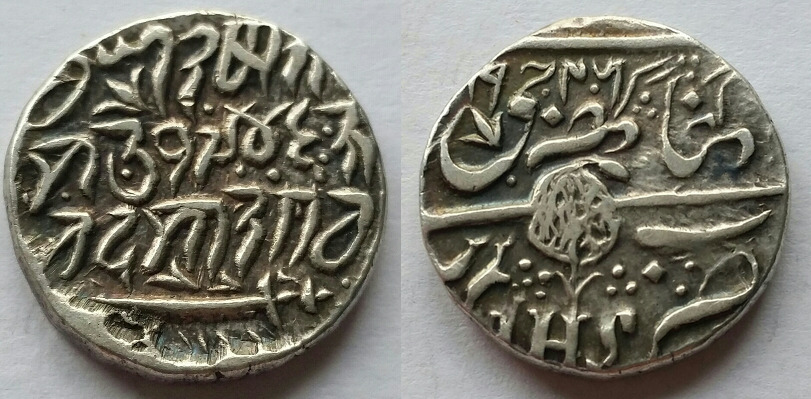
Silver (light?) Rupee 19mm 6.6g
VS 1946 / 1889 AD
Obv: Takari legend (would love a translation!)
Rev: Urdu legends, leaf, VS date 19-46 in Urdu numerals, IHS at bottom
Jammu and Kashmir was one of the largest and most populous states in colonial India, created when the East India Company seized territory formerly held by the Sikh Empire and sold it to a local member of the royalty for 7.5 million rupees in 1846. The state assisted the British during the Indian Rebellion of 1857, and was therefore granted honors and a greater degree of autonomy than other states in post-Company India.
Under Pratap Singh, Jammu and Kashmir underwent modernization, building modern road infrastructure, capitalizing on industrial foresting, and building hospitals as well as implementing vaccination routines to curb mortality rates. In recognition of his success, Pratap and his successors were granted a 21-gun salute by the British, one of the highest honors granted to a foreign head of state. Jammu and Kashmir was one of the few states that remained autonomous after the 1947 dissolution of British rule in India, and ultimately partitioned itself between India and Pakistan in 1952.
These rupees are popular among numismatists because of their only Western characters: JHS or IHS. Both ostensibly mean IESVS HOMINVM SALVATOR, Jesus, Savior of Mankind. How exactly these got onto a coin minted by a Hindu king for a predominately Muslim state is a matter of debate - somewhat apocryphally, the story goes that maharaja Gulab Singh, in conversation with a British diplomat, asked how such a small island nation could be so prosperous to control so much of the world. He was answered that the British, being a Christian nation, had found favor with God. Wishing to have this for himself, he asked the diplomat for a sign or symbol of the Christian faith and was given the initials JHS.
These coins are, as far as I know, the only which utilize the obscure Takari script, a sister script of Devanagari which is seldom used today.
One thing which I am unclear on is the weight - which at 6.6 grams is far too light to be a rupee by the traditional definition of a silver coin between about 10-11.5 grams. There are however no larger denominations.










 Posted 05/23/2019 04:15 am


