| Author |
 Replies: 9 / Views: 2,827 Replies: 9 / Views: 2,827 |
|
|
Pillar of the Community
Poland
3201 Posts |
1. Germany 1 heller 1741. Reverse: FR monogram. Copper. Could someone look it up in Krause to tell which German state is this from? 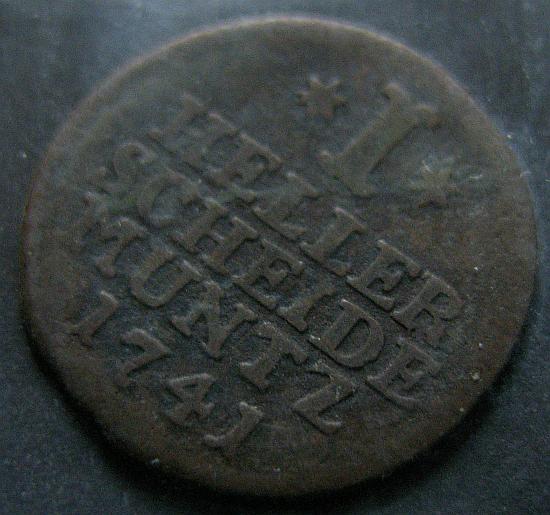 2. Wert-marke. Reverse: 5. Bronze (?). Does anyone has any further information on these (I've seen various denomination looking like this piece)? 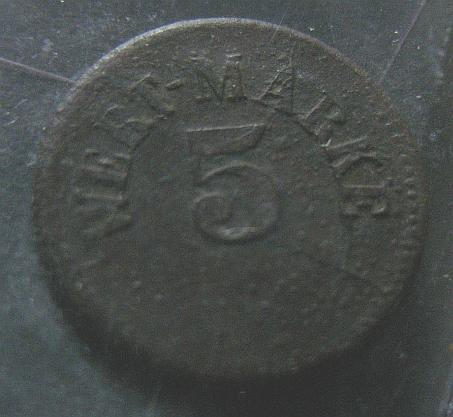 3.  any ideas at all? 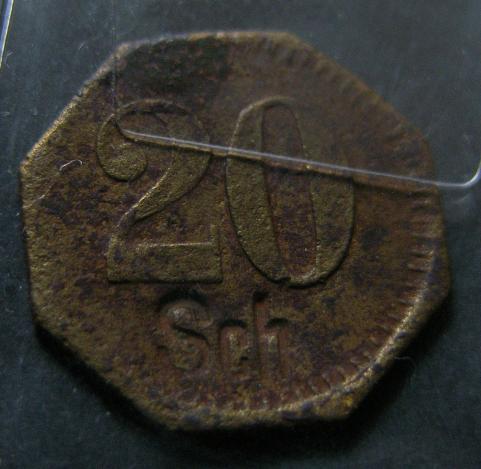 Thanks  Edited by Sap
08/30/2008 08:07 am
|
|
|
|
Pillar of the Community
United States
1415 Posts |
Number 1: Hesse-Cassel KM#401 no mintage numbers - worth about $7 US.
|
|
Pillar of the Community
 Poland
3201 Posts |
Finally something else than Prussia!  Thank you! |
|
Pillar of the Community
United States
2669 Posts |
Your wertmarke is a token produced in Germany by private companies. They are sometimes counterstamped. Wertmarke banknotes were for the German concentration camps (see http://www.germannotes.com/faq_camp...elbau.shtml)Is there anything on the other side of the #3 coin? |
|
Pillar of the Community
United States
2669 Posts |
|
|
Pillar of the Community
Poland
3201 Posts |
On the other side of the 3rd coin there is the "20" denomination and nothing besides it. I wonder what currency the "Sch" is - Schilling?
|
|
Pillar of the Community
United States
2669 Posts |
Quote:
I wonder what currency the "Sch" is - Schilling? Probably. Without a year and ruler, I would guess this is another token... but hopefully someone with more knowledge will chime in. |
|
Moderator
 Australia
16982 Posts |
I don't think "Sch" is the monetary unit; 20 schillings (Austrian) was a lot of money, and the schilling wasn't introduced until 1925, by which time the post-war monetary crisis was over.
The "Sch" is stamped in afterwards, not part of the original design. I'd assume it's a generic stock token that's been countermarked by the issuer to make it more distinctively theirs. "Sch" might be the abbreviation of the issuer's name, or the locality it was issued in.
Both #2 and #3 are notgeld tokens of some kind. There's no other inscriptions on the other sides of #2 or #3 to help identify them?
Don't say "infinitely" when you mean "very"; otherwise, you'll have no word left when you want to talk about something really infinite. - C. S. Lewis
|
|
Pillar of the Community
United States
2669 Posts |
Sap.. the reverses seem to just have the number. I didn't even notice the 'Sch' was stamped later, but now that you point it out I definitely see it. A little over half down the page is what looks like #2 http://home.psknet.com/tbirde3/Medals/Medals.htmlWert-Marke.These are normally known as waiter's checks. The token may also belong to a restaurant, as 15 pfennig was the standard price for beer. The most famous manufacturer of Wert-marken was L. Christian Lauer in Nürnberg, but there were several other manufacturers. They may be circa 1900-1940, except for 1915-1923 when most copper was used during WWI and hyper inflation 1922-23 needed higher values. It may be impossible to trace their origin. There was a standard for marking wertmarken with 2 or 3 letters (#3?). These tokens were not used only in Germany. There are many wert marken listed in catalogs by Menzel and Hasselmann. Also good stuff at http://www.chicagocoinclub.org/proj...PiN/not.htmlAnd here: http://www.coinworld.com/news/120103/bw_1201.asp |
|
Pillar of the Community
Poland
3201 Posts |
Sap, right, it's quite unlikely it's a Schilling as I recall now that 25 schilling was in fact a gold coin. Thanks for reminding me of it  Only other denomination I can think of is Schwaren but that was used before 1871. So it might be that the "Sch" is not a denomination but a merchant's/region mark. Exactly, the reverses only have a number, nothing more, no inscriptions. Thanks for the link, xshift, looks like I have a 1/3 beer token.
Edited by DL20K
08/25/2008 09:32 am
|
| |
Replies: 9 / Views: 2,827 |
|







 Posted 08/24/2008 1:26 pm





