The commemorative coins for the 150th anniversary of American Independence were proposed in the same bill that established a National Advisory Commission to the Sesquicentennial Exhibition Association (the Exhibition Association was the Philadelphia group responsible for staging the Sesquicentennial Exposition in Philadelphia). The resolution also paved the way for the US Government and foreign governments to participate in the Exposition.
Joint Resolutions were introduced in the House and Senate on February 16, 1925. Section 4 of each chamber's resolution proposed a pair of commemorative coins: a gold $1.50 and a silver 50-cent piece. Up to 500,000 of the gold coins were authorized to be minted, up to one million of the silver half dollars could be struck.
The Treasury Department did not approve of a new gold denomination. It supported the striking of commemorative coins for the anniversary of American Independence, but it did not believe a new coinage denomination was needed to do so.
Read More: Commems CollectionThe proposed legislation stated that the coins were to be "...the standard troy weight, composition, diameter..." This would have required a new set of specifications for the $1.50 gold coin considering the US had not previously issued such a coin. All things considered, however, it would not have been very difficult for the Mint to determine the new requirements as the then-current composition of 0.900 fine would have continued and the Mint would only have had to do a bit of math to determine the appropriate weight for the new coin. The $2.50 gold quarter eagle of the time had a weight of 4.18 grams with a net gold weight of 0.12094 ounces. With this as a guide, I would estimate that the $1.50 coin (at 60% of the value of the $2.50 coin) would have had a weight of ~2.508 grams and a gold weight of ~0.07256 ounces. Its diameter would likely have been about 16mm.
In the end, the resolution that was signed into law called for a lower number of gold coins of an existing denomination - up to 200,000 $2.50 gold coins - along with the original request for up to 1 million silver 50-cent pieces.
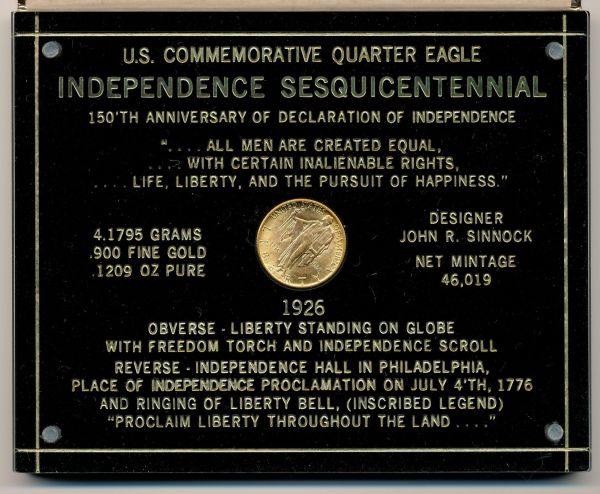


The $1.50 denomination of the gold coin would have been a novel and fitting tribute to the country's 150th anniversary of independence, but it was, unfortunately, "juuuust a bit outside" of the Treasury's comfort zone. (Sorry for the Harry Doyle /
Major League movie reference, but baseball season is fast approaching!)
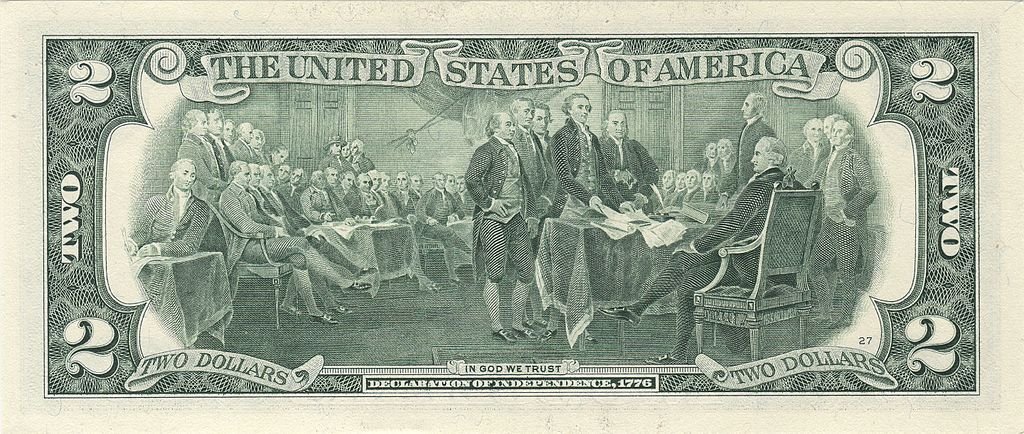
Also of note to numismatists, the original Resolutions called for a $1.00 note that would carry a design commemorating the signing of the Declaration of Independence. Of course, no such note was ever approved or produced. Fifty years later, the Series 1976 $2.00 notes, featuring an engraved adaptation of John Trunbull's
Declaration of Independence painting, were issued to celebrate the nation's bicentennial; the design continues in production to the present day. It took awhile, but we finally got a "commemorative" note for our independence!




 Posted 02/03/2020 08:37 am





