| Author |
 Replies: 8 / Views: 1,152 Replies: 8 / Views: 1,152 |
|
|
New Member
United States
34 Posts |
Hi! I'm completely out of my element with ancient coins. I've been looking through pictures of obverses & reverses till I'm bleary-eyed with no luck identifying this. Thanks for any help. 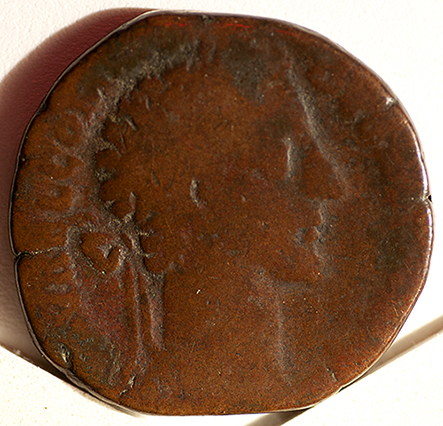 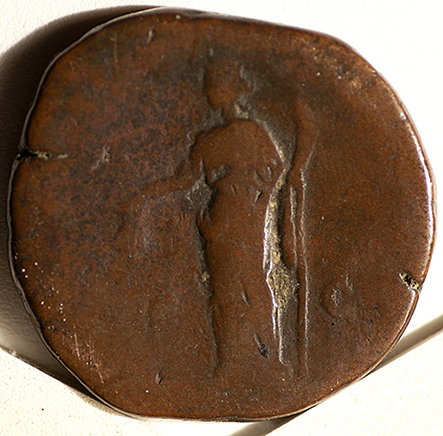 |
|
|
|
CCF Advertiser
 United States
1318 Posts |
|
|
Valued Member
Germany
141 Posts |
May I suggest Commodus sestertius w/ Libertas standing as a possibility? Adding the weight would help  |
|
CCF Advertiser
United States
1318 Posts |
Sorry, if this is heavy, and it does look thick, I should have said sestertius as well.
|
|
New Member
 United States
34 Posts |
The weight of this coin is 15.4g.
It is 27mm x 29 mm across, and about 2.6mm thick.
Thanks for your help!
|
|
Valued Member
Germany
141 Posts |
That sounds like either an exremely heavy as or a lightweight sestertius with a copperish look struck on an extremely thin flan  (It is not uncommon for sestertii from that era however, to vary wildly in weights and flan sizes) Maybe AE Sestertius, RIC 1588 to 1590 (M.Aurelius) ? Here an example of one of these types: 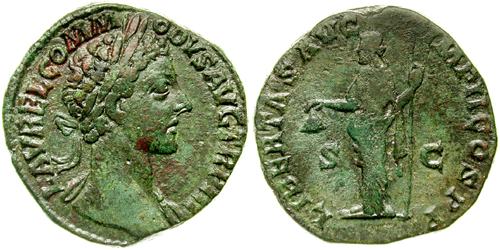 What do you think? |
|
New Member
United States
34 Posts |
Well, the devices do look similar.
I've found a few images of sestertii online that also nearly matched mine, (much better condition, though).
Is it unrealistic to expect to find an image of another coin struck with the same die pair as mine?
Is there a way to tell for sure what the denomination is?
Thanks again for your help.
|
|
Valued Member
Germany
141 Posts |
Quote:
Is it unrealistic to expect to find an image of another coin struck with the same die pair as mine?
Not unrealistic at all to try! But it is also possible you may never find them, depending on the coin. For this particular type, I honestly don't know how hard can it be. Also, keep in mind that you can probably find only one die match and not necessarily both obverse and reverse matching at once. Quote:
Is there a way to tell for sure what the denomination is? Usually coin measurements are enough, generally speaking of course. Flan size is by far the most notorious way to tell for well patinated coins, where asses and sestertii coexisted with similar designs. Also, an as from this era will be made of copper whereas a contemporary sestertius should be made of an alloy identical to bronze. If by any chance some of the bare metal can be seen (As in a scratch, for instance) beneath the patina, that's another way to tell. This coin looks copperish, but from the pictures I am not able to tell if that's just how the patina looks. Edited by DirtyHarry
08/14/2020 01:49 am
|
|
New Member
United States
34 Posts |
It certainly looks like copper to me, and there really aren't any scratches down to bare metal.
Oh well, I suppose I can live with a little mystery!
|
| |
Replies: 8 / Views: 1,152 |
|







 Posted 08/12/2020 11:23 pm





