Here's the story of another proposed commemorative half dollar that did not succeed...Representative John Taber (R-NY) served in the US Congress for 40 years (1923-1963), being elected to the House of Representatives for 20 consecutive terms. In 1948, mid-way through his 14th term, he introduced a bill that called for a commemorative 50-cent piece in recognition of the one-hundredth anniversary of the founding of Auburn, New York.
Auburn is located in the Finger Lakes region of New York (i.e., the northwestern part of the state, south of Lake Ontario), the city is west of Syracuse and east of Buffalo. It is just north of Lake Owasco with the Owasco River cutting through the town in a SE to NW direction from the lake. It is the County Seat of Cayuga County.
The area in which Auburn, NY would ultimately develop was originally settled in 1793 by John Hardenburgh, a colonel in the Continental Army during the Revolutionary War; the area became known as Hardenburgh's Corners. The growing settlement became known as "Auburn" in 1805 (Many believe the name was taken from Oliver Goldsmith's 1770 poem titled "The Deserted Village," The poem begins with the line "Sweet Auburn! loveliest village of the plain." If the poem did inspire the settlement's naming, folks clearly chose to ignore the very negative messaging delivered by much of the rest of the 430-line poem!). Auburn formally became a town in 1823 and was incorporated as a city in 1848. The 1948 anniversary proposed to be commemorated with a coin was for the city's centennial of incorporation, and not related to its founding or original settlement.
The city of 37,000 (circa 1948) staged a week-long celebration of its centennial from August 1st through the 7th; the event was called "Through the Years in Auburn - A Century Review." Each day of the centennial week featured a special theme/event in addition to the standard schedule for each day. Each day included special centennial exhibits at the Cayuga Museum for Art and History, a midway with rides and games and a fireworks display at night.
As did many other such city commemorations of the time, the Auburn centennial featured a large historical pageant that chronicled the city's history and development. The "Century in Review" pageant consisted of 17 episodes plus a "March of Freedom" Finale; it was staged each night of the centennial week at Auburn's East High School football stadium.
Like the Albany, NY half dollar that came before it in 1936, the Auburn coin was sponsored by its namesake city vs. a private organization created for the event. Funds raised through sales of the coin were to go toward helping defray the costs of staging the city's centennial celebrations. The bill's language specified that only an authorized representative of the city could order/receive the coins.
An interesting aspect of the proposed legislation was that it included fairly specific language regarding the designs of the proposed coin. The bill stated that the coin was to carry "the likeness of William H. Seward, a resident of the city of Auburn, New York, and Secretary of State in the Cabinet of Abraham Lincoln, and also the seal of the city of Auburn, New York..." Most commemorative coin bills of the time simply stated that the coin was to have a "special appropriate design" without listing specifics.
Seward is most famous for spearheading the Alaska Purchase during Andrew Johnson's administration. Called "Seward's Folly" at the time, the $7.2 million purchase from Russia has, of course, proven to be an incredibly wise decision. Alaska has 663,300 square miles of territory which equates to 424,512,000 acres which means the US paid ~$0.0170 per acre - less than
Two Cents per!
The bill was referred to the House Committee on Coinage, Weights, and Measures upon its introduction, but was never reported out. It was a slow time for US commemorative coin approvals, with no authorizations since the Iowa Statehood Centennial and Booker T. Washington Memorial coins of 1946. As such, the Auburn coin proposal fell by the wayside and none of its proposed 100,000 half dollars were ever struck by the Mint.
I'm not aware of a commemorative medal being struck for the Auburn centennial, but offer the following two images to give a sense of what could have been featured on the 50-cent piece if it had come to fruition.
Obverse of 1967 Alaska Purchase Centennial Medal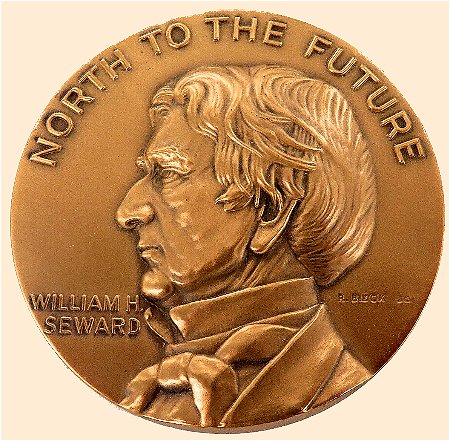 Auburn City Seal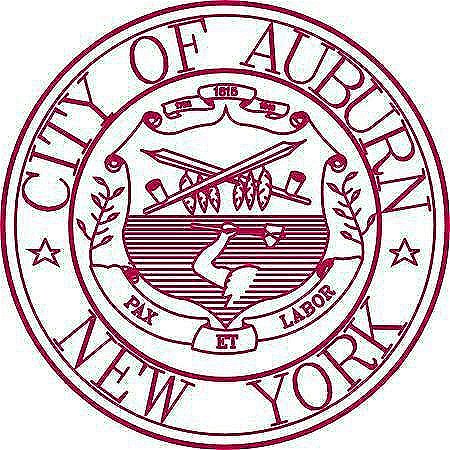
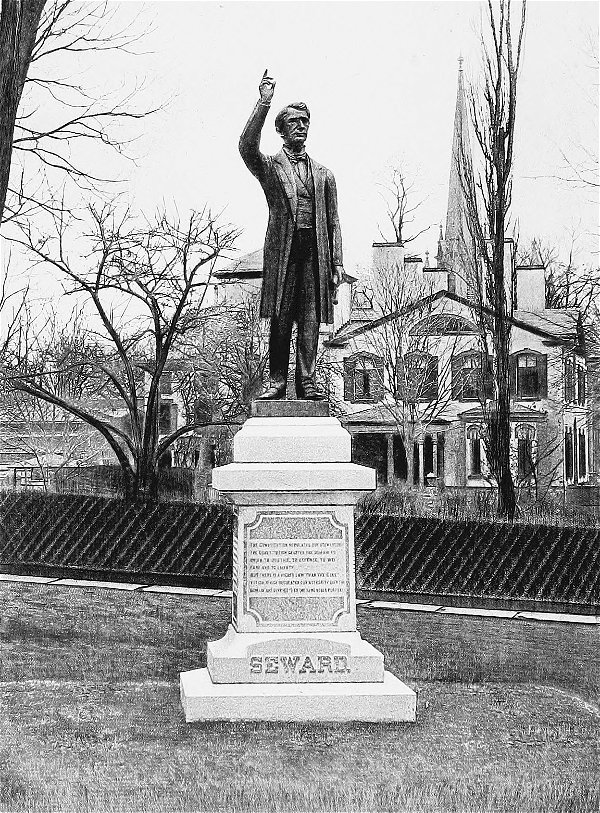
In 1888, Auburn dedicated a monument/statue to William Seward. The following image is included in
The Unveiling of the Seward Memorial Statue book that was published in 1889 to permanently capture the events of the day. Following is the image of the statue featured in the book.
 Read More: Commems Collection





 Posted 02/12/2021 8:22 pm





