PCGS - The modern bullion coin market wouldn't exist without the forerunner that became at one point the world's most traded bullion unit, the South African Krugerrand. While bullion gold was quite common prior to the Krugerrand's introduction in 1967, its convenient 1 oz. form offered an easy way to buy, sell, invest, and trade bullion worldwide. With its success, other countries followed suit with their own bullion coin issues.
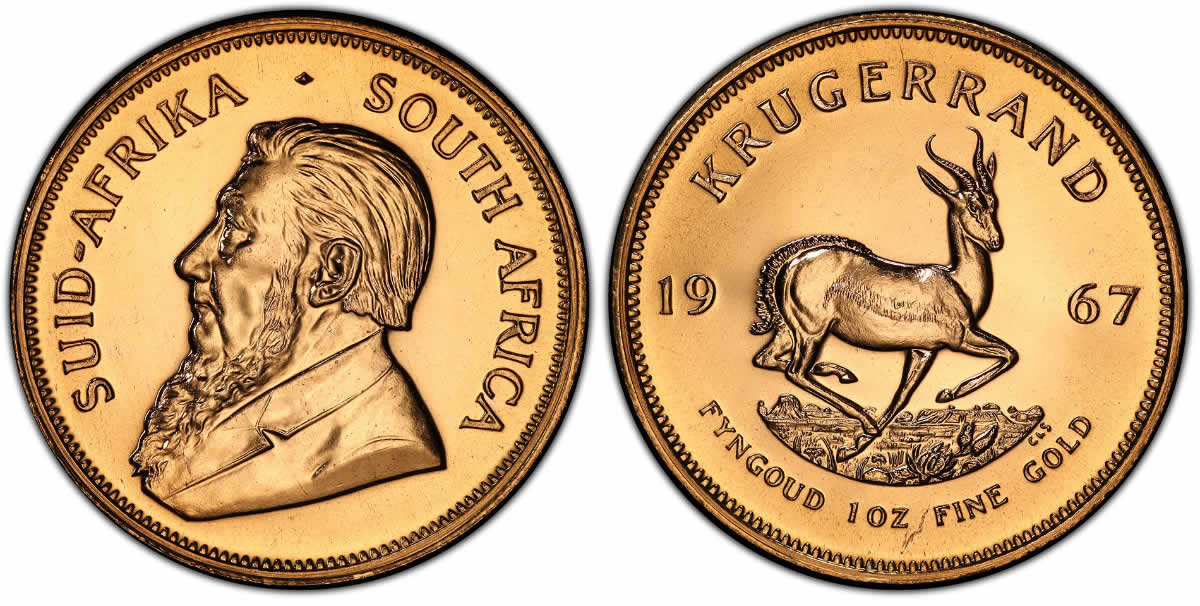 South Africa 1967 Krugerrand PCGS MS67
The concept for the 1 oz. bullion coin may originate from multiple sources. In the South Africa Mint Museum there is a piece struck prior to 1941, made by
The Royal Mint in Pretoria, for a 22-karat one-ounce gold coin. This museum-owned piece might just be the inspiration for the Krugerrand coin. The more likely inspiration came from the 1960 Chamber of Mines 24-karat 1 oz. gold medallions that feature two springboks. These medals had two versions, one minted with English inscriptions and boasting a mintage of 4,000 and another in Afrikaans with a mintage of 2,000. Unfortunately, most of these medals, often considered patterns for the Krugerrand by South African collectors, seem to have been melted for the bullion and as such are scarce today. Yet, selling a 1 oz. bullion issue from the Chamber of Mines likely inspired those who wanted to have an output to market South African gold to create their own units for sale.
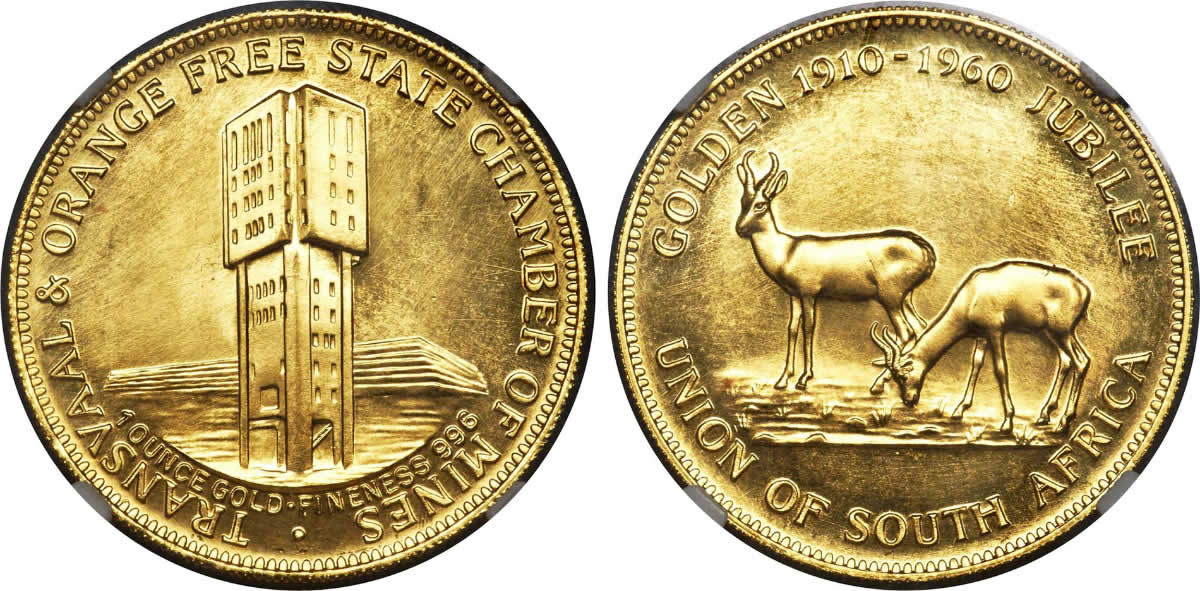 South Africa 1960 Chamber Mines 1oz Medal
In an effort to market and sell the gold of South Africa, the Rand Refinery and the South African Mint collaborated on the production of a 1 oz. bullion coin. The design chosen was that of the former Boar leader and president of South Africa, Paul Kruger, based off the designs of Otto Schultz. The obverse would feature the portrait of Kruger and South Africa in two languages, English and Afrikaans. The reverse was that of a single springbok, flanked by the date, with the notation 1 oz. fine gold, again in two languages with the denomination "Krugerrand" above. The denomination was a fictious joining the name of Paul Kruger with that of the South African currency, the rand, to create a Krugerrand.
Read the Entire Article 




 Posted 07/30/2021 09:56 am





