In the United States, almost all commemorative coins have been produced for the purpose of raising funds for a non-Federal Government sponsor. There were some exceptions in the early years of the modern era (1982 to date), but all of the classic era coins (1892-1954) had a sponsor who looked to benefit from the sale of its coin(s). (You can read about the modern exceptions here:
Reducing the National Debt.)
As mentioned above, all of the classic era US commemorative coins had a sponsor. In just about every case, the sponsor - or the sponsor's bank of record - was specifically named in the coin's legislation. This identified who could request the coins from the Mint and who was responsible for paying for them. In seven cases, however, the approved coinage legislation did not name a sponsor or bank of record.
The earliest US commemorative coin issues, from the 1892 Columbus half dollar through the 1916-17 William McKinley Memorial gold $1, clearly identified their sponsor/beneficiary within each coin's enabling Act.
The first coin bill to omit such identification of the sponsor was the 1918 Illinois Statehood Centennial half dollar - popularly referred to as the "Lincoln" due to the portrait of Abraham Lincoln on the coin's obverse. The sponsor of the coin was the Centennial Commission of the State of Illinois, but it was not identified in the coin's legislation.
1918 Illinois Statehood Centennial Half Dollar
The language of the successful Illinois Statehood coin bill was used as a template or guide by several coin proposals that followed. The bills for the 1920 Maine Statehood Centennial and the Landing of the Pilgrims 300th Anniversary half dollar each used the Illinois template and thus neither coin's bill included a named sponsor. The State of Maine sponsored the Maine half dollar and the Pilgrim Tercentenary Commission sponsored the Pilgrim half dollar with the Shawmut National Bank of Boston as its authorized distributor - no sponsor names were included in either coin's enabling Public Law.
1920 Maine Statehood Centennial Half Dollar 1920 Pilgrim Tercentenary Half Dollar
The same is true for the 1921 Alabama Statehood Centennial half dollar and the 1921 Missouri Statehood Centennial coin - a named sponsor was absent from their bills/enabling Acts. The
Alabama Centennial Commission was the driver behind the Alabama half dollar, and the Missouri Centennial Committee was the sponsor of the Missouri coin; the Missouri Committee used the Sedalia Trust Company for distribution.
1921 Alabama Statehood Centennial Half Dollar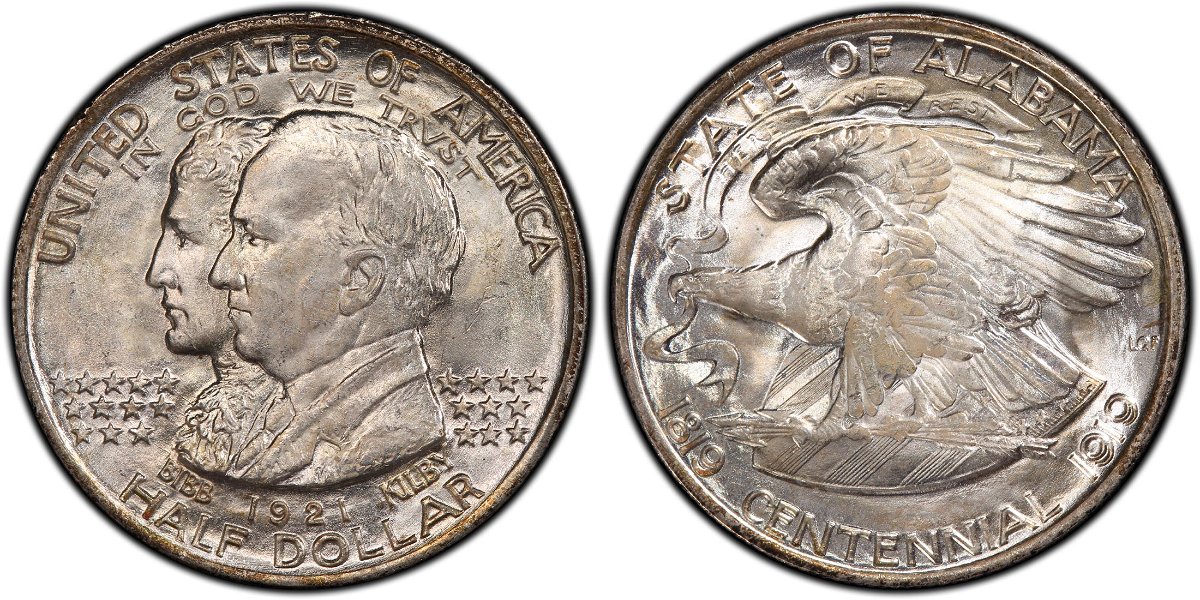 1921 Missouri Statehood Centennial Half Dollar
The legislation for the gold $1.00 and silver half dollar in honor of the 100th anniversary of Ulysses S. Grant's birth was the next to not name a sponsor. The legislation was very specific in what was to be done with the funds raised by sale of the coin - two community buildings and a short highway - but was silent as to who would administer the coin and arrange for the construction projects. The U.S. Grant Centenary Memorial Association was the organization responsible.
1922 Grant Birth Centenary Memorial Half Dollar
In an interesting twist, the legislation for the Battle of Bennington-Vermont Sesquicentennial half dollar does not list a sponsor, but the two coinage bills that were added to the Bennington-Vermont bill via amendment have sponsorship language included. The Vermont coin, as it is nicknamed by collectors, was sponsored, in fact, by The Vermont Sesqui-Centennial Commission (set up by the Bennington Battle Monument & Historical Association).
1927 Battle of Bennington-Vermont Independence Sesquicentennial Half Dollar
The clue to the fact that each of the coins did, in fact, have a sponsor comes from the last line in the legislation for each: "
Provided, That the Government shall not be subject to the expense of making the necessary dies and other preparations for this coinage." This line prevents the coins from being struck if the production expenses are not covered by a party other than the US Government - i.e., an outside/private sponsor.
Here's a quick summary of the above:
     Coin                        Unnamed Sponsor
1918 Illinois                    State of Illinois, Centennial Commission
1920 Maine                       State of Maine, Treasurer
1920 Pilgrim                     Pilgrim Tercentenary Commission
1921 Alabama                     Alabama  Centennial Commission
1921 Missouri                    Missouri Centennial Committee
1922 Grant Birth Centenary       U. S. Grant Centenary Memorial Commission
1927 Battle of Bennington/
      Vermont Independence       Vermont Sesqui-Centennial Commission
Image Credits: All images are courtesy of PCGS CoinFacts at http://www.PCGS.com/coinfacts.



 Posted 05/11/2021 09:47 am





