| Author |
 Replies: 12 / Views: 1,488 Replies: 12 / Views: 1,488 |
|
|
Pillar of the Community
United States
3552 Posts |
What do you do when you see the horrible effects that verdigris and/or rust can have on your coins?
Do you ever test the atmosphere of your coin's storage container?
What element is THE most essential component to initiating degradative chemical reactions leading to the formation of damaging products to a surface of a coin?
|
|
|
|
Pillar of the Community
 United States
3552 Posts |
a picture is worth 10,000 words... 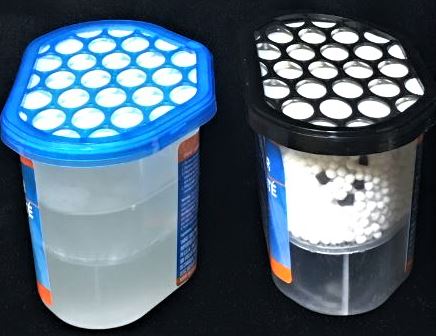 I asked myself these questions and placed a $1 dessicant inside of a safe and waited for three months. The two shots here show how drastically the amount of water had accumulated inside of this dessicant while residing inside of a 'closed' safe. |
|
Bedrock of the Community
United States
94367 Posts |
There is no simple answer to your question.
Please show us images to start a conversation.
|
|
Pillar of the Community
United States
3552 Posts |
Virtually every chemical reaction must have H2O to begin and come to an end.
The recommend Rh for coin storage is ideally about 30%. Anything lower is harder to achieve but not impossible.
IMO it is unnecessary to measure Rh unless you want to purchase more meters which can be avoided by simply observing and changing out the dessicant every couple of months or as needed.
|
|
Pillar of the Community
United States
3552 Posts |
Quote:
...show us images Either this question was posted before I uploaded the two desicants or it refers to coins' before and after status. If it is the later, the only point being made here is that destructive chemical reactions will occur significantly slower or not at all without the presence of water... |
|
Bedrock of the Community
Australia
21794 Posts |
Beautiful rainbow toning on a silver coin is delicate and unstable over the long term, and it's deterioration cannot be reversed -
much like feminine pulchtitude.
Unlike the feminine version, it can be however be almost be completely arrested by housing the coin in a completely air tight environment. A screw seal acrylic capsule of appropriate diameter would be the best solution to this problem.
Can't do that with the feminine version. She might have you arrested first!
|
|
Pillar of the Community
 United States
8077 Posts |
Yes, it's a good reminder that most corrosion reactions need water present. So using dessicants can slow whatever reactions take place. In many homes, it's less of an issue due to seasonal fluctuations in RH (indoor air is pretty dry in the cold months here in the midwest) and modern HVAC systems. If I lived in the southeast and didn't have air conditioning, I would certainly consider using dessicants where my coins are stored. Or moving ...  |
|
Bedrock of the Community
United States
20753 Posts |
Keep moisture away from coins. I simply put coins in Plastic Zip lock bags.
|
|
Pillar of the Community
United States
5825 Posts |
Quote:
Keep moisture away from coins. I simply put coins in Plastic Zip lock bags. #1 Moisture is definitely the most damaging factor. Use desiccants. #2 Keep the temperature as constant as reasonably possible. And I'm not so sure about Plastic Zip lock bags. They may contain PVC (plastic softener). Non-PVC flips or 2x2's would be preferable. Capital Plastics holders are very good but very expensive. |
|
Moderator
 United States
198103 Posts |
Quote:
And I'm not so sure about Plastic Zip lock bags. They may contain PVC (plastic softener). They do not. They are made with polyethylene. I would only use the clear ones though to avoid issues with dyes. And to be clear, PVC is a rigid plastic. It is the softeners (plasticizers) added to it that cause problems for coins as it leaches out. |
|
Pillar of the Community
United States
8077 Posts |
Correct.
And polyethylene is a pretty good moisture barrier, but it does allow some in.
|
|
Moderator
Australia
17032 Posts |
The other chemical to avoid is sulfur. Silver, in particular, reacts with sulfur-containing chemicals in the atmosphere to produce silver sulfide, which is black, and it does not need moisture in the air to form. This is what "tarnish" and "toning" on silver coins is made of. It is also why you get a "rotten eggs smell" when you clean tarnished silver coins with silver dip, as the silver sulfide reacts to form hydrogen sulfide gas.
Sulfur can be found in numerous everyday items. Virtually every kind of "rubber" has sulfur in it, because it's the sulfur cross-links that make a polymer "rubbery". Paper and cardboard, particularly if it's coloured, often has sulfur compounds in it (hence the oft-heard claims of Taco Bell napkins being good for "re-toning" silver coins). And of course sulfur could be in the air to begin with; ambient sulfur dioxide is less common nowadays with anti-acid-rain pollution control laws put in place way back in the 1980s, but if there's a kitchen in the house where garlic and other aromatic foods are being prepared, there'll be plenty of sulfur put up into the air from that source.
Sulfur will also cause coins of other metals to turn black - particularly copper and bronze.
Don't say "infinitely" when you mean "very"; otherwise, you'll have no word left when you want to talk about something really infinite. - C. S. Lewis
|
|
Pillar of the Community
United States
8077 Posts |
The silver sulfide reaction does require water:
The main product of silver tarnishing is silver sulphide. The reaction mechanisms are:
8Ag + 4HS- <---> 4Ag2S + 2H2 + 4e-
02 + 2H2O + 4e- <---> 4OH-
The first reaction is believed to occur in a thin film of water on the silver surface. In dry air, tarnishing does not take place.
/www.vam.ac.uk/content/journals/conservation-journal/issue-18/tarnishing-of-silver-a-short-review/
The HS- ion results from hydrogen sulfide dissolving in water: H2S + H2O <-> HS- + H3O+
Edited by tdziemia
09/16/2021 8:50 pm
|
| |
Replies: 12 / Views: 1,488 |
|




 Posted 09/15/2021 10:17 pm





