The concept of a female figure personifying Britain dates all the way back to Roman times. Roman coins featuring Britannia,
like this one, commemorating the conquest and occupation of the island by the Empire, are rather pricey.
In more recent times, Britannia has featured on British coins more-or-less continuously since the mid-1600's. When Britain "went decimal" in 1971, Britannia was promoted from the bronze coins to the cupronickel 50 pence; it was only last year that the Brits finally replaced her with something more...
abstract.
But Britannia can still be found on Britain's non-circulating
silver and
gold bullion coins, which are known as "Britannias".
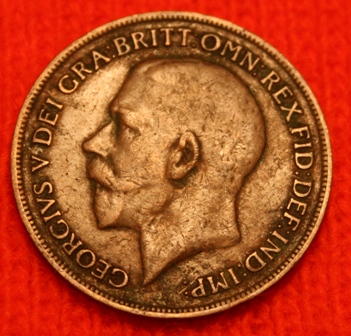
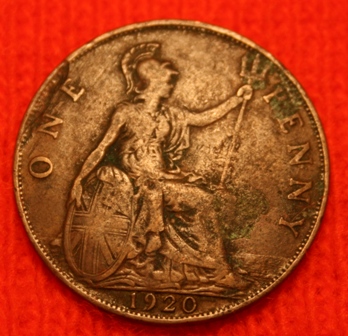
So, back to your coin. You'll notice on the reverse, there's the faint outline of the king's head, slightly indented into the fields. It's most noticeable as a faint line between the word ONE and Britannia's arm, and as a faint line connecting Britannia's head with her trident. This is a phenomenon commonly seen on British pennies. It's called "ghosting", and it's caused by the mint using a design with too high a relief being struck on a coin blank that's too hard and thin. Almost all British pennies from 1902 to the mid-1920's show this effect to some degree.
In 1926, the Mint finally acknowledged this problem and redesigned the portrait, reducing the relief to try to make it less susceptible to ghosting. This didn't really work, so in 1928 they modified the portrait again, this time shrinking the portrait in size. Finally it worked; ghosting is much less apparent on George V pennies dated after 1928. There are therefore three portrait varieties of George V pennies to collect (1911-1926, 1926-1927 and 1928-1936).
Don't say "infinitely" when you mean "very"; otherwise, you'll have no word left when you want to talk about something really infinite. - C. S. Lewis







 1920pennyfrt.jpg
 1920pennybck.jpg


 Posted 01/26/2009 11:19 pm





