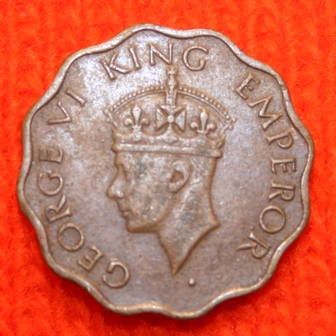
These coins may be something of a novelty in America, but they are very commonly found here in Australia, because Australian troopships returning from World War II duty in Europe or the Middle East often stopped off in India to refuel and resupply, and the troops acquired such coins while there. As a result, most old soldiers' collections of war memorabilia usually contain a few coins like these.
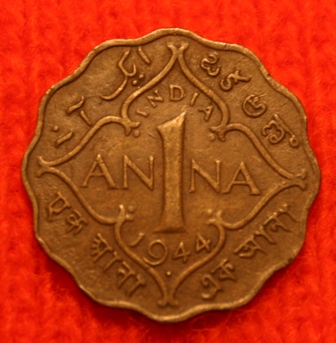
As for the coin itself: the denomination is "1 anna". The monetary system in use in British India was non-decimal, and complicated: there were 3 pies to a pice, 4 pice to an anna, and 16 annas to a rupee; the rupee was a medium-sized silver coin, about the same silver content as an American half-dollar. So 1 anna would have had the purchasing power of about 3 US cents.
British India had several mints. The two most important mint-cities were Calcutta (now known as "Kolkata") and Bombay (now known as "Mumbai"). Calcutta mint coins have no mintmark. Bombay mint coins have a small diamond below the date which, as you can see, yours has. These coins have an extremely high mintage; in 1944, there were 457 million minted in Calcutta, 157 million in Bombay. As such, they aren't particularly valuable, but nevertheless quite historic.
As with most places during WWII, copper for coinage was scarce. Both before and after WWII, 1 anna coins were struck from cupronickel (the same alloy in non-wartime US nickels). But these wartime 1 anna coins were struck from nickel-brass, and are typically a pale yellow colour.
As a testament to the huge diversity of cultures within India, the denomination is written on the coin in five languages: English is in the centre, and clockwise from the top left, we have Farsi (a variant of Persian), Telugu, Hindi and Bengali.
As for the shape: many of the different coin denominations in use in India had their own distinctive shapes and sizes. This was for the benefit of the local population, many of whom would still have been illiterate in any of the five languages which appear on this coin - so the odd shapes helped them tell the different denominations apart.
Don't say "infinitely" when you mean "very"; otherwise, you'll have no word left when you want to talk about something really infinite. - C. S. Lewis










 Posted 01/26/2009 12:15 pm


 1944indiafrt.jpg
 1944indiabck.jpg


