PCGS - In writing about grading previous Paris Express submissions, I have discussed scarce United States issues that are submitted by European dealers and collectors. From time to time, Territorial gold will be among those issues submitted to PCGS. However, Fractional California gold does not appear often. Yet, one recent submission from Paris included a California Fractional gold rarity.
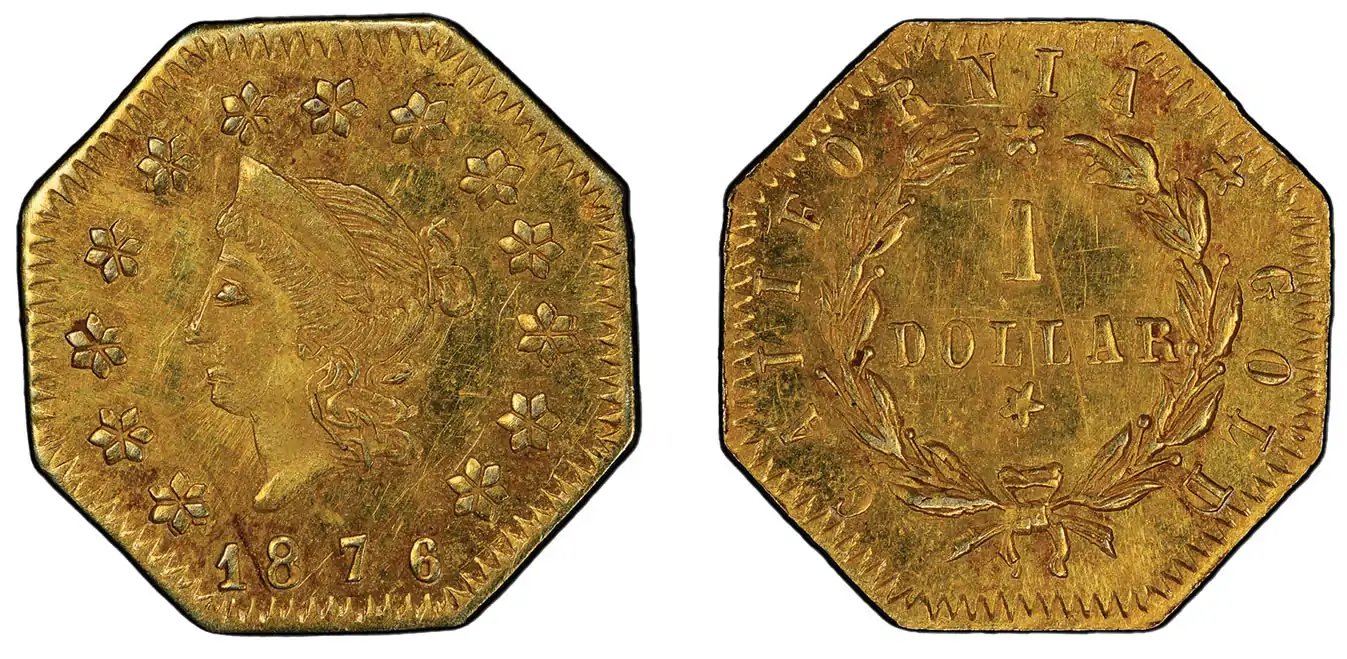 1876 Gold $1 BG-1117, PCGS MS62
Prior to the research done by many numismatists, the coins now called California Fractional gold were an enigmatic and problematic series. With the publication of California Pioneer Fractional Gold by Walter Breen and Ronald J. Gillio, this area of numismatics was documented, classified, and broken down into three periods. The first period came with the California Gold Rush, resulting in the mass migration of people, an abundance of gold, and the lack of small change. These factors led to the private manufacturing of coinage by jewelers and others to meet the need of commerce. These pieces were struck and dated 1852 until 1857.
Pieces from the second period are dated from 1857 through 1882. With the opening of the San Francisco Mint in 1854 and the mass production of small change, the need for fractional gold was mostly eliminated. Furthermore, the passage of the Private Coinage Act of 1864 ended the practice of manufacturing such pieces in 1883. While not primarily struck for circulation, pieces from this period were popular and were made by jewelers who filled demand. Gold pieces from the third period were sold to collectors as genuine coins, but most were in fact counterfeits and replicas.
The California Fractional coin submitted in Paris was classified as BG-1117 (Breen and Gillio) and falls under the classification of period two - not made for commerce. The piece was made by San Francisco jeweler Herman J. Brand, who arrived in San Francisco around 1867-1868 and worked for and partnered with other jewelers until 1871 when his partnership was dissolved. In 1873, Brand began making his own fractional gold coins and produced both octagonal and round pieces in the denominations of quarter and half dollars, along with octagonal dollars. He began his production using recycled Liberty punches made by Robert B. Gray, with the coins being backdated 1860-1870. In 1875, Brand moved to a new location and retired the punches by Gray, and produced his own unique design now known as "Baby Heads." Brand would produce Baby Head Dollars for only about six months in 1876 when another jeweler was arrested for producing California Fractional gold, causing Brand to stop production of dollar coins.
There are two different "Baby Head" Dollars, one classified BG-1117 and the other BG-1117a, with both being rare today. The BG-1117 is ranked in the second edition of California Pioneer Fractional Gold as a Rarity 7, with an estimated five or six known examples. PCGS has numerically graded just four examples. Of those graded, two are MS63, with one example being sold by Bowers & Merena in 2010 for $8,913. An MS62 example, previously of the F.C.C. Boyd Collection has made three auction appearances since 2003. The example in the Paris submission marks the second example graded MS62 by PCGS and only the fifth certified to date. This specimen will be added to the census for this rare California Fractional gold issue.
One of the biggest lessons with this story is that quite possibly anything can appear anywhere. The journey the coin made from San Francisco, California to Europe, is undocumented, and that history will likely never be known. It also begs the question of what is yet still to be discovered around the world.
 Check out Baby Head on ebay
.










 Posted 08/16/2023 3:15 pm


