A "Most Obscure" candidate?In June 1937, a Joint Resolution (JRes) was introduced in the Senate that called for half dollars to be struck "in commemoration of the one hundred and fiftieth anniversary of the settlement of Meadville, Pennsylvania." A House version of the JRes was introduced in December 1937. The Senate JRes was introduced by Joseph Finch Guffey (D-PA); the House JRes by Charles Noel Crosby (D-PA). As with nearly all coinage bills, the Senate JRes was referred to the Senate Committee on Banking and Currency; the House JRes to the House Committee on Coinage, Weights, and Measures.
Not familiar with Meadville, PA? Don't feel bad, most folks outside of its geographical area aren't!
Meadville, PA is a small city in northwest, Pennsylvania in Crawford County (it is the County Seat); it was founded at the confluence of the French and Cussewago Creeks. At the time of the coin bill, the city had a population of ~18,000; today, the population stands at ~13,000 - a drop of nearly 30%!
The anniversary date selected for the coin traces back to the 1787 date of a scouting trip made by brothers David and John Mead; other settlers began arriving and building houses in the area in either 1787 or 1788 (historical accounts vary; today, the City of Meadville officially uses 1788 as its founding date). In 1787, the Mead brothers visited the area to determine its potential. Their interest is believed to have been sparked - at least partially - by accounts of the area made by Major George Washington.
In 1754, Wasington was sent to present-day western Pennsylvania (then western Virginia) on a mission to peacefully convince the French to leave the area and cease the building of forts in the region. The written message he carried stated that the area was"notoriously known to be the property of the Crown of Great Britain." In the journal that he kept of the trip, Washington described the area of present-day Meadville as consisting of "extensive and very rich Meadows." It was a promising location for a settlement that could benefit from nearby waterways and proximity to Fort Franklin (a trading post) on the Allegheny River.
The area surrounding Mead's settlement grew as other settlers came to the area to claim the land grants that were awarded to them for service against the British during the American Revolution (the new nation didn't have the money to make good on all of its debts following the War, but it did have land on its western frontier that it could give as compensation!). The area continued to grow and incorporated as the Borough of Meadville in 1823 and as a City in 1866; it became the County Seat of Crawford County in 1880.
The companion Joint Resolutions called for a minimum of 25,000 half dollars of standard specifications to be struck at a single US Mint facility, all with a date of 1937. The coins were to be struck for the benefit of the Meadville Sesquicentennial Celebration and Coin Commission, with coin orders required to be in batches of
no less than 25,000 coins. The issuing authority for the coin was set to expire one year after enactment of the JRes.
The only design specification included in the JRes was that "some recognized emblem of the city of Meadville, Pennsylvania" was to be included. The Seal in use at the time would have been a possibility:
Meadville, PA Seal/Emblem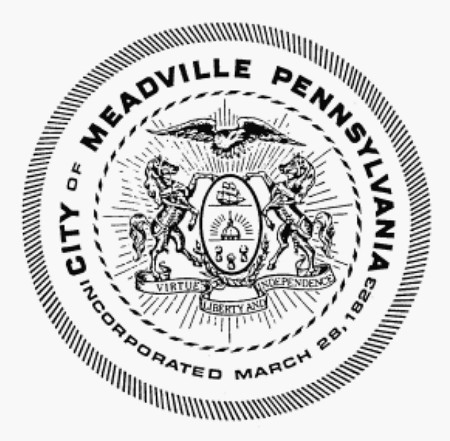 (Image Credit: City of Meadville. Fair use, education.)
Meadville was not the site of any decisive battles during the American Revolution or the US Civil War, nor was it the location for any life-changing inventions or the development of any break-through technologies. (It was, however, the home to a large zipper factory for a time!) All-in-all, I don't believe it had the type of resume that would make it a viable candidate for a legal tender, US commemorative coin.
Neither JRes gained the necessary traction in Congress, and neither was reported out of Committee. Like so many other 1937-dated commemorative coin proposals, the Meadeville, PA half dollar attempt went by the wayside with the adjournment of the 75th Congress in June 1938.
For more of my topics on commemorative coins and medals, including other What If? stories, see:
Commems Collection.










 Posted 01/07/2023 1:03 pm


