I'm thrilled to add these recent additions to my Caracalla collection.
I've been looking for a "Caesar" coin of Caracalla for a while now and jumped at the opportunity of purchasing these two types, which came up for sale from a seller I regularly buy from, the first coin being the earliest reverse type of Caracalla as "Caesar" which is

.It was minted in 195-196 AD when he was around a mere 8 years old..
At this point I'll add a little bit of history just in case there are collectors out there who aren't familiar with this sweet little boys life!
Ok..Caracalla was born in Lugdunum (Lyon), Gaul (France) on the 4th April 188AD to his father, the future Emperor Septimius Severus (193-211) and his mother Julia Domna (193-211). His birth name was Lucius Septimius Bassianus and at the age of 7 was renamed Marcus Aurelius Antoninus, but we all know him by his nickname of 'Caracalla'. The name derived from a Gallic hooded tunic he wore probably during the Rhine and Danube campaigns. He reigned from 198 - 217, Co-ruled with his father from 198-211 and with his younger brother Geta from 209-211 (that's another story)!. His father died in early February 211 leaving Caracalla and his brother Geta to co-rule. This didn't work out well and in late December of the same year Caracalla had his brother Geta murdered...Caracalla now continued to rule as sole Agusta for another 6 years until in April 217 whilst travelling to Carrhae in modern Turkey, he was stabbed to death by an irrate soldier named Justin Martialis. This was probably incited by Macrinus who held the position of Praetorian Prefect at the time and would become the next Emperor.
In AD195/6 Caracalla was given the Imperial rank of "Caesar", he was 8 years old and 2 years later in AD198 rose to joint Augustus with his father Septimius Severus, the young boy was still only around 10 years old!..This small 2 year period makes his coinage as "Caesar" a little less common and an area I've become very interested in...
Here's the first coin showing a very stern looking lad!! This is the earliest type Denarius of Caracalla as "Caesar"..Looking at this portrait I think the alarm bells should've been ringing at this point but hey it's Rome!
Coin 1...
Caracalla, as Caesar, 196-198 AD. AR Denarius (3.21 gm, 17mm). Rome mint. Struck 195-196 AD.
Obv.: M AVR ANTONINVS CAES,(Marcus Aurelius Antoninus Caesar), bare-headed and draped bust right.
Rev.: SEVERI AVG PII FIL,(To Severus, son of the pious Emperor Augustus), Lituus, Sacrificial knife (axe), Guttus, Simpulum and Aspergilum.
RIC#4. gVF.

Shown on the reverse are 5 sacrificial implements. I've noticed that if the implements are individually described by sellers they are quite often incorrectly named which is probably a copy and paste tipo. Here's a breakdown of what I'm seeing portrayed on the reverse...
Firstly to the left is the Lituus...A curved Augurs staff which was used as a cult instrument in ancient Roman religion by Augurs to mark out a ritual space in the sky called the "Templum". The Augurs were basically priests who practiced Augury, being the interpretation of the will of the gods within the "Templum". This could encompass the flight of birds, cloud shapes and of course at night the star formations..Also anything in between!

Here's a nice print showing an Auger proclaiming "They will attack from the East"...Maybe check out your Western Borders just in case!?....


Next to the Lituus is a Sacrificial knife/axe. Probably don't have to explain in too much detail what this was used for!?...........................Yeh why not?...Used for slitting the jugular of larger animals such as oxen, sheep, pigs and goats etc or simply decapitating smaller creatures such as chickens or geese in one foul swoop!

In the centre is the Guttus being a narrow necked ceramic or glassen vessel used in sacrificial ceremonies for pouring (in drops only) water or oil during the offerings.

To the right of the guttus is the Simpulum. This was a small, long-handled ladle used when making libations by pouring sacred wine over the head of the sacrificial victim.

Lastly to the right is the Aspergilham...A sacred water sprinkler. This was a staff or rod tipped with an animals tail used to purify an area or sacrificial animal.

Coin 2..
This second coin was minted probably around a year or less before the young caesar became joint Augustus...The portrait has a much softer rendition of the young 9/10 year old...Again the reverse shows sacrificial implements, this time there are 4 but two of them are different from "Coin 1".
Coin 2..
Caracalla, as Caesar. 196-198 AD. AR Denarius (3.00 gm, 17mm). Rome mint. Struck 196-198 AD.
Obv.: M AVR ANTO[N CAES PON]TIF, (Marcus Aurelius Antoninus Caesar Pontifex (High priest)), bareheaded and draped bust right.
Rev.: DESTINATO IMPE[RAT],(Designation to the empire,basically calls Caracalla "Emperor to be "), Lituus, Apex, Bucranium, and Simpulum.
RIC#6; BMCRE 193; RSC 53. VF.

Interestingly...
The following information comes from Harlan J Berk: The reverse calls Caracalla "emperor to be", a title accorded otherwise only to Titus as Caesar. The bucranium, here depicted with a beaded band tied around the bull's forehead and hanging down on both sides, is an unusual priestly attribute on Roman coins, otherwise occurring only on a small medallion of Commodus Caesar (BM pl. 84,13) on the aureus and denarius of Augustus once attributed to Caius Caesar
Far left and right are again showing the Lituus and Simpulum, described above on "coin 1".
But here (middle left) is shown an Apex. This was a religious cap worn by certain priests. Usually pointed at the top and held in place using two ties under the chin.
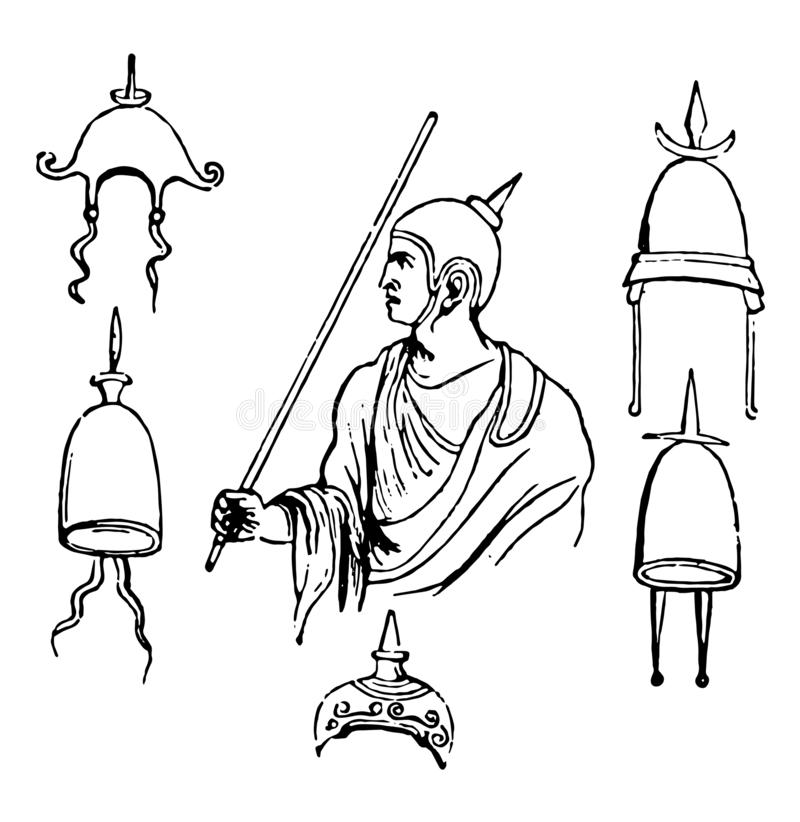
Next to the Apex (middle right) is the most, imo, interesting implement being the Bucranium (ox skull). This was a symbol used in ritual sacrice being actually real or an object carved in stone or wood and probably originated from the ancient practice of sacrificing garlanded oxen to the gods as far back as neolithic times. Perhaps the most famous ancient example of a sculpted bucranium survives on the remaining section of the entablature of the Temple of Vespasian and Titus (80s AD) in the Roman Forum.Along with the bucranium are sculpted representations of the instruments of sacrifice: the whisk or aspergillum for sprinkling wine or water on the animal's head, the mallet for stunning it, the axe for killing it, the knife for cutting it up, a ceremonial wine jug, the patera or shallow plate for holding the wine, and the priest's headgear.


Please feel free to post your coins of Caracalla as caesar..




 Posted 02/19/2023 09:38 am