Introduced in June 1935 alongside the Jefferson Davis medal bill (
1935 Jefferson Davis Medal) by John Jackson McSwain (D-SC), the Lee bill called for medals "with appropriate devices, emblems, and inscriptions commemorative of the valor and integrity ol General Robert Edward Lee." A simple name swap in the phrasing vs. the Jefferson Davis medal bill. The bill was referred to the House Committee on Coinage, Weights, and Measures.
As with the Jefferson Davis bill, the medals were to be struck at the Philadelphia Mint for the benefit of the principals of elementary schools in South Carolina. Owing to greater name recognition and perceived popularity, up to 25,000 medals were called for (vs. 10,000 for the Jefferson Davis piece).
Robert Edward Lee was born in Stratford Hall, Virginia on January 19, 1807. He graduated from the US Military Academy at West Point in 1929, and served for 17 years in the US Army Corps of Engineers working on coastal defense emplacements. His battlefield career began in 1846, during the Mexican-American War. He later returned to West Point to serve as its superintendent from 1852 to 1855.
General Robert E. Lee - Circa 1865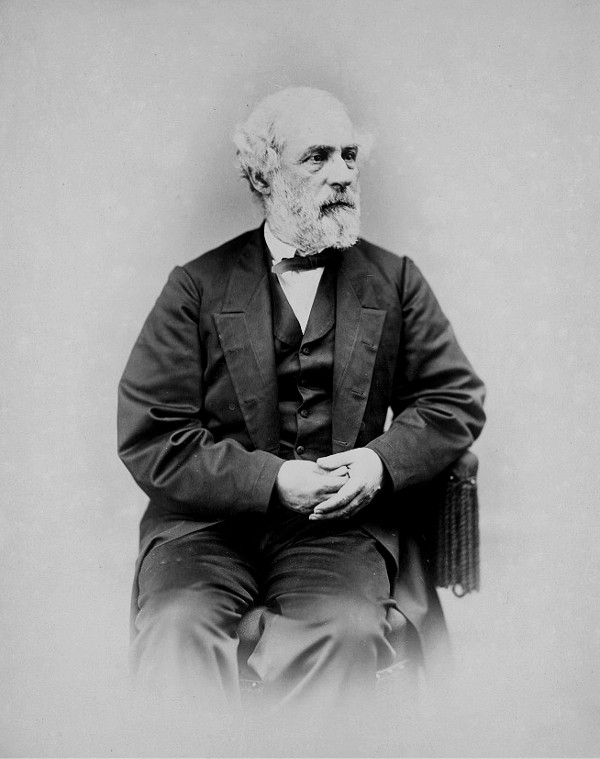 (Image Credit: Library of Congress, Prints and Photographs Division. Public Domain.)
He left his position at the Academy and joined the US Army Calvary. US President Abraham Lincoln offered him the command of Federal forces in the war with the South, but Lee declined the offer, resigned his position in the US Army and was appointed a General in the Confederate Army. Lee was a successful military leader during the US Civil War, leading his Army of Northern Virginia to notable victories. In the end, however, he was forced to surrender his army to General US Grant at Appomattox Court House on April 9, 1865 - an event that hastened the end to the War.
He was jailed for a time after the War, but was eventually paroled. Lee took the position of President of Washington College in Virginia and served in the position until his death on October 12, 1870, The school is known today and Washington and Lee University.
I recommend that those with an interest in learning more about Lee to use their preferred internet search tool to locate one or more of the many biographies available. His story is far too expansive for me to adequately summarize here.
As with the Jefferson Davis House medal bill, Ellison DuRant Smith (D-SC) introduced a companion bill in the Senate in August 1935. The bill was immediately referred to the Senate Committee on Banking and Currency.
Neither the House bill nor the Senate bill was reported by its respective Committee, and thus received no further consideration in either chamber. The US Mint and US Congress each had received some criticism for the 1925 Stone Mountain Memorial Half Dollar due to its honoring of the Confederacy, so it is certainly possible that the Committees shied away from medals for Confederate heroes so as not to incur additional negative feedback from the general public.
For a related commemorative medal story, see:
-
1935 Jefferson Davis MedalTo read about the attempt to secure a commemorative half dollar for fellow Confederate hero General Stonewall Jackson, see:
-
What If? 1934 Stonewall Jackson Birthplace MemorialFor more of my topics on commemorative coins and medals, including quite a few What If? stories, see:
Commems Collection.




 Posted 04/05/2023 8:21 pm





