Rear Admiral Richard Evelyn Byrd - US naval officer (Retired), explorer, aviator - captured the imagination of America and the World with his daring trips across the frozen Arctic and continent of Antarctica in the 1920s and 1930s. He was the first to fly over the South Pole (November 29, 1929) and established "Little America" - the first permanent American research base in Antarctica (on the Ross Ice Shelf).
In early 1930, Representative John Levi Cable (R-OH) indicated that he was planning on introducing a commemorative half dollar bill to recognize Byrd's accomplishments and to help pay for any outstanding debts incurred by his Antarctic expedition. At the time, Cable was a member of the House Committee on Coinage, Weights, and Measures and could have exerted noticeable pressure for the bill's passage.
Byrd graciously thanked Cable for the thought, but indicated that the expedition did not run in a deficit and that such financial assistance was not necessary. (A refreshing lack of selfishness!) Byrd's expedition was financially supported by National Geographic Society. As popular as Byrd was at the time, passage of the half dollar bill may have faced a struggle, considering the April 21, 1930 veto of the Gadsden Purchase coin bill veto by President Hoover.
Instead, Cable introduced a House Joint Resolution that called for the Secretary of the Navy to prepare and present gold, silver and bronze medals, as deemed appropriate, for presentation to the officers and men of Byrd's Antarctic expedition. The medals were to "express the high admiration in which the Congress and the American people hold their heroic and undaunted services in connection with the scientific investigations and extraordinary aerial explorations of the Antarctic Continent, under the personal direction of Rear Admiral Richard E. Byrd." The Joint Resolution was introduced on May 1, 1930 and became Public Law on May 23, 1930. As the medals were personal award medals, bronze duplicates for public sale were not authorized,
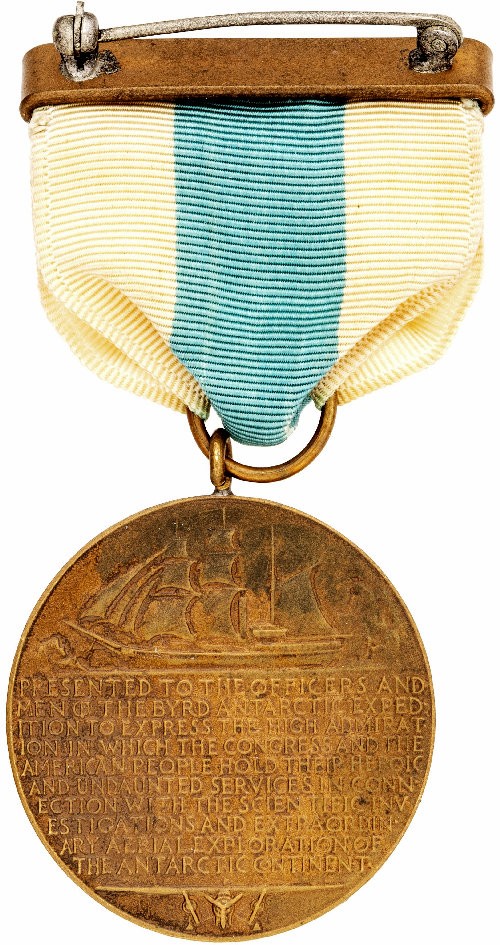
Rear Admiral Byrd Antarctic Expedition Medal
 (Image Credit: Heritage Auctions, https://www.ha.com.)
The obverse of the hanging medal depicts Admiral Byrd in a parka, facing left. The inscription "BYRD ANTARCTIC EXPEDITION 1928-1930" encircles Byrd at the rim.
At the top of the medal's reverse is seen Byrd's sailing ship the
City of New York City. Below it is the multi-line inscription: "PRESENTED TO THE OFFICERS AND / MEN OF THE BYRD ANTARCTIC EXPED- / ITION TO EXPRESS THE HIGH ADMIRAT- / ION IN WHICH THE CONGRESS AND THE / AMERICAN PEOPLE HOLD THEIR HEROIC / AND UNDAUNTED SERVICES IN CONN- / ECTION WITH THE SCIENTIFIC INV- / ESTIGATIONS AND ESTRAORDIN- / ARY EXPLORATION OF/ THE ANTARCTIC CONTINENT."
The National Geographic Society awarded Byrd a Gold Medal in recognition of his accomplishments; the medal was presented to Byrd by US President Herbert Hoover at a special ceremony on the White House lawn. During the presentation, Hoover said of Byrd: "I speak not merely for myself but for the Nation as a whole and for every individual citizen. His contribution to exploration and scientific research has done honor to his country, and his country takes a just pride in them and in him. More than that, his daring and courage have thrilled each one of us individually, because he has proved anew the worth and power and glory of qualities which we believe are latent in our people. For men of our race to master extraordinary difficulty, to carry through great adventure, thrills us with pride, with hope, and with confidence. I sometimes think that this is the greatest value of modern explorers."
National Geographic Society Special Award Gold Medal for Byrd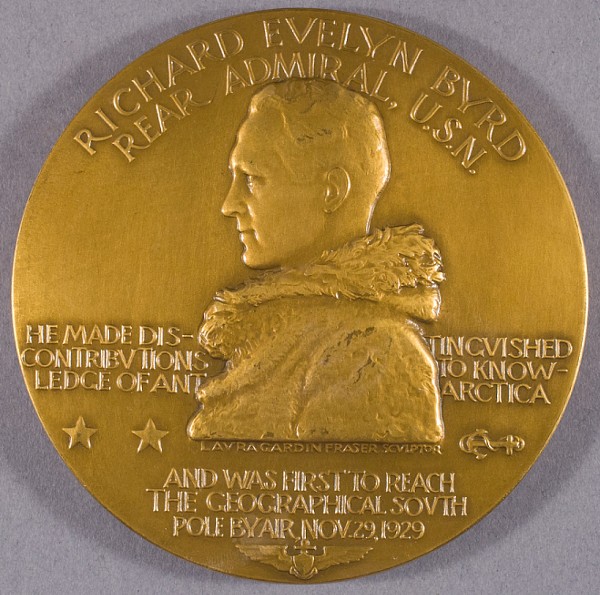
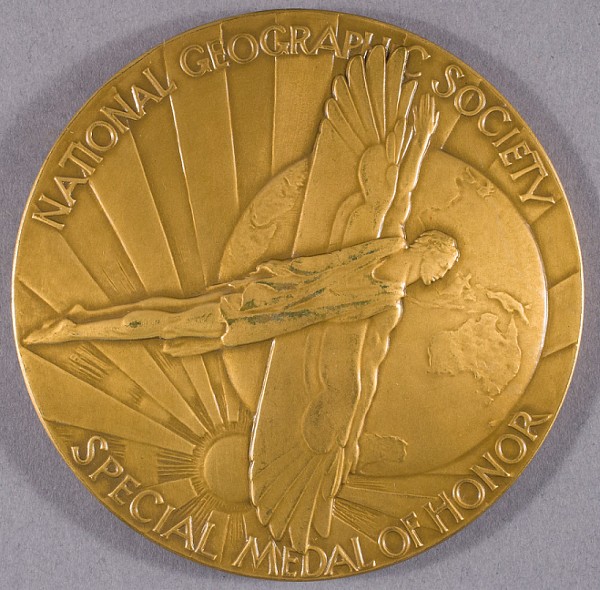 (Image Credit: Smithsonian National Air and Space Museum. Fair use, education.)Admiral Byrd Receives National Geographic Society Medal from President Hoover on White House Lawn
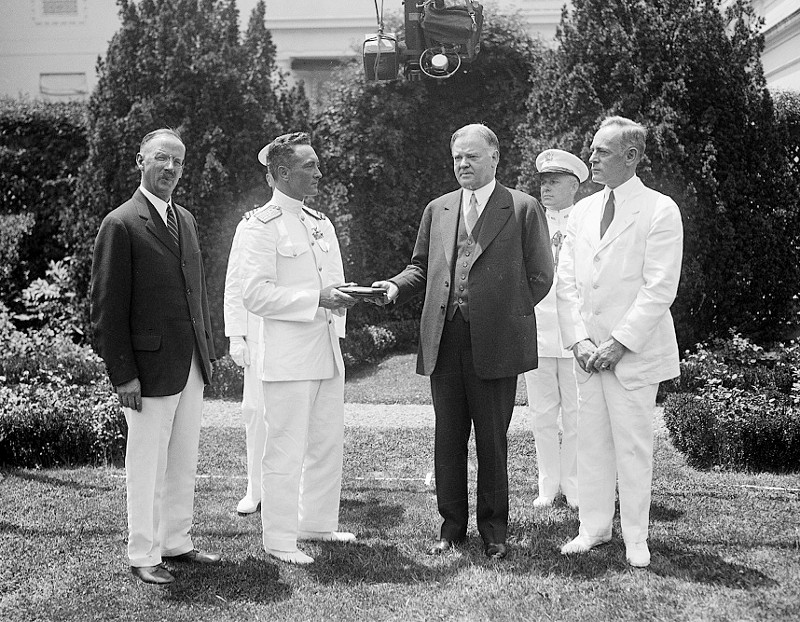 (Image Credit: Library of Congress, Prints and Photographs Division. Public Domain.)
For other of my topics on commemorative coins and medals, including many more What If? and What If? Phantome stories, see:
Commems Collection.







 Posted 04/29/2023 3:32 pm


