One of the primary objectives of the Oregon Trail Memorial Association's coin program was to raise funds to permanently mark the Oregon Trail before it was lost forever. Included among its planned markers for important forts on the trail were Fort Hall, Fort Laramie, Fort Bridges and Fort Kearney.
Within its first year of operations, and before its coin sales program had taken on its full nationwide scope, the Oregon Trail Memorial Association ("Memorial Association") began its efforts to secure land at/near Fort Hall's original site on what was then the Fort Hall Indian Reservation. The land in question had been acquired by the Federal Government in 1924 as part of the American Falls Reservoir project. The Memorial Association petitioned Representative Addison Taylor Smith (R-ID), to introduce legislation in the US Congress to achieve this objective. Smith subsequently introduced two bills in the House of Representatives, one in December 1926 and one in January 1927.
Fort Hall was set up as a fur trading post by Nathaniel Jarvis Wyeth of Boston, MA in 1834; it was named in honor of Henry Hall, the oldest member of Wyeth's financial backers. It became an important site/staging area for settlers traveling west along the Oregon and California Trails in later years (when it was owned by the Hudson's Bay Company). Thousands of travelers stopped at Fort Hall each year at the peak of the American westward expansion. The influx of American settlers passing through the area played a noteworthy role in it becoming a part of the United States vs. a British colony as per the Oregon Treaty of 1846.
Fort Hall was essentially abandoned after 1855 and the last of its wood was hauled away by 1863 to build a nearby station for the Hollady Stage Lines. Today, only a replica of the original Fort exists in a nearby location in Pocatello, Idaho.
Though Smith's January bill was reported favorably by the House Committee, and was recommended to pass, it was not considered by the House, and died for lack of action when the 69th Congress adjourned in May 1927.
A number of markers were erected over the years in the area of Fort Hall - prior to and following the Memorial Association's initiatives. A stone marker erected in 1932 near the original Fort Hall site by a local Boy Scouts troop and the Utah Pioneer Trails and Landmarks Association - the Memorial Association often worked with such groups to erect its markers - features a Memorial Association plaque at its top that was sculpted by
Laura Gardin Fraser and
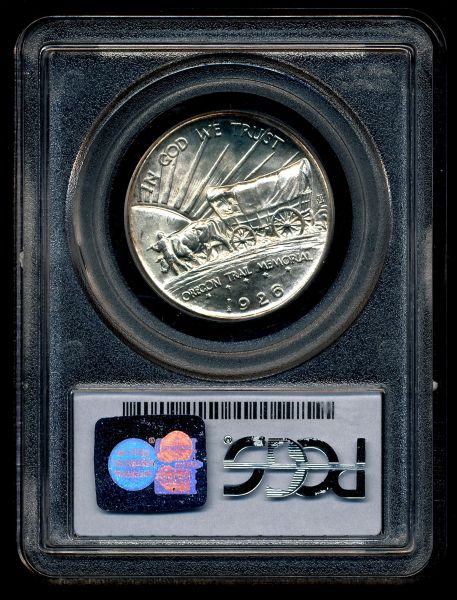
James Earle Fraser; it resembles the obverse (i.e., Conestoga wagon side) of the commemorative half dollar.
1926 Oregon Trail Memorial Association Half Dollar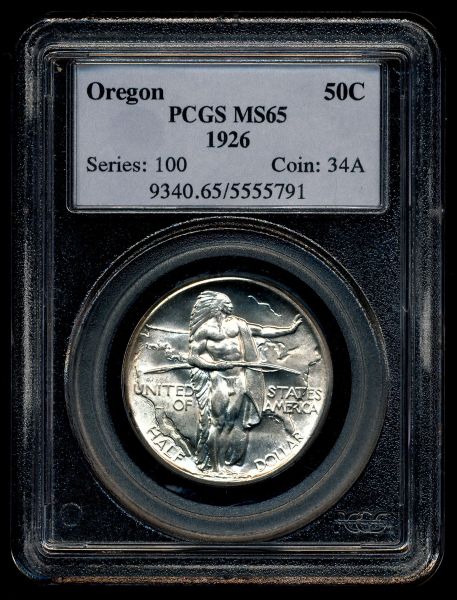
The Memorial Association also recognized Fort Hall in 1934 by promoting the Fort's centennial year via a nickname applied to its coin. You can read more about it here:
-
1926-39 Oregon Trail Memorial - 1934 Oregon Trail CentennialsThe Pocatello (Idaho) Unit of the Oregon Trail Memorial Association pre-dated the national Memorial Association and initiated the plan to mark the original Oregon Trail. In 1947, the group tried to secure Oregon Trail commemorative half dollars that were authorized in 1926 but never struck. You can read more about it here:
-
What If? 1947 Oregon Trail Memorial RevivalFor other of my topics on commemorative coins and medals, see:
Commems Collection.







 Posted 05/15/2023 10:12 am





