The 1901 Pan-American Exposition was held on an approximately 350-acre tract of land in Buffalo, NY from May 1 through November 2, 1901. It was originally planned to take place in 1899, but the 1898 Spanish-American War delayed it and almost caused its cancellation. Local political pressure in Buffalo, however, pushed it forward.
The objectives of the Exposition were to celebrate the growth of the countries in the Western Hemisphere and to stimulate trade among the Pan-American nations (i.e., countries of North, Central and South America plus those in the Caribbean Sea). As with other Expositions - past and future - the Pan-American Exposition also highlighted recent advances in technology.
(FYI: Though often referred to as a World's Fair, the Bureau International des Expositions (BIE), the international group that sanctions World Fairs/Expositions, does not view the Pan-American Exposition as meeting the criteria for a World's Fair.)
The Exposition is sometimes referred to as the "Rainbow City" due to the brightly colored paint scheme used for the Exposition's temporary buildings constructed with a Spanish Renaissance theme. Architectural highlights of the Exposition included the Electric Tower, the Temple of Music and the US Government Building. The Exposition also featured beautiful fountains, original sculpture, and an entertainment midway, plus music concerts/shows and sporting events (e.g., baseball, basketball).
Temple of Music at 1901 Pan-American Exposition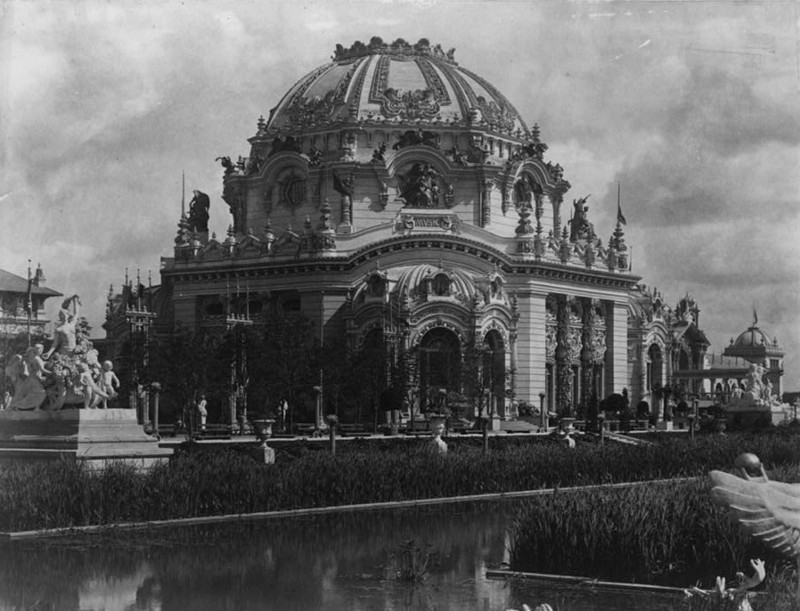 (Image Credit: Library of Congress, Prints and Photographs Division. Public Domain.)Night View of Electric Tower at 1901 Pan-American Exposition
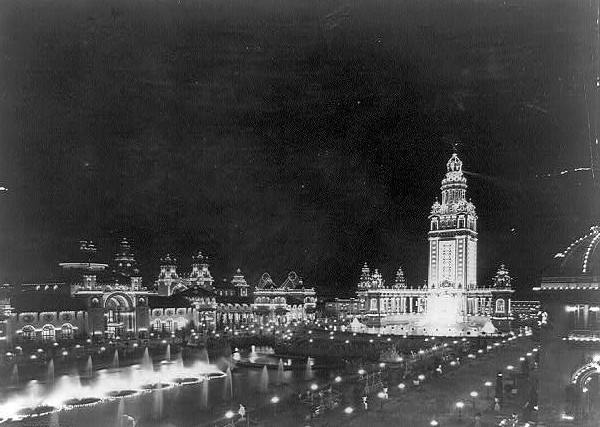 (Image Credit: Library of Congress, Prints and Photographs Division. Public Domain.)
Technological highlights of the Exposition included its use of power generated more than 20 miles away at Niagara Falls to illuminate its grounds and the filming of the Exposition's daytime activities by the Edison Manufacturing Company, founded by Thomas Edison.
William McKinley at the 1901 Pan-American Exposition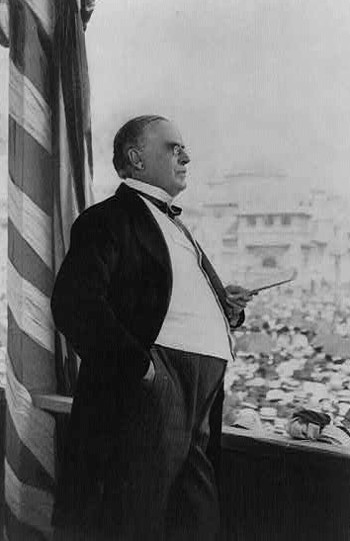 (Image Credit: Library of Congress, Prints and Photographs Division. Public Domain.)
The Exposition is most remembered, however, for the tragic event for which it bore witness - the assassination of US President William McKinley by Leon Czolgosz, an unemployed American anarchist. McKinley was shot twice in the abdomen on September 6, 1901 in the Exposition's Temple of Music as he was shaking hands with a line of (mostly!) well-wishers. His condition varied over the next week, sometimes worsening, sometimes showing improvement. Ultimately, his condition deteriorated and he died from an infection on September 14, 1901.
Attendance at the Exposition was fairly strong, reported at ~8 million, with over 5 million paying to get in. The Exposition's expenses totaled more than $7 million - the US Government had appropriated $500,000 to cover its participation expenses. The Fair did not succeed financially, however, and reportedly lost approximately $3 million.
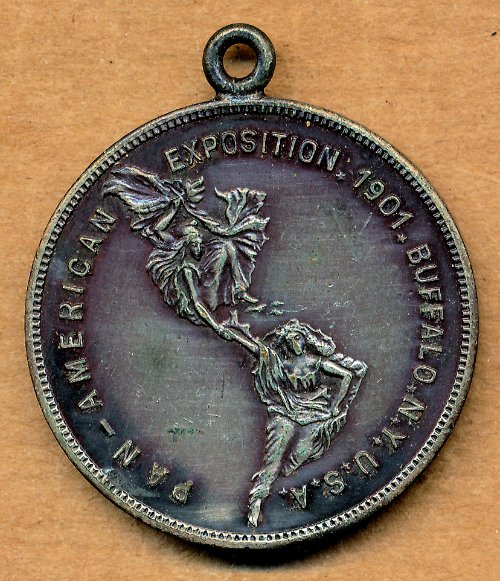
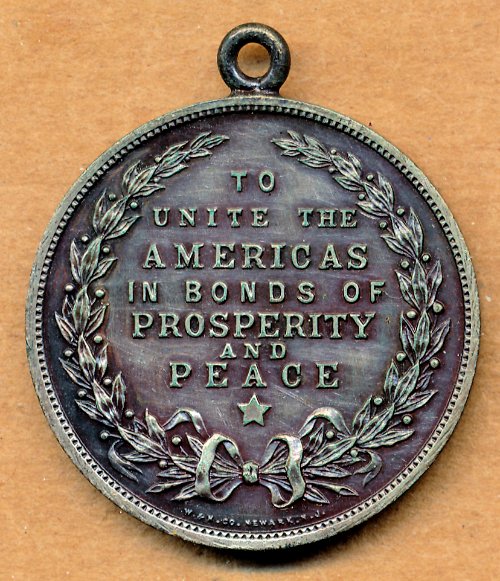
A variety of buttons and medals were produced as souvenirs for the Exposition, including a US Mint piece.
1901 Pan-American Exposition US Mint Medal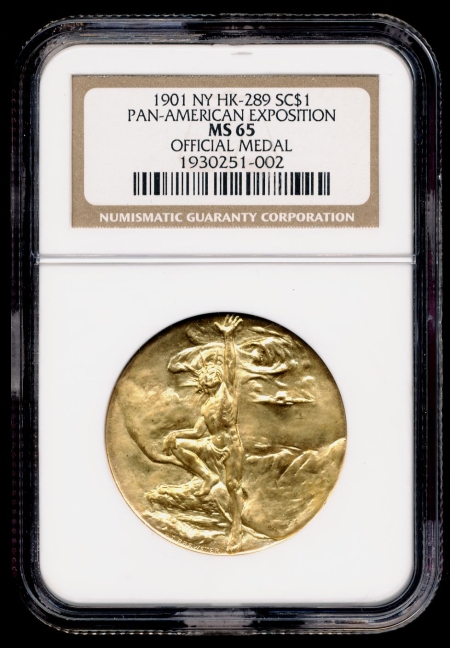
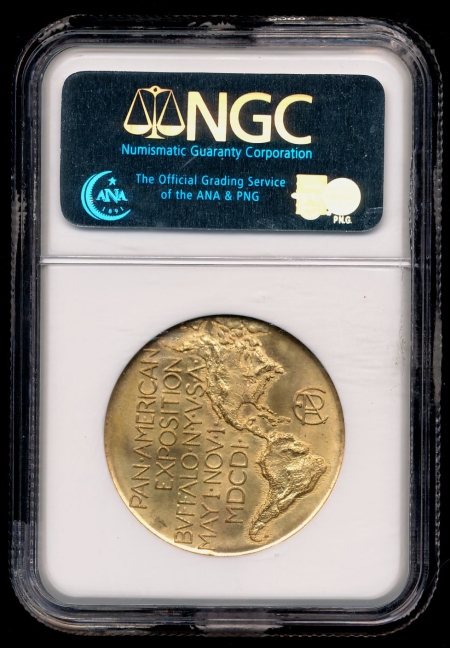
On the medal's obverse is depicted an allegorical male figure with his left arm upraised and wearing a headdress that features a series of rays similar to those on the Statue of Liberty (aka "Liberty Enlightening the World"; the figure is shown riding an eagle as it soars through the clouds. Below the clouds at the 7 o'clock position is seen "G T Brewster" - the medal's designer:
George
Thomas
Brewster.
The reverse design of the US Mint's medal for the Exposition played off the Exposition's official logo (later adapted/borrowed by the 1923
Monroe Doctrine Centennial Half Dollar) created by Raphael Beck (see below). The medal presents a topographical map of the continents of North and South America in their proper geographical orientation. To the left of the map is the multi-line inscription "PAN-AMERICAN / EXPOSITION / BUFFALO-NY-USA / MAY 1-NOV 1 / MDCDI." (The Inscription is a bit difficult to read when the medal is oriented with the proper view of the continents, as its words are priinted vertically (bottom to top).) At right is seen the interlocking initials monogram of the Exposition: "PAE."
For other of my topics on commemorative coins and medals, see:
Commems Collection.






 Posted 05/17/2023 09:48 am





