I've written before about how the classic-era US commemorative coin series, almost from its start, played a bit loose with the dates that appear on the coins. It all began with the "dateless" Lafayette dollar that was struck in 1899 but is, technically, per the US Mint, "undated." (See below for a Lafayette date discussion.)
But the Lafayette was certainly not the last commemorative coin to feature a date that did not accurately reflect when the coin was minted. I compiled a list of these date mismatch coins and present it here:
                                 Coin     Year    Event
Issue                            Date    Struck   Year      Notes

Lafayette Memorial               1900     1899     1900       1
Alabama Statehood Centennial     1921     1921     1919       2
Oregon Trail Memorial            1926-39  1926-39  ? ? ?      3
Danial Boone Birth Bicentennial  1935-38  1935-38  1934       4
Arkansas Statehood Centennial    1935-38  1935-38  1936       5
Texas Independence Centennial    1934-38  1934-38  1936       6
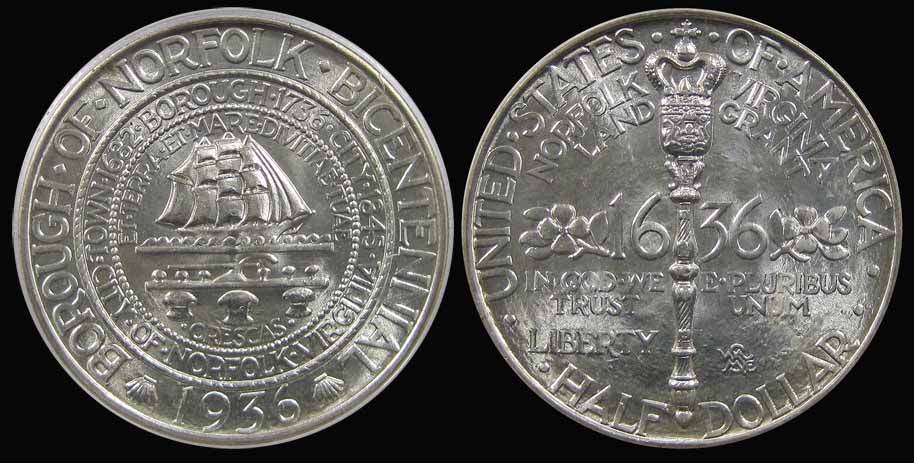
Elgin, IL Centennial             1936     1936     1935       7
Delaware Tercentenary            1936     1937     1938       8
Battle of Gettysburg             1936     1937     1938       9
Norfolk, VA Bicentennial/
  Tricentennial                  1936     1937     1936       10
New Rochelle, NY 250th
Anniversary 1938 1937 1938 11Notes:1. All examples of the Lafayette dollar were struck on December 14, 1899 (the 100th anniversary of George Washington's death). The Lafayette Memorial Commission desired a "1900" dated coin - the year the US' Lafayette statue was to be presented to France - but the US Mint was not authorized to strike coins with a date that differed from the year in which they were struck, As a compromise, the Mint included "1900" as part of the inscription on the reverse as the date of the Paris Exposition; the coin does not feature a standard date.
Per the US Mint, the "1900" is not the coin's date, but rather the date of the Paris Exposition. Technically, the coin does not feature a date - as noted above, the coins were struck in December 1899.
2. Alabama marked the 100th anniversary of its admission into the Union in 1919. It was not until late February 1920, however, that a commemorative coin proposal was introduced in Congress. Though the proposal was passed in May 1920, the Mint did not strike the Alabama Statehood Centennial half dollar until fairly late in 1921. As the coin's enabling Act did not specify a date for it, the Mint followed its standard procedure and dated the coins for the year they were struck - 1921.
3. The Oregon Trail Memorial half dollar has one of the more unusual date stories. The first year of issue for the coin was 1926 - a year for which no Oregon Trail milestone anniversary date was celebrated. The coin was also struck (and dated) in 1928 and annually from 1934 through 1939; in addition to strikes by the Philadelphia Mint, some years also saw coins struck in Denver and/or San Francisco. Some years, the coins were marketed as being associated with trail-related anniversaries or events. (See link below for more.)
4. The 200th anniversary of Daniel Boone's birth occurred in 1934; commemorative half dollars were struck and dated "1934" - as would be expected. The problem occurs in 1935, 1936, 1937 and 1938 - the US Mint stated it was required to place the year of striking on the coins. By doing so, the dates were no longer bicentennial years. The Boone Commission succeeded in 1935 in getting their original coin legislation amended so as to have a small "1934" added to the coin's design so that the bicentennial year would continue to be recalled on later strikes/issues.
5. Arkansas marked the 100th anniversary of its statehood in 1936. It got a jump start on the celebrations, however, with a 1935-dated half dollar. The Arkansas Centennial Commission then followed the formal anniversary year with additional releases in 1937, 1938 and 1939. (At least funds raised by the coins supported public projects vs. solely private profits.)
6. Texas celebrated the 100th anniversary of its independence from Mexico in 1936. To aid in the construction of the Texas State Museum, coins were issued beginning in 1934, and continued through 1938 - another case of pre- and post-anniversary coin issues! There's nothing like getting a two-year head start on things!
7. The City of Elgin, IL was founded in 1835 and celebrated its centennial with various events in 1935. The Act authorizing the commemorative half dollar stipulated a date of "1936." While the coin, ostensibly, had the objective of marking the 100th anniversary of Elgin's founding (an event that had already occurred), it was more directly intended as a fundraiser in support of the Pioneer Memorial statue already in process by sculptor Trygve Rovelstad. Not enough funds were raised to complete the Memorial, however, and it was mothballed for decades. (You can read more about it via the link below.)
8. The Delaware Tercentenary half dollar was authorized in May 1936 and included the specification that struck coins were to feature a "1936" date; the designs for the coin were not approved by the Commission of Fine Arts until December, 1936. The Delaware Tercentenary coins were struck in 1937 and delivered to the sponsor; sales of the coin began. Delaware's actual 300th anniversary took place in 1938, and it is in that year that it held its official tercentenary celebrations. The coin features the dual commemorative dates "1638-1938" to mark the tercentenary.
9. The Battle of Gettysburg half dollar was "penalized" for proper planning and calendar management. The coin was proposed early enough for it to be authorized in 1936 even though its targeted 75th anniversary event was not to be commemorated until 1938 (the battle took place July 1 - July 3, 1863 and the 75th Anniversary Reunion was to take place in 1938). Unfortunately, the authorizing legislation specified a "1936" date for the coins. On the up side, the coins were struck in 1937 and available for sale ahead of the anniversary and corresponding Blue and Gray Reunion of 1938.
10. The Norfolk half dollar was not authorized until late June 1937, but its authorizing legislation stipulated that the coins must be dated "1936" regardless of when they were struck; production at the Mint in Philadelphia took place in September, 1937. Regardless of production date requirements, the coin marked anniversaries connected to 1636 - 1936 was the true anniversary year and so it makes sense for the coin to bear the "1936" date (especially since the coin was a one-year issue).
11. The New Rochelle half dollar was authorized in May 1936, but its authorizing legislation stipulated that the coins must be dated "1938" regardless of when they were struck; the Mint struck the coins in 1937 with a "1938" date. The 250th anniversary of New Rochelle's settling occurred in 1938. IMO, this is how the dating on commemorative coins should be - they should feature the anniversary date of the who/what they commemorate vs. other dates that just add confusion.
For more on the Elgin Pioneer Memorial Statue:
-
1936 Elgin, IL Centennial Vs. City Of ElginFor more on the Oregon Trail Memorial Anniversary Coins, see:
-
1926-39 Oregon Trail Memorial - 1934 Oregon Trail CentennialsFor some related prior posts, see:
-
Quick Bits #63 - Single-Year Issues With Non-Matching Dates-
Quick Bits #64 - Fictitious Anniversaries-
Quick Bits #65 - Dates That Shouldn't Be BelievedFor other of my posts about commemorative coins and medals, including more on each of the coins referenced here, see:
Commems Collection.




 Town 1682

 Posted 06/02/2023 11:36 am





